


















Founders of Gloomhaven Deep Dive
What the Community Thinks About Founders of Gloomhaven
Reviewers tend to split on Founders of Gloomhaven along a clear line. Players who enjoy a dense economic puzzle come away impressed, while those who struggle with its rules describe it as hard going. The game is a standalone title set in the same world as Gloomhaven, but it takes place hundreds of years earlier and depicts the city's original construction. Pair of Dice Paradise, in its August 2017 list of popular games, described it as a competitive tile placement, action selection and city-building design and noted that it is "vastly different" from its predecessor.
The cardboardrhino Kickstarter roundup focused on the blend of worker placement, hand management and blind bidding, and on the tension between competition and cooperation at the table. The Board to Death TV Gen Con interview with designer Isaac Childres framed the game around a single idea: each player controls only a couple of the eight basic resources, so no one can build anything alone. The Getting Games three-player playthrough was largely appreciative and admitted that the game rewards repeated play, since the interactions between roads, resources and bids only become clear with experience. The Board Gaymes James review was the sharpest critique, saying the tile placement rules were clumsy and that the game was too confusing to enjoy after three hours on the table.
Core Mechanics That Define Founders of Gloomhaven
Resource Management
Every turn revolves around converting basic goods into advanced ones. Players start with access to only one or two basic resource types, and the Getting Games playthrough shows how quickly the economy branches. A player places a basic resource tile through the import action, then uses the trade action to buy access to tiles that other players own. Access is paid for, and the money goes to the owner rather than the bank, which makes buying in a meaningful decision. Advanced buildings such as a kitchen, a brickyard or a jewelry maker require several resource types connected by roads, and a player's income track rises with the number of different resource types they control. In two and three player games, neutral resource tiles fill the gaps, and reviewers noted that these tiles can complete a prestige building without any road connection, though neutral players absorb a share of the points.
Auction / Bidding
Prestige buildings are the game's scoring engine, and they are chosen through blind bids. Designer Isaac Childres explained in the Board to Death TV interview that the main scoring mechanism is periodic voting on building proposals, which are placed on the board and reward the players who supplied their required resources. Players bid fleeting influence, which disappears after every auction, and lasting influence, which counts for double vote power but costs a permanent victory point whether or not the bid wins. The Getting Games host showed how ties resolve by fewer victory points and then by player order, and they later admitted that spending a few lasting influence points earlier might have swung a key vote. The winning bidder on the winning building chooses where it goes, which turns the auction into a positional contest as well as a points race.
The Founders of Gloomhaven Experience
Interactive/Dynamic
The game is built around following. When a player leads with a card, every other player may follow with a basic action such as taking money, gaining influence or placing a road, which keeps everyone engaged even during another player's turn. The Board to Death TV interview described this as a way to reduce downtime and increase player interaction, and compared the card-led structure to a Puerto Rico mechanic. Buying access from opponents adds another layer of direct contact, since each purchase moves money between players. Reviewers say the constant trading and blocking gives the table a lively, competitive energy, even when the players are nominally working toward a shared city.
Cerebral
Each choice in the game weighs several overlapping concerns at once. Players must consider road connections, adjacency rules, the cost of buying access, the influence needed for the next auction and the points that a future prestige building might pay out. The Getting Games host said that the more they played, the more they saw the intricate ways these systems intersect, and that a deeper strategic layer emerges for those who return to the table. The same depth that rewards careful planning is also what frustrated the Board Gaymes James reviewer, who felt that the rules did not support that level of thinking without a clear reference.
What Makes Founders of Gloomhaven Stand Out
Players Must Depend on One Another
The central design choice is that no player can build a city alone. Each race imports only a few resource types, so the economy depends on trading access with the other players. The cardboardrhino roundup summarized the balance well, describing a competitive game in which players must still work together, and the Pair of Dice Paradise list made the same point about players balancing their own goals against the group's needs. The Board to Death TV interview stressed that trading is not negotiated. Instead, one player places a resource and another buys in, so cooperation happens through the board rather than through table talk.
A City That Grows From Market Stalls
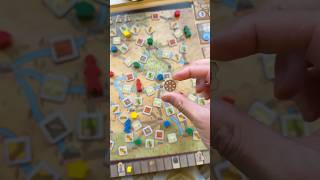
The board starts nearly empty, and the city expands as players lay roads, add bridges and gates, and place advanced buildings across the three districts. The Getting Games host described the goal of showing how the city "organically evolves" from small market stalls into a bustling urban center with major avenues of roads and bridges. Some rules reinforce this growth. No district can hold two buildings of the same type, bridges and gates are usable only by the player who matches their color, and the game ends when six prestige buildings are complete, which gives each game a visible clock.
Potential Drawbacks
Rules Clarity and Adjacency
The most consistent criticism concerns how the tile placement and adjacency rules work in practice. The Board Gaymes James reviewer said that a player cannot sit adjacent to their own buildings but can sit next to other players' buildings, and that the reliance on roads that need not be physically connected made placement confusing. The reviewer also noted that few cards explicitly allow building more than one piece at a time, and that money felt tight. Even the Getting Games host, who enjoyed the game, missed several rules during their own playthrough, including a neutral resource that should have been filled immediately, which suggests the rulebook and the tracking demand real attention.
Presentation and Follow Clarity
The follow mechanic is central to the design, yet reviewers found it hard to parse. The Board Gaymes James reviewer compared it unfavorably to Lisboa, whose actions they found very powerful, and said that upgraded cards gave no explicit text for what a following player could do. The same reviewer criticized the board's colors and the cards' graphic design, noting that a friend could not tell three of the clans apart. The artwork received praise, but the board and card layouts did not match it. The Getting Games playthrough was filmed with prototype components, and the host noted that art and components were still being finalized, so some presentation issues may change before release.
If You Enjoy Founders of Gloomhaven
- Gloomhaven: The most natural companion, since Founders shares its designer and its world. The Board Gaymes James reviewer noted that the earlier game's praise was the reason they tried this one, and Founders offers the same setting viewed from the city's founding.
- Puerto Rico: The Board to Death TV interview compared the card-led action and follow structure to Puerto Rico, which is a useful reference for players who enjoy choosing an action that everyone else benefits from.
- Lisboa: The Board Gaymes James reviewer used Lisboa as the yardstick for the follow mechanic, praising its powerful actions there. Fans of Lisboa will recognize the influence of following, though they may find Founders' follow options less transparent.
What Reviewers Are Saying
"My goal here really was to try and show how the city organically evolves from these tiny little market stalls out on the board at the beginning into this big bustling city with large major avenues of roads and bridges."
— Getting Games
"This game really could have used some longer term development time. It has a lot of potential. The artwork on the cards is really good, but the graphic design on them is bad."
— Board Gaymes James
"There is lots of worker placement, hand management and blind bidding. It's a competitive game but the players must work together, which brings a very good amount of player interaction."
— cardboardrhino