/pic2961675.jpg)








Four Against Darkness Deep Dive
What the Community Thinks About Four Against Darkness
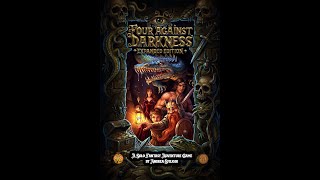
Four Against Darkness has earned passionate support from solo gaming enthusiasts who regard it as a cornerstone of the solo dungeon-crawling niche. Reviewers from The Dungeon Dive and Rob's Tabletop World consistently praise it as a masterpiece of accessible, rules-light game design, though they emphasize that the base game alone does not demonstrate its full potential. The consensus centers on the game's exceptional value, affordable price point, and modular expansion system that lets players customize their experience. Where the game shines brightest is in its ability to deliver a complete, imaginative dungeon-crawling adventure using minimal physical resources and playtime, making it an ideal choice for solo players seeking depth without overwhelming complexity or shelf footprint.
Core Mechanics That Define Four Against Darkness
Dice Rolling and Tables
At its heart, Four Against Darkness revolves around a core loop of rolling dice and consulting lookup tables. Players roll dice, cross-reference the results against printed tables, and translate the outcomes into narrative game events. This mechanic forms the backbone of exploration, combat, room generation, and treasure discovery. The system uses D6s primarily, keeping the mathematics simple and the pace contemplative. Rather than requiring mental calculation or complex rule subsystems, players spend most of their time in a meditative rhythm of rolling, looking up, and noting results. This design lets players focus on storytelling rather than mechanics, making the game accessible to veterans and newcomers alike.
Dungeon Crawl and Procedural Generation
Players control a party of four adventurers moving room by room through procedurally generated dungeons. Each dungeon unfolds through a series of decisions driven by die rolls and chart results. Reviewers emphasize that the dungeon layout, room contents, encounters, and treasure are all generated on the fly using tables, allowing no two adventures to play identically. The crawl takes players through a loop of exploration, combat encounters with monsters and minions, trap navigation, and loot discovery. Character progression comes from leveling up and finding better gear as the party delves deeper. This system creates an experience that echoes classic computer dungeon crawlers like Bard's Tale and Wizardry, translating that nostalgic gameplay to the tabletop in a completely solo, GM-less format.
The Four Against Darkness Experience
Nostalgic and Retro Charm
Four Against Darkness deliberately echoes the golden age of computer RPGs and tabletop gaming. The game's mechanical simplicity and chart-heavy design pay homage to classics like Bard's Tale, Wizardry, and Might and Magic, all of which stripped Dungeons and Dragons down to pure dungeon crawling. Reviewers note that the game captures the spirit of those early computer games and classic tabletop adventures by keeping the focus tight: heroes exploring dungeons, fighting monsters, collecting loot, and surviving threats. The rules-light approach and emphasis on rolling dice and consulting tables create a distinctly retro feel that appeals to players seeking that throwback experience without requiring extensive rulebook memorization.
Contemplative and Affordable Solo Adventure
Four Against Darkness delivers a relaxing, turn-based experience well-suited to solo play. Reviewers describe the pace as slower and more meditative than typical board games, with plenty of time to absorb results and imagine the story unfolding. The game requires only a few basic materials: dice, graph paper, a pencil, and an eraser. This minimal footprint makes it ideal for players with limited shelf space or budget constraints, and reviewers consistently highlight the exceptional value proposition. A single rulebook costs just a few dollars in PDF form, or slightly more in print, making it one of the most affordable dungeon-crawling experiences available. This accessibility means players can experiment without financial risk and discover whether solo dungeon crawling appeals to them before investing in multiple expansions.
What Makes Four Against Darkness Stand Out
Expansion System That Expands Without Overwhelming
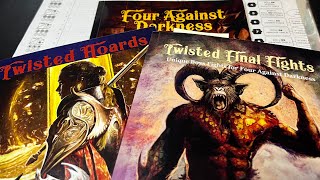
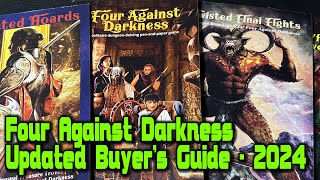
Four Against Darkness' greatest strength lies in its modular expansion system. The base game provides a functional but limited experience, with a small bestiary, few boss encounters, and predictable treasure tables. However, rather than bloating the core rulebook, designers packaged major enhancements into separate books with titles like Twisted Dungeons, Twisted Minions, Twisted Final Fights, and Twisted Hordes. Each expansion adds specific layers: Twisted Dungeons modifies dungeon complexity, Twisted Minions introduces new enemy types and encounter variety, Twisted Final Fights provides 48 unique boss encounters with individual stat blocks and special abilities, and Twisted Hordes expands the treasure tables dramatically. Reviewers emphasize that buying the core book plus a few key expansions transforms the game from a thin experience into something offering hundreds of hours of play. The "Twisted" series especially earns praise for adding complications and variety without requiring players to learn entirely new subsystems.
Boss Encounters That Feel Like Mini-Games
Among all the expansions, Twisted Final Fights stands out for its presentation and mechanical depth. Rather than simple stat blocks, each of the 48 bosses receives a full page with custom artwork, a unique narrative description, and special powers or mechanics that require tactical thought to overcome. Reviewers describe these boss fights as feeling like mini-games within the main dungeon crawl, with varied mechanics that go beyond simple dice rolls. Some bosses scale with party level through a simple formula (Hero Class Level plus bonuses), ensuring that boss encounters remain challenging even as characters advance. The inclusion of art for every boss, combined with the tactical depth of their special abilities, makes fighting through the boss table repeatedly engaging rather than tedious. Players speak of actively hunting specific bosses they saw in the book, lending narrative momentum to their adventures.
Potential Drawbacks
Base Game Limited Without Expansions
Reviewers unanimously note that the core rulebook alone provides insufficient variety to sustain long-term play. The enemy list is small, dungeon tables are basic, and treasure options are sparse. New players who purchase only the base game often report bouncing off the experience, encountering the same enemies and loot repeatedly across successive dungeon runs. This is not a flaw in execution, but rather an intentional design choice that relies on expansions to unlock the game's true depth. However, it does create an initial friction point: a casual browser may purchase the base game, find it repetitive, and conclude the game is shallow without realizing that pairing it with Twisted Dungeons and Twisted Minions is essentially mandatory for a satisfying experience.
Rules Scattered Across Multiple Books
With more than 40 expansions published across several years, the ruleset has become fragmented. Different expansions introduce new rules, modify existing mechanics, or reference rules from other books, creating a situation where knowing which rulebook to consult for a specific rule requires knowledge of the entire catalog. Reviewers express frustration that a comprehensive rules reference guide or enhanced second edition compiling all rules into one place has been slow to materialize. While the recently released expanded edition consolidates significant portions of the ruleset, some specialized expansions still require cross-referencing multiple books during play. This complexity is manageable for dedicated players but creates a barrier to entry for newcomers unsure how various supplements interact.
If You Enjoy Four Against Darkness
Reviewers frequently compare Four Against Darkness to other solo dungeon crawlers in the market. D100 Dungeon emerges as the closest competitor, offering a more detailed dungeon simulator with extensive bookkeeping and optional world-building layers, though reviewers note both games are "so different" that they cater to different preferences and "are both fantastic in their own way." Players seeking lighter alternatives might explore games like Notequest or Caves and Catacombs, though these take different mechanical approaches. For players already invested in Four Against Darkness, the natural next steps are acquiring the Twisted expansion series, trying the town-building modules like Treacheries of the Troublesome Towns, or progressing characters to higher levels using advanced expansion books like Four Against the Abyss and Four Against the Forsaken Depths.
What Reviewers Are Saying
"Four Against Darkness is a masterpiece and something that you need to have in your collection. Why? Because it's great. That's as simple as it could be."
— Rob's Tabletop World
"The games I'm talking about in this episode offer that kind of raw dungeon crawling experience on your tabletop in an analog form and often at a fraction of the cost of a comparable board game, and they take up a lot less space on your shelves."
— The Dungeon Dive
"This expansion right here is I think one of the best expansions in the entire Four Against Darkness line. The fact that each one of these bosses has a full entry about it and has variety to it and has its own art, I really really enjoy this book a lot."
— The Dungeon Dive