
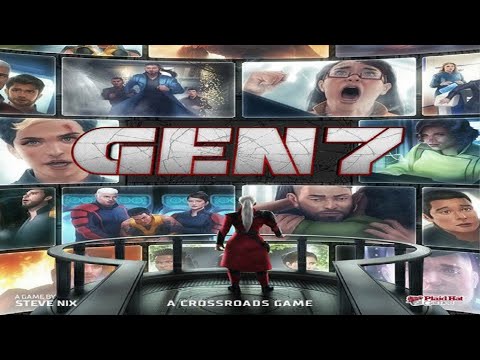






Gen7: A Crossroads Game Deep Dive
What the Community Thinks About Gen7: A Crossroads Game
Gen7 has a notably divided reception among board game reviewers. While the game concept, steering a generation ship through moral crossroads, carries genuine thematic weight, the execution has fallen short of expectations set by Plaid Hat Games' earlier crossroads success. The most common criticisms center on three issues: the rulebook's substantial errors requiring errata lookups, a merit track system that undermines the cooperative experience by creating conflict over personal advancement, and a price point of 80 to 100 dollars that reviewers consistently describe as unjustifiable for the components and mechanics delivered. Several reviewers explicitly compare Gen7 unfavorably to Dead of Winter, noting that the earlier game achieved narrative tension and player investment far more effectively.
That said, Gen7 does have at least one genuine strength that emerged consistently across reviews: the table talk and banter potential. In one memorable playthrough, a group embodied their roles as bureaucratic middle managers squabbling over responsibilities while the ship fell apart around them. That social experience, however, appears to be a byproduct of the group's creativity rather than something the game mechanics reliably deliver.
Core Mechanics That Define Gen7: A Crossroads Game
The Merit Track System
Plaid Hat Games positioned Gen7 as a cooperative game, but reviewers discovered a fundamental flaw: the merit track introduces semi-competitive incentives that split the group's goals. Players earn merit points for completing tasks, and these points unlock abilities and rank advancement that let higher-ranked players shape story outcomes through voting. One reviewer noted that after the first mission, once one player pulled ahead in merit, they could essentially dictate how the narrative developed. This creates a scenario where lower-ranked players feel removed from meaningful choices, undermining the very story-driven experience the game promises. The system works technically but produces the opposite emotional response from what a cooperative narrative game should achieve.
Dice-Placement Crew Task Resolution
Gen7 uses colonist dice (rolled crew members) placed on various ship sections to meet task requirements. The core loop involves rolling dice to determine crew availability, then allocating them to critical tasks. Reviewers consistently noted that this becomes a math-heavy exercise requiring players to calculate equations and verify dice values match task requirements. Rather than feeling strategic, the mechanic often felt like homework. One reviewer described entire rounds as "just doing math the entire game" and suggested it would be a good teaching tool for pre-algebra. The dice themselves lack thematic resonance; several players found the mechanic arbitrary and removed from the narrative stakes.
The Gen7: A Crossroads Game Experience
Bureaucratic Tedium Mixed With Occasional Camaraderie
When the social element clicked, Gen7 created moments of genuine fun. The best playthrough involved a group embodying middle managers bickering over work schedules while their ship burned around them. Players would refuse to help with repairs because "it wasn't on the work schedule." That kind of table-talk comedy emerged from the roleplay potential of the premise, not from the mechanics themselves.
Stress Without Payoff
For many players, the experience tilted toward frustration. The constant mounting crisis cards, mission objectives, and dice rolls created a relentless sense of pressure, but not the good kind found in genuinely tense cooperative games. One reviewer called it "stress that you're like, what was this for?" The game fails to deliver the narrative payoff that would justify the tension. Decisions feel hollow because the story railroad becomes apparent quickly, and replayability is limited since the mystery of who is sabotaging the ship vanishes after the first campaign.
What Makes Gen7: A Crossroads Game Stand Out
The Crossroads Narrative Concept
The foundational idea has merit: players face moral dilemmas that alter the story's direction. Reviewers acknowledged that the crossroads mechanic itself, inherited from Dead of Winter, is sound in theory. The problem lies in execution. The story does not feel reactive to player choices, and relationships with crew members change in predictable, linear ways rather than reflecting player behavior. One reviewer noted that if you are kind to someone, they stay kind; if you are mean to them, they turn traitor. There is no complexity or surprise to how relationships unfold.
Table Talk Potential When Roleplay Clicks
At its best, Gen7 can serve as a vehicle for collaborative storytelling. The bureaucratic setting of a generation ship appeals to players willing to lean into character and banter. The crew member names and their roles offer hooks for roleplay, and a group committed to treating the game as an improv exercise rather than a mechanical puzzle can build memorable moments. One playthrough yielded some of the best table-talk experiences the reviewers had ever had in any game. The game does not force this outcome, but it permits it for groups inclined that direction.
Potential Drawbacks
Rulebook Errors and Learning Curve
Multiple reviewers flagged that the first printing rulebook contains significant errors and omissions. Players need to seek out errata and FAQ documents, and even with those, certain mechanics remained unclear after multiple plays. One reviewer described the rulebook as "literal trash." The game has a setup and rules reference structure rather than a proper how-to-play tutorial, leaving players to piece together how rounds actually flow. This is especially frustrating for a campaign game where early confusion can color the entire experience.
Merit Track Creates Toxic Play Dynamics
The most damning mechanical flaw is the merit system's impact on cooperative play. Because higher-ranked players gain voting tiebreaker power and story-shaping abilities, lower-ranked players feel sidelined. One reviewer described sitting at the table watching another player make unilateral story decisions while everyone else was "along for the ride." This transforms a game that should feel collaborative into one where agency depends on early dice rolls and merit point accumulation. The designers attempted to justify this thematically (hierarchy on a starship), but mechanically it breaks the social contract of cooperative play.
If You Enjoy Gen7: A Crossroads Game
Reviewers who connect with Gen7 tend to recommend Dead of Winter as a superior alternative, since it achieves what Gen7 aspires to: a narrative game with genuine stakes and player investment. If you are drawn to the space-survival theme specifically, Arkham Horror Card Game, Deep Madness, and This War of Mine were mentioned as alternatives that deliver stronger thematic experiences at comparable or lower price points. Fog of Love was also cited as a game that explores difficult relationship dynamics more effectively. For groups specifically interested in roleplay-heavy cooperative games where rules take a backseat to social play, Gen7 can work, but most reviewers suggest either waiting for a significant price drop or exploring Dead of Winter first to see if you prefer the zombie-survival variant of the crossroads formula.
What Reviewers Are Saying
"We had four people playing bureaucratic middle managers arguing and bickering while their colony ship started to burst into flames around them. I had some of the best table talk and banter of any game I've ever played."
— 3 Minute Board Games
"But it's literally a setup and a rules reference. They teach you how a round goes and then the rest of it is a rules reference. It's like, but I don't know what to do. Like our first mission, we didn't record specifically because we know how to play the game."
— Board Games UnLocked
"But you said it was $80. This game is $80 for it to be this boring, but it's a big old slap."
— Board Games UnLocked