/pic134109.jpg)
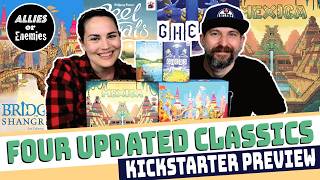
The players are gods at the dawn of time, creating earth's landscape and inhabiting it with people. They can command the creation and destruction of continents and the rise and fall of civilizations.
As gods, players seek to gain followers among the civilizations. They offer those followers luxuries, and oversee the building of pyramids and temples on their continents. In the end, the god with the most loyal, wealthy, and powerful followers will become ruler of gods, and wins the game...
Play involves placing triangular tiles to form islands, coastlines and continents. Players can also replace tiles to reform the topography of the planet.
Each civilization is represented by a color, and once a civilization is “born” a player can gain worshipers in that civilization, which in turn may score points for that player in various ways.
The placement or replacement of tiles may result in civilizations migrating, or going to war with other civilizations. These things are resolved by the various icons on the tiles.
The game is fairly simple, but offers quite a lot of tactical possibilities.


- Strategic gameplay involving map building and manipulation.
- Engaging player interaction through potential wars and breaking/joining islands.
- Need to spend scoring tokens before the game ends to gain points.
- Playing as a god gaining favor with different civilizations' followers by creating archipelagos and developing civilizations.
Mechanics (from transcript analysis)
- area control/influence — Players gain followers from civilizations and can cause conflict like war between civilizations.
- End game trigger — The game ends when six 'epoch' tiles are drawn from the deck.
- Hand Management — Players hold two tiles at a time and play one, drawing another at the end of their turn.
- scoring tokens — Players have three scoring tokens to spend to score victory points for their followers based on symbols on the map.
- Tile Placement — Players place terrain tiles to create archipelagos and develop civilizations.
Video topics + discussion points
Quotes (from this video)
- This is a sponsored preview and this is a prototype copy in front of me. So, all rules, components, and things like that are subject to change.
References (from this video)
- Incredibly interactive
- Constant growth and fall of civilizations
- Simplified and smooth ruleset
- Interesting decisions on when to score
- Tactile point tokens
- Shines at full player count
- Not as good at two players
- Can be a 'super mean' game
- Collectively building and populating an island as gods.
- An island
- The King Is Dead
Mechanics (from transcript analysis)
- Area Control — Players aim to have the most cultures and pyramids in specific sections of the island.
- scoring rounds — Scoring occurs when special epoch tiles are drawn, or through the use of special scoring tokens.
- Set Collection — Players collect people tokens within cultures and aim to have the most pyramids in their cultures.
- Tile Placement — Players play triangular tiles to build an island, either adjacent to existing tiles or on top of them.
Video topics + discussion points
Quotes (from this video)
- this is a paid preview for the Play for Keeps crowdfunding campaign where they are remaking four classic games.
- This is a super mean game, and it reminds me a lot of uh the king is dead, kind of that idea of I don't own any of these, but I'm kind of invested in a bunch of them, but with a really simplified, really smooth rule set.
- So, this is a super mean game, and it plays actually quite a bit different.
- This is just going to feel very different each game because of like the tiles and how that whole map builds out.
- Bridges of Shangri-La, I would say, is the most.
- This really feels like a classic game.
- If you told me that this is a game that has existed for like 300 years, I would believe you.
- So, I think the big thing here is that there are very few rules. There's no luck and you have perfect information.
References (from this video)

- Cool theme
- Visually appealing art
- Interesting cooperative/one-vs-all dynamic
- High replayability potential
- Board might be uninspiring
- Learning the rules can take time
- Players are boys and girls uncovering secrets and embarking on quests in a magical atmosphere.
- Old Prague
- Scenario-based adventure game with a cooperative or one-vs-all dynamic, featuring a choose-your-own-adventure feel.
- Dragon's Lair
- Clue
- Rear Window
Mechanics (from transcript analysis)
- Cooperative — Players can play cooperatively to achieve common goals.
- Modular Board — The game features a modular map with pathways that can intertwine, enhancing replayability.
- One vs All — The game can also be played with one player against the rest, adding a competitive element.
- Set Collection — Collecting secrets and achieving quests likely involves set collection.
- Worker Placement — The game uses worker placement, with worker placement affecting actions and benefits.
Video topics + discussion points
Quotes (from this video)
- Factions that win that have their own abilities that have their own winning combinations.
- It's too heavy for me.
- Yeah, it sounds absolutely amazing.
- Yep. And nobody knows it exists.
- I played Circadian First Light and I liked it.
- Scrolling through this thing with you said with the 300 responses and the people arguing about this game and I s there and it's like it's so amusing. The best part about it is you have these people arguing about Marxism and and uh and democratic socialism everything like that and then you have the people that are just trying vainly to get answers about the mechanics of the game. How does this work with the tricks when you do the thing? And it's just people going back and forth about, you know, screaming about uh, you know, like like how they're going to fix the world or whatever, which I I get it, you know, just it's it's who doesn't do that? But that's that's the part it it reminds me of.
- I watched in disbelief as businessmen voted for a repeat bankrupt, laborers for a boss infamous for stiffing his workers. Evangel evangelicals for a serial adulter for an admitted sexual assaulter. Patriots for a draft dodger who would sell his country's secrets for trivial gain. educated men for an ignoramus. But they did so with fierce gladness in their hearts because what their chosen one had done was open Pandora's box. Yes, the old one filled with the ancient calamities of race hatred and rage and cruelty and blood lust and infinite greed. and tell them that these things were the remedy for all of their grievances, that all their anger was justified, and most important, none of what ailed them was their own fault or ever had been.
- That is like the best paragraph I've ever uh Greg Isles in his book Southern Man.
- That is that is one of the that is uh yeah that was that is one of that is poetry.
- I played it and I could not remember anything. And that's it was such a quarter eater because they would like you'd be dead and it would like make you repeat the the move again and be like, 'Okay, is it left or right or up or down?' And you hit the button.
- No, it was free play, but it was like I played it and I'm like, 'Man, I really loved this back in the day and now I don't like it at all.'
- Everything but the ninjas is easy. The ninjas were like the the the And the ninjas just went on and on and on. You had to defeat like a thousand of them. It felt like
- Happy birthday, Bruno.
- It's just a It's just a It's just a virtual reality pinball.
- The elbow back. It was the most powerful move in the game.