/pic192271.jpg)
Gin Rummy is a popular two-player "draw and discard" standard deck playing card game derived from Rummy in which players follow basic Rummy rules for forming "melds" of three or more cards of the same suit, or 3 or 4 cards of the same rank. Each turn players draw a single card, either from the top of the discard pile or from the top of the draw deck, and then discard a card from their hand.
Melds are formed in a player's 10-card hand and kept there until a deal is ended by one player "knocking" when he has few enough non-melded "deadwood" cards to "go out": generally cards whose values total 10 or less (with face cards valued at 10 and aces low), though some variants value differently. The player that did not go out then has the opportunity to place his melds and "lay off" any of his cards that he can add to his opponent's melds. The values of the remaining deadwood are compared and the player with the smallest total scores the difference.
If the player that did not go out's deadwood is the same or less than his opponent, he gets a 20 point (Variant: 25 points) bonus for "undercutting"; if the player that went out with "Gin" by emptying his hand without deadwood, he scores a 25 point bonus (and cannot be undercut, and the opponent cannot lay off deadwood to his Gin meld). The game continues with subsequent deals until one player's total score reaches at least 100. At that point, the winning player is awarded an additional 100 points (he also doubles this score if his opponent has not won a hand). Each player then scores an additional 25 points for each hand won. The winner is the player with the most points. (Numerous variants and much regional variation occurs in the values assigned to these scores, and many bonuses and additional variations in scoring exist.)
Gin Rummy is distinguished from Rummy in general in being a "knocking" game in which melds are retained in the hand until the end of a deal, and in which it is possible to "go out" without completely emptying one's hand. It is distinguished from games like "500 Rum" in that only deadwood scores.
In Spanish-speaking countries, the game is played with the Spanish deck and it's typically called "Chinchón" or "Txintxon" (in Spain) and "Conga" or "Golpeado" in Uruguay and Peru, respectively.
- More accessible
- Ubiquitous
- Mechanisms incorporated into modern games
- Actively played
- More versatile than Bridge
- Uncle Wiggly
- Bridge
- Rook
Mechanics (from transcript analysis)
- Rummy — The name itself implies the core rummy mechanics of forming sets and runs.
- Trick-Taking — Chaz mentions 'trick taking' in relation to Jin Rummy, though this might be a misattribution or a characteristic of games influenced by it.
Video topics + discussion points
Quotes (from this video)
- And which one of these are going to get lost in the shuffle.
- We'll vote secretly on our candidate and if we are unanimous in our decision, that game will move forward.
- And the Landlord's Game was created 30 years earlier and then stolen from the designer of the game.
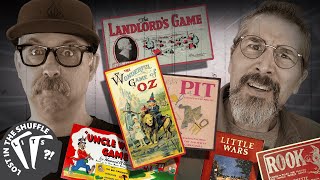
- I think The Landlord's Game is what became Monopoly.
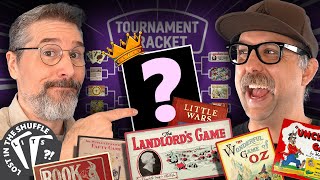
- Which of these two antique board games will be now crowned number one?
- So, congratulations, Jyn Rummy. You are the best antique board game out there. Even though you're a card game, but you know, still.
References (from this video)
- enduring familiarity; still played by the speakers
- no modernization in this edition may feel dated
- set collection, runs, and card gameplay
- family game night; traditional card game vibe
- classic, nostalgic
- Bridge
- Rook
Mechanics (from transcript analysis)
- Set Collection — Players form sets/runs from a hand; draw and discard cycles common to gin-rummy variants.
- set collection and runs — Players form sets/runs from a hand; draw and discard cycles common to gin-rummy variants.
Video topics + discussion points
Quotes (from this video)
- Bridge is a lifestyle game. That's all we play is bridge and if you don't know bridge, you cannot be my partner.
- we discovered a game of Bunko and we're pretty sure it was haunted.
- This is a specific complete edition of Tiddly Winks.
- What does a good boy do when he accompanies grandmother to church?
- Do you always feel like you don't have enough time?
- I will say this is a game I still play.
- Hickey Pickity. Boy, is that fun to say.
- The landlord's game is a precursor to Monopoly
- this is thematically you are going on a shopping spree.
- Little Wars is seen by many as being the first modern war game.
- the box is like with a bell.
- Pogs is making a comeback even now 100 years later.
- Rook came out 20 years before Bridge.