

















Hats Deep Dive
What the Community Thinks About Hats
Reviewers treat Hats as a small card game that asks a lot of its players. The rules are short, and most channels say so, but the decisions are not. The overall impression is of a tight filler where the card values are simple while the planning around the tea table is hard. Most of the praise centers on that tension, and most of the complaints center on how much of the outcome depends on the cards you happen to hold.
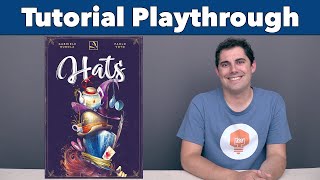
Getting Games covers the game in two videos, a tutorial and a full three-player playthrough. The tutorial presents the rules as easy to follow, and the playthrough shows how quickly a plan can change. The host describes a game where a single new card can overturn a strategy, and where the last cookie token keeps changing hands as players chase the tiebreakers.
Before You Play is the most enthusiastic voice in the group. Monique and Naveen call Hats a solid filler that plays quickly but still demands focus. They admit that their first game left them lukewarm, partly because the game asks a lot of the brain, but that a few more plays turned them into fans. They compare its feel to Parade and Arboretum and note that it is a game they hunted down specifically to feature on their channel.
Pair of Dice Paradise includes Hats in a GenCon preview of upcoming releases. Chaz Marlar reads the rules summary quickly and focuses on the core idea: players acquire the most lavish hats while each exchange changes how the hats are scored. The preview is short, but it reflects the same sense of a game where values move as the table moves.
The Dice Tower provides the main dissent. In a roundup of many recent releases, Tom Vassel gives Hats a very low rating and frames the problem around agency. The Dice Tower is the only critical voice in this set, and its objection is specific: the player feels trapped by the hand they are dealt. That complaint is worth weighing alongside the praise from the other channels, because it describes a real feature of the design that other reviewers treat as the point of the game.
Core Mechanics That Define Hats
Hand Management
Every turn in Hats starts with a choice between two actions. A player can exchange a card from hand with a card on the tea table, provided the played card matches the color of the table card or has a higher value. Alternatively, the player can place a card face down as a black hat worth one point at the end. Optionally, at any point in the turn, a player may discard one card and draw a replacement from the deck. Getting Games explains that a hand loses one card every turn and never refills, so the final card left over becomes the favorite hat for scoring. In a three-player game, that means the first moves set the stage for the last few turns.
Reviewers repeatedly describe the moment-to-moment feel of this system. Before You Play points out that players can never draw up to more cards than they hold, so every discard is a real sacrifice. The Getting Games playthrough notes that a fresh draw can force a complete change of plan, and that the optional discard often becomes the most important decision of a turn. Because the hand shrinks, the game rewards players who think about what they will still be holding in the final turns, not just what they can do right now.
Compound Scoring
The final score in Hats is built from several separate tallies that add together at the end. Each hat color on the tea table sits in a numbered position, and a collection's value depends on where its color lands. If two cards of the same color end up on the table, the higher-value card flips over and the lower one stops scoring. Players also count black hats for one point each, and the favorite hat, scored by adding up all cards of that color in front of the player and subtracting the value of the final card held. The Last Cookie adds five points to whoever has the most distinct hat types, with ties going to the lowest card.
Before You Play describes how much a single tiebreak can matter. In their two-player game, the cookie swung the result by ten points, which turned a near-tie into a clear win. Getting Games makes a similar point in their playthrough, noting that one simple decision can have many consequences because the tea table scoring keeps moving. A player who builds a huge collection of one color can still lose if the table positions drift in the wrong direction.
The Hats Experience
Quick Turns, Heavy Thinking
Hats plays fast. Turns are short, the rules fit on a napkin scoreboard, and a three-player game moves briskly even when players are deliberating. That speed is part of the appeal for the reviewers who like it. Before You Play describes it as a filler that is quick to play but full of thought, and Pair of Dice Paradise calls it a light game that still carries real strategy. The feeling is of a game that is over before you have fully settled into it, which many players find satisfying and others find frustrating.
Constant Flux
The game changes shape with almost every turn, and reviewers describe the experience as interactive in a way that goes beyond simple trading. Opponents can take cards that you were counting on, and they can make the tea table dramatically different with a single exchange. In the Getting Games playthrough, a planned three-turn sequence collapses when an opponent makes an unexpected move, and the host has to adapt on the fly. Before You Play says they were anxious the whole time, wondering what their opponent would do next, and says that anxiety is part of why they enjoyed it.
Player count changes the experience significantly. Before You Play notes that the two-player game is intense and that the second player has a meaningful advantage because they get the last word on the table. In a four-player game, the optional discard becomes a chance to pass a card to a partner, which lets teammates communicate without naming colors or values. Getting Games reaches the same conclusion, describing the team format as an interesting dynamic that adds a layer of signaling to the game.
What Makes Hats Stand Out
Player Count Changes the Game
Reviewers consistently point out that Hats plays differently at each player count, which gives the box more replay value than a game of its size might suggest. The two-player version is tense, because each opponent card is easy to track and the last-word advantage matters. The three-player version is looser, with more colors in circulation and more unpredictable cookie fights. The four-player version adds the partner exchange and turns the game into a limited-information team game. Before You Play highlights this range as one of the main reasons they came to love the game after the first session.
A Theme With Charm
The Alice in Wonderland tea party setting is not heavy, but reviewers enjoy it. Before You Play calls the theme loose and endearing, appreciating that the game is set at a specific moment in the story. The components add to the charm: the cookie token, the napkin that doubles as a scoreboard, and the dry-erase tally on its back are all things reviewers mention with approval. The artwork is abstract and the colors are bold, which some players find more distinctive than the average filler.
Potential Drawbacks
Limited Agency in a Hand-Driven Game
The most serious criticism comes from the Dice Tower, which says the game gives players very little control. Tom Vassel finds that the player is largely stuck with whatever cards arrive, and that success depends on hoping for good hats. The Getting Games playthrough acknowledges that opponents can disrupt plans, which supports the concern that the player's agency can be undercut by the table. Not every reviewer finds this fatal, since many players enjoy the flux as part of the appeal, but the critique is a useful warning for anyone who wants to plan far ahead and see those plans carry through.
Similar Colors on the Tea Table
Before You Play raises a practical issue with the art. Some colors, specifically the orange, pink, and red hats, look very similar, which makes the tea table harder to read at a glance. The two-player setup removes some of those colors, which reduces the confusion, but the reviewers suggest that a more distinct palette would have helped. Because the scoring depends on correctly identifying the color and value of each card on the table, this is more than a cosmetic complaint for players with visual difficulties or for anyone reading the table quickly during a busy turn.
If You Enjoy Hats
Before You Play compares Hats to Arboretum, but draws a clear contrast. Arboretum asks players to plan toward an end goal and keep to it, while Hats keeps moving underneath them, so the planning is always about adapting. Players who like Arboretum's careful lines of play may find Hats more chaotic, but they will recognize the same satisfaction of building toward a good final position. Parade is another filler the reviewers mention as a point of comparison, and it shares Hats' quick pace and sense of building something specific from a small hand.
Hats will also appeal to players who like short games where the last few turns matter more than the first. If you enjoy games where a single card can change the outcome, where scoring rewards positioning as much as collecting, and where opponents can undo your plans, Hats is built for that kind of table. Expect a compact, interactive session, and expect that the game will feel different each time you sit down.
What Reviewers Are Saying
"I hate this game so much. There's no agency at all. You're just stuck with the cards in your hand. You hope you have good hats."
— The Dice Tower
"This is a really solid filler game. It plays really quickly, there's a lot of thinking."
— Before You Play
"Perhaps this hat goes out of vogue, it is no longer very much a hat that you want, but this other hat, which used to be a garbage hat that certainly nobody would want, now everyone wants that hat."
— Pair Of Dice Paradise