













Herbaceous Sprouts Deep Dive
What the Community Thinks About Herbaceous Sprouts
Reviewers largely agree that Herbaceous Sprouts is a light, approachable dice game with a lot of charm. Pencil First Games publishes it, and it shares a world with For Basis, the card game that Liz Davidson of Beyond Solitaire points to when describing the setting. Where opinions diverge is on how much the dice dominate the experience. The reviewer at cardboardrhino calls it a dice game that can make you relax, with easy rules and enough flavor to suit the whole family. John Perkis of Actualol offers the most distinctive comparison, placing it beside Herbaceous, the card game from the same team, which Perkis considers purer and more immediate, finding the dice version a little longer and more complicated than it needs to be. Perkis still sees it as a relaxed option that could work well with parents or newcomers.
Danny of Board Game Sanctuary approaches it as a dice placement game with four competing parts of the garden and says the channel enjoys games that offer complex decisions. Tom Vassel of The Dice Tower lists it among the smaller titles on the library shelves, which suggests it is a stable, well-regarded entry in the collection rather than a headline release.
Core Mechanics That Define Herbaceous Sprouts
Dice Drafting
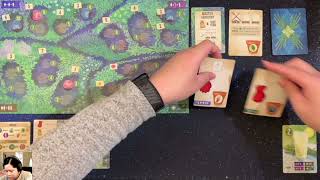
Dice drafting is the foundation of the game. Each round, dice are drawn from the bag and placed on a row of tool cards, and players take turns choosing a card and collecting the dice on it. Cardboardrhino explains that some cards simply hand over their dice to your wheelbarrow, leaving you to decide later when to spend them on a planting goal. Liz Davidson at Beyond Solitaire shows that the tools add a second layer. A glove rerolls a die, a package turns one die into another face, and a pot can be stored and planted later as if it were a die. Danny at Board Game Sanctuary describes the same loop as drafting dice and action cards together, so each choice gives you both a die and an ability. Because the card you take determines which dice your opponents can get, selection order and denial matter as much as the dice you roll.
Action Timer
Herbaceous Sprouts has no physical clock, but reviewers describe a built-in one. Liz Davidson notes that the number of tool cards in the deck sets the length of the game, so the game ends when the deck runs out, giving it what Liz Davidson calls an automatic sort of timer. Players are therefore weighing whether to plant modest points now or hold dice for premium spots, knowing that the round, and the game, may close before they get what they need. That tension keeps the rolling from feeling passive, even though the timer never speaks up.
The Herbaceous Sprouts Experience
Relaxed
The most consistent emotional note in the reviews is calm. Danny at Board Game Sanctuary says the game is super easy to teach and really relaxing to play. Liz Davidson describes the solo game as very peaceful, with an AI opponent that runs smoothly and never demands much attention. Perkis at Actualol says the game has a nice relaxed vibe that makes it easy to imagine playing with family. Even when a tool or a rival garden move disrupts a plan, reviewers describe the frustration as light, the kind of setback that prompts a laugh and a reroll rather than a tense argument.
Gorgeous Art
Reviewers repeatedly single out the visual presentation. Cardboardrhino highlights the gorgeous seed dice and the illustrations that accompany the gameplay. Liz Davidson praises the beautiful herbs and the art, and Perkis notes that Pencil First gave the game a different theme with really nice artwork. The herb and flower imagery matters functionally as well as aesthetically, because the dice faces are the game's language, and reviewers describe the table as pleasant to look at while the rounds unfold.
What Makes Herbaceous Sprouts Stand Out
Rules Built for Whole Families
Reviewers consistently praise how little teaching the game requires. Cardboardrhino says it is very easy to learn and easily recommendable for the entire family, while Perkis argues that the rules are not much more complicated than the card version and that the game can serve as a gateway for players who are not yet used to heavier dice or card games. The reviewers agree that this accessibility is not a compromise. The push-your-luck decisions remain, and new players can enjoy them without first mastering a dense rulebook.
A Solo Rival That Teaches by Comparison
Liz Davidson's walkthrough of the solo game shows how the AI works. The rival gardener drafts, plants according to its card, and never needs a complex rule set to play. Liz Davidson's verdict is that the scoring is about the gap, not the total: a tie against the AI reflects a close game, while a large margin is a real achievement. Davidson also notes that the AI's aggressive plays can feel unfair, because its placements can take premium spots without any effort. Even so, the solo framework gives a single player a clear target and a way to measure progress across plays.
Potential Drawbacks
Heavy Reliance on Rolling
Liz Davidson acknowledges that the game involves a lot of rolling. Davidson does not mind it, but notes that players who dislike the randomness of dice will find many turns are decided by what the bag and the tool cards produce. Reroll tools soften the luck, and Davidson describes successful turns built on combining several rerolls, yet the reviewers agree that some turns simply fall flat. Players who want strategic control over every outcome may find the game too reliant on what comes out of the bag.
Rival Plays That Feel Unfair
The solo rival can be frustrating. Liz Davidson describes a moment when the AI took the best planting spot in the whole game after a die had landed in the same section of the garden, calling it a bad break in a way that undercut the plan. The complaint is not that the AI cheats, but that its placements are hard to counter once a spot opens up. Players who prefer to outmaneuver an opponent directly may feel that the solo experience depends more on luck than on planning.
If You Enjoy Herbaceous Sprouts
Players who enjoy the push-your-luck dice drafting in Herbaceous Sprouts will find a familiar satisfaction in Herbaceous, the card game from the same team. Perkis at Actualol describes the card version as having the immediacy of the card game, where the decision comes down to when to plant and when to keep waiting. For Basis suits players who like the Herbaceous Sprouts setting, since Liz Davidson explains that the dice game is set in the same world. Delicious and Liftoff are the other Pencil First titles mentioned in the Gaming with Edo and Jessica conversation, and Edo notes that Delicious was the publisher's new title at PAX Unplugged and sold particularly well there. Players who want a similarly accessible game with more table presence may find those titles a natural next step.
What Reviewers Are Saying
"The idea isn't to get a higher score necessarily. It's not about the number of your score, it's about how much higher your score is than the AI score."
— Beyond Solitaire
"I think it's got a really nice relaxed vibe. I could totally imagine playing this with sort of parents. It could be a gateway game."
— Actualol
"It's very easy to learn and easily recommendable for the entire family."
— cardboardrhino