



HOP! Deep Dive
What the Community Thinks About HOP!
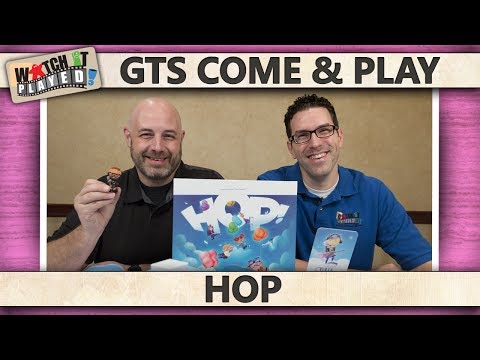
Reviewers agree that HOP! is a loud, physical, and social game that works best when the whole table is watching. Scott Morris of Passport Game Studios, speaking with Rodney Smith on Watch It Played, described it as one of the most adorable and fun games they had seen, and said that everyone at a demo laughs at every throw. The channel BoardGameBollocks takes a far harsher view, calling the game overproduced and "stupid," yet still conceding that it is "quite an enjoyable" one. The two perspectives meet on one point: HOP! is a family party game rather than a strategic contest, and its value lies in the reactions it produces.
Core Mechanics That Define HOP!
Ring Toss Roles: Hurler, Skewer, Assistant, and Turbulator
Each turn begins with a card that assigns the active player the role of hurler. The hurler selects a rainbow ring and tries to drop it over the finger of the skewer, who holds a finger up in the air. Scott Morris points out that the rulebook calls for the index finger, but the cards routinely change the challenge. A card can require the skewer to raise a pinky, close their eyes, or give the Star Trek "live long and prosper" sign, and a hurler may be told to cover one eye, which affects depth perception. Additional roles add chaos to the throw. The assistant is directed by card text to guide a hurler with eyes closed, and the turbulator, Morris's favorite word in the whole game, physically interferes, such as by making a toucan noise or holding the hurler's hand still. Designed by Marie Cardouat and Ludovic Maublanc and published by Funforge, the system turns a simple ring toss into a sequence of small, unpredictable obstacles.
Cloud Tokens, Bird Bets, and Balloon Pops
Players who are not involved in the throw still take part by betting on the outcome. Each bettor places a cloud token with its sunny or rainy side showing, depending on whether they believe the throw will succeed. A correct bet earns dove tokens, and a wrong bet earns crows. Three doves can be exchanged to climb a level, while three crows pop one of the player's balloons. Cloud tokens carry small point values, and BoardGameBollocks and Watch It Played both note that these points matter at the end. The game can finish in two ways: a player reaches the top of the sky, which triggers final scoring, or a player loses all of their balloons. Morris explains that reaching the top does not guarantee victory. A player on level two can still win if a rival on level five has fewer cloud tokens, because the scoring counts both altitude and collected tokens.
The HOP! Experience
Shared Laughter at Every Throw
The defining feeling of HOP! is the collective laughter that builds around each attempt. Morris describes a table where everyone, including adults, reacts to every throw, and notes that players at demonstrations filmed their attempts and then tried to toss rings across the room. BoardGameBollocks describes the same energy in more skeptical terms, suggesting that the game is played in a "dungeon fire" style, where players stand on one leg or perform other awkward contortions to make the throw. The experience is built on the expectation that a failed toss is funnier than a successful one, and the reviewers treat physical comedy as the main reason to play.
Tension Maintained Across the Whole Table
Even players who are not on the throw remain invested because of the betting system. Morris observes that people watching quietly still care whether the hurler succeeds, and the bet encourages them to commit to a prediction. The social dynamic also shapes strategy. Morris notes that a hurler who keeps choosing the same skewer effectively hands that player extra points, which pushes players to spread their support around the table. The result is a tension that is less about winning a race and more about whether the group will cooperate with, or sabotage, one another in the moment.
What Makes HOP! Stand Out
Prepainted Miniatures and Distinctive Illustration
Watch It Played highlights the production quality of the prepainted figures, which come with the game in a box that has a small window so that buyers can see them on a shelf. Morris describes the set as three girls and three boys, each with a distinct personality, and says that viewers frequently identify with a figure that resembles themselves as a child. The card art is also a major draw. Morris calls Marie Cardouat's illustrations "absolutely beautiful" and "breathtaking," noting that every card in the large deck is individually illustrated, and that several cards are funny enough to be favorites.
Accessible Fun Across Age Groups
Reviewers repeatedly stress that the game is accessible to a wide range of players. The box lists an age range of six and up, and Morris reports that six-year-olds "go crazy for it" because their only goal is to land the ring on someone's finger. Adults engage differently, often turning the game into a contest of distance or precision and seeing how far they can throw from across the room. BoardGameBollocks likewise frames the game as something that suits families and casual groups rather than experienced hobbyists.
Potential Drawbacks
Overproduction and Shelf Footprint
BoardGameBollocks is the most critical voice on production. The reviewer calls HOP! an "overproduced stupid game" and says the box is too large for a typical shelf, to the point that the reviewer planned to keep only the cards and ring and discard the rest. For buyers who value a compact collection, the physical size and component volume may outweigh the enjoyment that the game delivers at the table.
Limited Depth for Experienced Players
The same reviewer argues that the game has little strategic depth and could be played with "a piece of pasta" in place of the rings, suggesting that the game's humor does not sustain long-term interest. Morris, by contrast, argues that the game is not as simple as it looks, citing the way card variations make a basic toss harder. Experienced hobbyists may find that the core ring-toss action wears thin once the novelty of the cards and roles has passed, while families and parties are likely to find the same content sufficient.
If You Enjoy HOP!
Players who enjoy HOP!'s illustrated charm will find a natural companion in Dixit, the game whose artwork Marie Cardouat is best known for. Morris draws this connection directly when introducing the designer, and the shared emphasis on whimsical art and a group-oriented experience makes Dixit a logical next step. Players who appreciate the publisher's production values may also want to explore Samurai Spirit, which Morris cited as one of the Funforge titles that most people already recognize. It offers the same polished presentation from the same publisher, which may appeal to players who want HOP!'s quality in a different style of play.
What Reviewers Are Saying
"This is probably one of the most adorable and fun games I've ever seen and had the opportunity to play. It really creates quite an impression on the table."
— Scott Morris, Watch It Played
"It's Hop, I mean, this, it's actually quite an enjoyable stupid game. What you're going to be doing, you're going to be chucking a ring over somebody's finger. You'll be doing it in the dungeon fire sort of style."
— BoardGameBollocks
"Somebody will put their finger up in the air and you'll be trying to throw the hoop over their finger in certain ways. The cars dictate you, it's quite silly, good fun, it's pretty well produced."
— BoardGameBollocks