






Horrified: World of Monsters Game Deep Dive
What the Community Thinks About Horrified: World of Monsters
Horrified: World of Monsters is a cooperative game from Ravensburger in the Horrified series, where heroes defend a village from classic monsters by drawing items from a bag and spending actions to answer each threat. Reviewers treat it as the box that brings Lovecraftian monsters into the line, built around Cthulhu and three companions: the Yeti, the Sphinx, and the Jiangshi. The mechanics reviewers name are Modular Board, Cooperative Game, and Boss Battler. Across the reviews, the same core system carries over from the rest of the series, and the debate centers on theme, puzzle design, and how much game the box delivers.
Core Mechanics That Define Horrified: World of Monsters
The Shared Turn Structure
Heroes take a set number of actions on their turn, and each action might guide a citizen home, pick up items from a location, or spend items to advance a puzzle. The monster phase then adds new items from the bag, resolves an event, and moves monsters toward the heroes. Monsters attack when their symbols line up with a hero's position, and the outcome depends on the dice showing hits. The terror track climbs when heroes take damage or fail a task, and the group loses if it reaches the end of the track. Reviewers in Allies or Enemies also point out that the monster deck running out is a win condition, so the table is always racing two clocks at once.
Item Colors and Strength
Items come in several colors and carry a strength value, and most of the tricky decisions in the box come from that math. The reviewers who played the Cthulhu finale describe discarding matching-color items whose combined strength meets a target, and they note that discarding costs a full action per item. Ryan and Bethany Board Game Reviews, in a cooperative-games gift guide, name this box as their current favorite of the category. Jess and Sean highlight that the perk cards are steampunk inventions, which gives players an extra reason to read the card text carefully.
Monsters With Their Own Puzzles
Each monster has a different way to defeat it, and that variety is the strongest argument in the reviews. The Sphinx presents a sum-based riddle grid, which Ryan and Bethany compare to a Sudoku-style mechanism. The Yeti hides its cave under face-down layers, so heroes must reveal and uncover the right layer before the monster can be dealt with. The Jiangshi requires building a sword from polyomino pieces, and in one playthrough the group had to discard a cumulative sum of purple items to finish it off. Before You Play describes a Deja Vu monster card that re-seeds the board with monsters, which keeps the threats from settling into a predictable pattern.
The Horrified: World of Monsters Experience
Two Stages and a Separate Battlefield
Cthulhu is the headline boss, and Jess and Sean say it is the first monster in the series with two distinct levels. The first stage plays on the main board, where heroes turn dials at the central void to open the way. Once Cthulhu is pulled into the void, the second stage moves to a new location called the corpse city. Before You Play describes the corpse city as a separate mat where each tentacle must be bound by discarding enough matching items, and all heroes must gather there before the final lock. Reviewers agree that this structure gives the game a big closing moment, even if the middle of the game can feel crowded.
Crowding Around the Void
Because movement keeps funneling toward the center, monsters tend to clump near the void. Jess and Sean point out that this makes entering the void dangerous, since heroes become easy targets. Before You Play observes the same problem in play, noting that running as far away as possible and letting the monsters crawl forward is often the best approach when Cthulhu is the only threat.
What Makes Horrified: World of Monsters Stand Out
A Steampunk Take on Lovecraft
The theme is the largest point of division. Jess and Sean say the Lovecraft flavor is not for them, but they like the steampunk town, the steampunk cards, and the perk cards that look like inventions. Ryan and Bethany praise the tone as having the right level of spookiness, and they like how each monster's defeat fits the story. The reviewers largely agree that the art and sculpts are strong, with Jess and Sean calling the sculpts among the best in the series.
Potential Drawbacks
Map Readability and Location Names
Ryan and Bethany's main criticism is the map. Most locations have invented names with no real-world anchor, so when a card says to place a token at a location, players must search the board for it. They describe that search as a pause that pulls everyone out of the theme during the first few plays, and they suggest that placing location artwork on the cards would help. Jess and Sean also point out that the steampunk buildings and locations are harder to find on the board than the familiar sites in American Monsters.
Component Problems
Jess and Sean name one physical flaw. The Cthulhu miniature lacks notches in its cardboard base, so it does not stay upright and its feet keep falling off. They call it an easy fix that the designers missed. The Shelf Life reviewer adds that balancing, playtesting, and rules clarity have declined since the first release of the series.
If You Enjoy Horrified: World of Monsters
Strengths for Cooperative Fans
The cooperative structure works for groups who enjoy tight finishes. The No Rolls Barred playthrough was a four-player game with the Yeti, the Sphinx, and the Jiangshi, and the table lost. Even so, the players repeatedly said they might win, and the game stayed tense until the final turns. The group also liked the perk cards, which can dramatically change a turn, such as a hero who can gather items from any space and redistribute them to another player.
Limits and Expansion Options
Several reviewers note that the box is narrower than others in the series. Jess and Sean say that the four monsters mean fewer combinations than the six-monster boxes, while Ryan and Bethany argue that the crossover with the Greek Monsters box adds real variety. The series as a whole is also a set of standalone games that expand one another, which means a group can start here and mix in other boxes later. Krampus, a limited edition holiday monster, can also be added, and a playthrough in Before You Play shows how it changes the game.
Choosing Among the Series
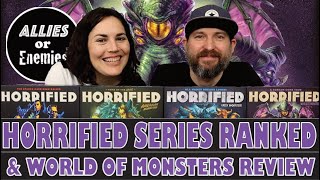
Reviewers rank the boxes differently, so the right pick depends on taste. Ryan and Bethany name American Monsters as their favorite for its puzzles, and the Shelf Life reviewer calls American Monsters the weakest box in the series for them. Jess and Sean rank this box last of the four horrified options they compare, mainly because of its smaller monster roster and its Lovecraft theme. Those who love the Cthulhu theme and the steampunk look may still find the most value here, while players who want a broader mix of monsters may prefer the other boxes.
What Reviewers Are Saying
"it's the exact right amount of spookiness not being scary"
— Ryan and Bethany Board Game Reviews
"this is the first monster that they've had that has two different levels to it"
— Allies or Enemies
"So yeah, World of Monsters was a call."
— Shelf Life