



Horrified: American Monsters Deep Dive
What the Community Thinks About Horrified: American Monsters
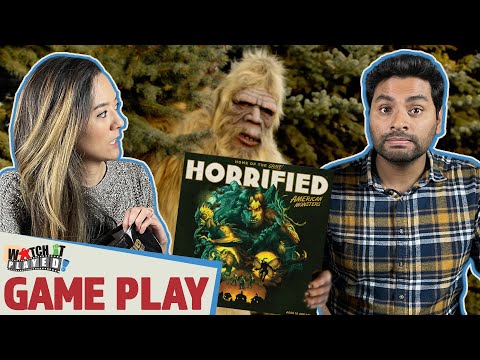
Reviewers treat Horrified: American Monsters as a favorite entry in the Horrified line. Its cooperative structure, simple system, and regional monster selection come up again and again as reasons people return to it, and several reviewers call it a good game to introduce to newcomers. A Watch Review video places it near the top of its personal rankings, praising how quickly new players catch on to the rules.
Reviewers mostly agree on the strengths: the monsters play differently from those in the original game, the 50s styling gives the game a distinct look, and the game becomes noticeably harder with four players than with two. Opinions diverge mainly on rankings. One Allies or Enemies ranking video places American Monsters third within the series, while a separate top-ten list puts it first. Bigfoot's rules are singled out as the part most likely to confuse people.
Core Mechanics That Define Horrified: American Monsters
Cooperative Game
Players work together as a town defending itself from monsters that keep invading. Investigators take their actions on each turn, and the monsters respond afterward, so the threat grows while the group plans its next move. Reviewers describe the cooperative design as the reason the game feels like a shared struggle rather than a contest between players. Monsters differ in complexity: the Mothman is rated medium, the Chupacabra low, and Bigfoot high. The Mothman moves toward investigators, and players can try to lure it into traps set around the board so that it can be captured. The combination of movement, trap placement, and monster phases forces the group to coordinate, which is why reviewers say setup and planning take real effort.
Boss Battler
Each monster functions like a boss with its own sequence of objectives. Every monster has a monster mat where its steps are resolved, and players flip and slide tiles on that mat to complete a goal before the monster can be removed. Bigfoot is the clearest example. Reviewers describe the objective as photographing the creature, which means working through a sliding-tile puzzle until the picture is complete, then finishing the monster's remaining steps. Monsters also move and act on their own schedule, so the group must decide which threat to face first. Reviewers note that the more creatures on the board, the harder it becomes to defeat them, which makes the boss encounters the main source of pressure in the game.
The Horrified: American Monsters Experience
Tension and Teamwork
Reviewers describe the play as tense in a satisfying way. Monsters close in while the group argues over priorities, and the cooperative format keeps everyone involved, since no single player can ignore the threats. Board Games for One framed the premise as a town fighting off scary monsters that keep invading, and that sense of a community under pressure runs through the reviews. Several reviewers also said the game can be taught to a family or a mixed group without much trouble, which helps the tension feel shared rather than intimidating.
Retro American Horror Theme
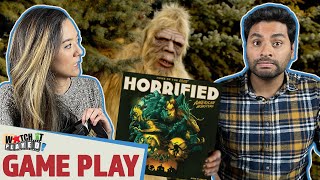
Reviewers consistently praise the 50s aesthetic and say it gives the game a character of its own. The monsters are drawn from American folklore, including Bigfoot, the Mothman, the Jersey Devil, the Chupacabra, the Banshee of the Badlands, and the Ozark Howler. One reviewer said the monsters are interesting even for players who know little about them beforehand. Presentation also gets praise, with figures that sit nicely in their stands and a board full of pieces. Bigfoot leaves footprint tokens as it moves, a small detail that reviewers enjoyed.
What Makes Horrified: American Monsters Stand Out
Regional Folklore
Reviewers note that the monster selection leans toward modern urban mythology rather than the classic Universal monsters of the first game. Many players will know Bigfoot already, but the rest of the roster is less familiar, which gives the game an educational angle. One reviewer described the monsters as an excellent way to explore different parts of America, and another mentioned that the game can bring younger players into conversations about geography. Small touches reward fans of the lore too, such as the Mothman's red eyes showing up in the game's tokens.
Different Monsters, Same Foundation
Reviewers say the monsters play very differently from those in the original, while the underlying system stays familiar. That combination means owners of the base game can enjoy both sets without feeling they are replaying the same experience. The turn structure is another point of praise. Investigators act, and the monsters respond immediately, which reviewers found more engaging than games where monsters wait until every player has finished. The result is a game that feels fast and responsive even when the threat is high.
Potential Drawbacks
Harder With More Players
One reviewer found that the game plays a little harder with four players than with two, a change that rewards experienced groups but can feel punishing to newcomers. Players who want a gentler introduction may prefer to start with a smaller group before adding more people. The difficulty increase is a feature for many, yet it is worth knowing before choosing a player count.
Bigfoot's Complexity
Bigfoot is rated the most complex monster in the set, and one ranking video describes Bigfoot as a point of confusion within the series. Its objective requires several steps across the monster mat, and reviewers say it takes time to learn. Groups that play Bigfoot for the first time should expect a slower round while they sort out the rules. Reviewers still consider the encounter one of the highlights once the rules click.
If You Enjoy Horrified: American Monsters
Reviewers who enjoy the cooperative structure and monster theme tend to connect this game to the base Horrified release, which established the template and the core system. Players who like the monster variety may also be interested in Horrified: Hollywood Monsters, which uses the same foundation with a different roster of classic characters. Reviewers who value the regional folklore and the 50s styling of American Monsters generally see it as the most distinctive entry in the series, which is why it earns a place among their favorites.
What Reviewers Are Saying
"if you decide to play it multiplayer with your family you are playing as a town fighting off these scary monsters"
— Board Games for One
"we think it plays a little bit harder with four"
— Allies or Enemies
"the more creatures that are in the game the harder it is you are trying to defeat them"
— Rolling Dice & Taking Names