/pic4543702.jpg)
/pic2871265.jpg)


/pic4543702.jpg)




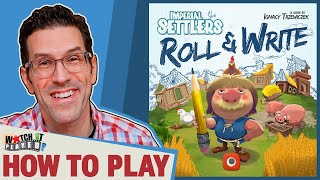
Imperial Settlers: Roll & Write Deep Dive
What the Community Thinks About Imperial Settlers: Roll & Write
Imperial Settlers: Roll & Write, designed by Ignacy Trzewiczek and published by Portal Games, wins over reviewers who expected little from the genre. Board Games UnLocked had stayed away from roll and writes because they never seemed to have much meat to them, yet found this one actually kind of fun. On Rolling Dice & Taking Names, Marty came in as someone who is not a big roll and write fan and Vanessa had never played one; both left as fans. Cardboard Crew, who had not played the original Imperial Settlers, said it left a really good impression. The recurring caveats are the basic rules, which Board Games UnLocked calls very boring, and a competitive mode where everyone plays the same sheet. Board Games UnLocked settles on a six out of ten, a little above average, and prefers it solo. Coverage includes a Watch It Played teach that Portal Games sponsored, and the Rolling Dice & Taking Names segment ends with a plug for the Portal Games website; Board Games UnLocked bought its own copy, and the Audible ads on its videos are unrelated to the game.
Core Mechanics That Define Imperial Settlers: Roll & Write
Dice-Driven Actions and Resources
As Rodney Smith explains on Watch It Played, the game runs for ten rounds. Each round the active player rolls four dice: three resource dice showing stone, wood, food or a wild gold, and a worker die that sets how many actions everyone gets. The results are shared, so if one player uses a stone, every other player can still use that same stone. Players then pick a favor token, such as the ally for an extra action or the lucky coin for an extra gold, and spend their actions crossing off boxes. Some boxes are free and others also require a matching resource. Crossing off every box beside one of the six buildings on the village sheet constructs it and unlocks its once-per-round ability. The other sheet, the empire sheet, holds rows for walls, cottages, granaries and bridges; the further along each row a player gets, the more points it scores, and bridges open fields that can be harvested for extra resources. Cardboard Crew found the balance between workers and resources interesting because every crossed box costs an action.
Engine Building Through Settlements
The advanced rules add the settlement phase. Each building shows a small shape, and if a player can outline that exact shape using completed sections of the empire sheet, the building's value goes up by one. Watch It Played's example is a farm that produces two food instead of one after its first settlement. Board Games UnLocked describes the Sentry Tower's shape as the T piece from Tetris and walks through how the Dark Chapel, which at first looks weak, keeps adding actions as more settlements are built around it. Rolling Dice & Taking Names sums up the loop: filling out the victory point rows in the right pattern makes a building better, which builds the engine toward more resources, more actions and more points.
The Imperial Settlers: Roll & Write Experience
A Thinky Filler
Board Games UnLocked puts a game at about 30 minutes, and Rolling Dice & Taking Names calls it a very quick game at only ten rounds. It was easy to pick up there too: after two rounds, the player who likes to learn by playing was good to go. Within that short frame, the settlement rules turn it into what Rolling Dice & Taking Names calls a thinky roll and write, one that people who like thinking games would enjoy as a filler. For Marty, most roll and writes had felt like push-your-luck affairs, and this one stood out for rewarding planning. Cardboard Crew agreed that it played fairly quick yet felt very satisfying by the end.
Planning Around Wasted Resources
Much of the tension comes from resources that cannot be saved. Cardboard Crew got fixated on how resources go to waste because there is no storage for them; the rule pushes efficient play, but at times nothing could be done with a roll. Board Games UnLocked's solo playthrough shows the same pressure from the other side: a low roll on the worker die in the penultimate round wrecked a plan to finish a scoring building, and an early settlement placed without enough thought blocked a second Temple. The game rewards looking a few rounds ahead.
What Makes Imperial Settlers: Roll & Write Stand Out
Advanced Rules That Change Everything
Nearly every review singles out the advanced rules. Board Games UnLocked found the basic game underwhelming at first, calling it just rolling and marking, but says the game explodes with strategy once settlements are added, and does not consider the advanced rules that advanced. Rolling Dice & Taking Names played the basic game with four players one night and advanced as a two-player game the next, and says the advanced rules take it to a whole new level. Cardboard Crew played the advanced version right away and found it really exciting. The advanced mode also adds the Architects building, whose shape scores eight points per settlement at the end of the game.
Forty-Eight Adventure Sheets for Solo Play
The solo adventure mode uses 48 unique village sheets, each with its own buildings. Watch It Played explains that the solo player draws three favor tokens for the whole game, that some buildings allow rerolls at the start of the action phase, and that a table in the rulebook ranks final scores; more sheets can be downloaded free from the Portal Games website. In Board Games UnLocked's playthrough of the first sheet, 64 points earned the rank of Duke, two points short of Emperor. Board Games UnLocked rates the game higher solo because the adventure sheets supply the variety the competitive mode lacks, and Cardboard Crew praises having almost a different set of buildings on every sheet.
Potential Drawbacks
A Competitive Mode That Grows Stale
In the two to four player game everyone uses the same village sheet, and only a few favor tokens come out each round. Board Games UnLocked calls the multiplayer game essentially a solitaire game, with the only interaction being which favor token each player picks, and says it gets very stale after even a couple of plays. The same reviewer contrasts it with the Imperial Settlers card game, where every player has a faction with its own identity, and wishes the adventure sheets' variety had been brought into competitive play. The scores in those two-player games were always close, though, so the issue is sameness rather than balance.
Bookkeeping in Your Head
Once buildings start chaining, there is a lot to track: Board Games UnLocked describes juggling five food, two gold and seventeen actions with nowhere on the sheet to note them, and the included pencils have no erasers. Rolling Dice & Taking Names wanted scratch paper after the basic game, but found that the box used to mark off each round works as a place to track extra resources and actions.
If You Enjoy Imperial Settlers: Roll & Write
Rolling Dice & Taking Names names The Castles of Burgundy: The Dice Game as the one other roll and write that won over a reviewer who dislikes luck-driven ones, a thinky game that translated well from the board game, just as this one does. Board Games UnLocked points players toward the original Imperial Settlers card game for faction variety, interaction and a longer engine-building game, while noting the roll and write offers a quick taste of that world rather than a replacement for it.
What Reviewers Are Saying
"So everyone has the same village sheet, everyone has the same buildings to go for, so there's not a lot of options. Like, it gets very very stale after just, I would say, even a couple plays."
— Board Games UnLocked
"It played fairly quick but it left a really good impression on me, just because, like, I felt very satisfied by the end of the game."
— Cardboard Crew
"So then that makes you think, okay, well if I'll fill out my victory points this way I can make this building better, which will help me generate my engine to build more resources to give me more actions in the end to generate more victory points."
— Rolling Dice & Taking Names