











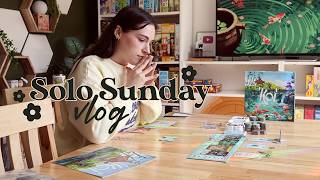

Koi Deep Dive
What the Community Thinks About Koi
The board game community has embraced Koi as a standout title from 2025, particularly among players seeking thoughtful, meditative experiences. Board Game Sanctuary's Danny describes it as a game that "really speaks to me" thematically, while The Board Game Garden's Jenna calls it "wonderful" and "relaxing"; a sentiment echoed by The Dice Tower's Oliver Reese, who notes it represents a meaningful step forward from its predecessor. The game's reception centers on its accessibility combined with surprising strategic depth: it welcomes players seeking a calming activity while rewarding those who engage with its economy. Across multiple reviewer channels, Koi appears on anticipation lists and recommendation rosters, suggesting broad appeal that transcends typical player demographics. The game particularly resonates with reviewers who value aesthetic presentation alongside mechanical substance.
Core Mechanics That Define Koi
Card Drafting and Market Mechanism
At its heart, Koi employs a clever market system where cards from a common pool are available for purchase. The key innovation: the first card costs more, but as cards sit in the market waiting to be selected, their cost decreases. This creates a push-pull tension between seizing an opportunity now or waiting for a better price later, but risking that another player will claim it first. Each card selected from the market carries its own reward or resource. The mechanic gives the game an economic depth that rewards both patient observation and bold speculation, making each turn a small calculation about timing and value.
Meditate vs. Work Action Economy
Every turn, players face a binary choice: meditate or work. Meditating allows players to acquire new cards and tiles from the market, building their resources. Working lets them place those resources into their koi pond, building their actual landscape and triggering scoring. This split reinforces a satisfying puzzle: you cannot do both in a single turn, so players must decide when to gather and when to build. As your engine grows through collected worker cards, work turns generate more actions, creating escalating capability, but only if you invested earlier in the meditate phase. The push-pull between these two modes creates the game's experiential rhythm.
The Koi Experience
Meditative and Zen
Playing Koi feels like an act of peaceful creation rather than cutthroat competition. Reviewers consistently describe the experience as "relaxing" and note its connection to themes of nature, balance, and contemplation. The game's pacing (never rushed, always thoughtful) mirrors the meditative quality of actual koi pond tending. There is no real-time pressure, no catch-up mechanics that punish leaders harshly, no elimination. Instead, the game invites players to craft their own aesthetic vision. Even when opponents execute strategies that affect your path, the tone remains constructive rather than adversarial. Many reviewers mention enjoying Koi as a solo experience, which speaks to its meditative nature.
Artistic and Visually Satisfying
The production design of Koi is central to its appeal. The standout feature is the transparent acrylic koi fish tiles: literal pieces of clear plastic with fish printed on them that players layer directly atop their pond landscapes. This layering mechanic creates a visual representation of fish "swimming" in water, and reviewers consistently highlight how this production choice reinforces the theme. One reviewer describes the moment of placing a transparent koi over water tiles as creating genuine visual beauty on the table. The overall aesthetic is zen and nature-focused, with artwork that players describe as "gorgeous" and "striking." The game becomes as much about creating a beautiful tableau as it is about scoring points.
What Makes Koi Stand Out
Transparent Fish Tiles and Layering Innovation
The transparent acrylic koi tiles are not mere flash; they represent a genuine innovation in how theme can be married to physical play. Rather than depicting fish on cards or tokens, the game uses literal transparency to create the illusion of fish in water. Players describe watching the koi "appear" in their pond as tiles layer, and this physical interaction strengthens the game's meditative, nature-building appeal. The Dice Tower's Oliver Reese specifically notes that "the production quality is definitely helping koi here because those fish tiles are transparent." This design choice separates Koi from countless other pond-building or nature-themed games and makes the act of placement viscerally satisfying.
Card Drafting Economy That Rewards Patience
The market mechanism creates an economic puzzle that rewards careful observation without punishing newcomers. The descending cost structure, expensive when fresh and cheaper when cards wait, gives players agency to either jump on an opportunity or speculate on future value. Board Game Sanctuary's Danny explains that the "interplay of do I store things now" alongside decisions about when to place them makes the puzzle "incredibly tight," creating engaging decisions without overwhelming complexity. This economy scales from light play to strategic play, allowing different player groups to engage at their own depth level.
Potential Drawbacks
Limited Solo Variability
While Koi includes a solo mode, some reviewers note that the experience may shift with repeated plays as the core market and tile selection becomes more predictable. One reviewer mentioned that solo play felt "swingy" depending on which cards appear, suggesting that the randomization may not perfectly balance solo experiences. For dedicated solo players seeking puzzle-like consistency, Koi's solo mode may feel less tight than alternatives designed specifically for solitaire play.
Koi Fish Size Scaling Concerns
A few reviewers noted a thematic quibble: the largest koi fish tiles appear disproportionately large compared to other elements like waterfalls and ornaments, creating an awkward sense of scale. While this does not harm gameplay, it is a small aesthetic inconsistency that breaks immersion for players who spend mental energy on thematic coherence. One reviewer joked about the absurdity of a koi being almost as large as a waterfall feature, suggesting the component sizing could be more carefully calibrated.
If You Enjoy Koi
Bonsai is the natural next step. Created by the same design team at DV Games, Bonsai shares Koi's market mechanism and tile-placement core but applies it to growing miniature trees instead of tending koi ponds. Where Koi emphasizes the zen of water and fish, Bonsai celebrates the art of careful pruning and shaping. Many reviewers describe Koi as offering slightly more strategic depth than Bonsai, making it a natural upgrade for players who enjoyed Bonsai's elegant simplicity but wanted more engine-building and decision complexity. If the meditative theme of Koi calls to you, Bonsai offers a parallel experience with different thematic flavor.
What Reviewers Are Saying
"The production quality is definitely helping koi here because those fish tiles are transparent. So you put them over the top and you do then see your koi swimming around the pond."
— The Dice Tower
"I love the kois. The kois compared to like the other things are very large. I understand that they had to make them the size of the different tiles, but like the waterfall is so small compared to the four-size koi. I'm like, that's a huge koi. But anyways, I liked this a lot. It has a lot of similarities to Bonsai, but instead of growing a tree and then trying to get objectives based off of the tree, you are building out a koi pond."
— The Board Game Garden
"This next game really spoke to me and it is called Koi. Look at the cover. Oh my goodness. I rarely talk about how amazing the art looks, but this just really pops. Koi is a game where you will be competing against other players to kind of craft your most zen koi pond."
— Board Game Sanctuary