


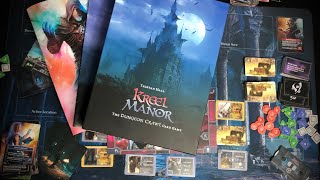



Kreel Manor: The Dungeon Crawl Card Game Deep Dive
What the Community Thinks About Kreel Manor: The Dungeon Crawl Card Game
Reviewers describe Kreel Manor: The Dungeon Crawl Card Game as a clever, quick card game for players who enjoy campaigns. Hungry Gamer places it in the same vein as Pathfinder Adventure Card Game, Aventuria and Sentinels of the Multiverse, and says it sits closest to Aventuria and Pathfinder because you play through a campaign of linked games to complete your quest. That review ends on a positive note, with the reviewer saying they really enjoyed the game and plan to finish the campaign with every character.
The same review praises the speed of play. The reviewer found the game over in about 40 minutes and expects a typical session to run closer to 45 minutes once the rules are familiar, which is longer than the box's listed 30-minute playtime. The reviewer also says setup is quick when the threat decks are sorted, and calls the game "a quick game" that is easy to replay after a bad draw.
Hungry Gamer lists the game among the titles planned for June in a monthly roundup, noting that it had sat unplayed since around December or January. That segment repeats a recommendation from Mark Danty of Not Board Gaming, and it highlights the horror theme and a horror playmat from Game Toppers. The reviewer had not yet played the game at that point, so the enthusiasm there is secondhand.
Meet Me At The Table includes the game in a list of 20 games designed for a single player. That video describes it as a solo or cooperative dungeon crawler in which each character has a personal story and the campaign runs through five missions, with missions two through four offering branching paths.
Core Mechanics That Define Kreel Manor: The Dungeon Crawl Card Game
The game is built around a dungeon crawl. Heroes move through a sequence of locations, fight threats, resolve plots and loot treasure as they advance. Each round follows a fixed order: a story phase for the character's personal story deck, a location phase, a check for ongoing effects and victory, a threat phase, and then the player turn. Hungry Gamer notes that you cannot win until every location has been cleared and that the main foe and plot cards must all be completed as well.
Dungeon Crawl Structure
Each campaign begins with a setup card that determines how many locations to add, which standard or harder locations appear, which main foe to face, and which decks to shuffle together to form the plot and threat decks. The threat deck works as a line that slides forward each round, so threats eventually flip face up and apply effects such as shields, lost items or damage. Plots are hidden inside that line, so the party keeps pushing to reach them. Between quests, players add two new cards to their decks and throw away weaker ones, which the reviewer says makes the heroes "stronger and stronger" over the course of the campaign.
Failure has lasting cost. Hungry Gamer explains that losing a campaign means starting the quest over with a wound, and that too many wounds end the whole campaign. A large book of fables links story cards and location choices to bonuses or harm depending on earlier decisions, which keeps each run's history distinct.
The Tilt Action Economy
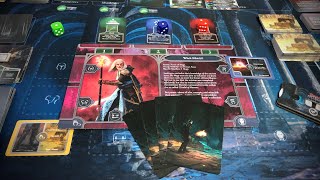
The second mechanic that reviewers highlight is the action system built on three colored cards at the top of the player board. Hungry Gamer names them fight, influence and sneak, while Meet Me At The Table describes the third as explore. Each turn you can tilt one of these cards to add a die that strengthens its ability, or turn it fully to the side to take an action such as drawing a card, using a location ability or making an attack. Taking an action rotates the row, so the used card drops to the back and the base values of the other two shift. The reviewer calls the result "really clever" because every turn forces a choice between a possibly less efficient move now and drawing a card to turn a card from three back to one.
The tilt is paired with unlimited card play. You may play as many skill cards from your hand as you want, but only one action and one tilt per turn. Some threats restrict how many skill cards you may play, which forces you to choose a different route through the same turn.
The Kreel Manor: The Dungeon Crawl Card Game Experience
Bursts of Power and Recharge
The most vivid feeling in the reviews is a rhythm of big turns followed by recovery. Hungry Gamer says the single action and single tilt limit, combined with unlimited card play, allows "awesome bursts of amazing" and then a need to recharge. After a big turn the reviewer sits back and plans how to handle the next threats, sometimes taking a hit for a turn so that a tilted action card can draw extra cards. Spirit, the health track, drops whenever a threat lands damage, and running out of spirit ends the game, so the recharge phase carries real stakes.
Horror Atmosphere and Quick Solo Sessions
Hungry Gamer describes the game as "very horror centric" in the monthly roundup. In the full review, the same channel praises the playmat for giving every card a place, and says it helped the reviewer start playing faster. Solo play is a central theme. Hungry Gamer finds the game does very well as a solo experience, noting that the rulebook itself calls it kind of a solo game and only gives multiplayer rules at the end. Meet Me At The Table likewise lists it among games that play exceptionally well solo, which makes it a natural pick for a short evening alone.
What Makes Kreel Manor: The Dungeon Crawl Card Game Stand Out
A Balance Between Plots, Locations and Threats
The reviewer's favorite element is the way the game balances hidden plot cards against threats that hurt. Plots tend to arrive every five or six cards and usually reward you or at least do no harm, so you keep looking for them while dealing with threats that do. Locations offer useful abilities, yet they must be cleared to win, so you sometimes skip a location's power to keep moving. Hungry Gamer calls this "a very clever balance" and says it is the reason the game works so well.
Personal Stories and Campaign Variety
Every character has a personal story deck, and the choices you make shape later games even when you replay the same hero. Hungry Gamer says the stories give a little reason for the character to be there and small bonuses, and that they are a fun way to open each session. Decks also diverge across the campaign as heroes trade base skills for stronger abilities. The reviewer notes that a hero can keep the starting abilities but usually keeps them because they are useful. Meet Me At The Table adds that the branching missions reward different routes through the same campaign.
Potential Drawbacks
Repetition and Slow Teardown
Many turns end up as an attack and a tilt, or a location action and a tilt, so the reviewer finds the game can feel repetitive. There were times when the foes were all defeated and the locations cleared, and the player simply kept fighting while waiting for the last plot to appear. Putting the game away is also slower than setting it up, because every threat deck must be shuffled and sorted again. Hungry Gamer says the teardown takes significantly longer than the setup.
Loose Story and Hit-or-Miss Loot
Because all threats are shuffled together and locations can be visited in many orders, the story can feel disjointed. The reviewer compares this to Too Many Bones, where quests guide you toward an end game but the sequence of beats is hard to follow as a single arc. The loot is described as "simple and easy, but it is very hit or miss." One playthrough drew nothing but hand items, which forced constant discards and left the reviewer far behind the setup shown in the rules overview.
If You Enjoy Kreel Manor: The Dungeon Crawl Card Game
Readers who like this game should look at the titles that reviewers name directly alongside it.
- Pathfinder Adventure Card Game: a campaign-driven card game of heroes moving through linked scenarios, which Hungry Gamer names as one of the closest relatives.
- Aventuria: a campaign of multiple games in the same vein, which the same reviewer says is the nearest match in structure.
- Sentinels of the Multiverse: a card-driven cooperative game that Hungry Gamer places in the same family of play.
- Too Many Bones: a quest-based dungeon game with a loose throughline, the comparison the reviewer uses when describing the disjointed story.
What Reviewers Are Saying
"It's clever because you're constantly cycling through which of those three types of actions you're really ready to go with."
— Hungry Gamer
"I like the limitations of one action and one tilt per turn, but then play as many cards as you want because that lets you have awesome bursts of amazing and then you kind of got to recharge and it is fun."
— Hungry Gamer
"The game utilizes a simple system of exhausting one of three actions, fight, explore or sneak, to complete challenges."
— Meet Me At The Table