




Light in the Dark Deep Dive
What the Community Thinks About Light in the Dark
Light in the Dark has earned mixed-to-positive reception from the solo gaming community, with reviewers consistently praising its thematic atmosphere and clever mechanics while flagging specific design issues that hold it back from being exceptional. The Dungeon Dive's Daniel describes it as "pretty good" and "a pretty neat little game," commending its setting and the variety it brings to the dungeon crawler genre. Watch It Played notes that combining plague-curing mechanics with dungeon-crawling combat is "not usually something you find in a Dungeon Crawl," a premise the channel finds immediately distinctive. Meeple University's Stella praises the "clever action management" and "dice-driven combat" as strengths. However, reviewers identify two persistent concerns: the four character classes function only as difficulty levels rather than meaningfully distinct heroes, and the iconography system for items is nearly incomprehensible without consulting the rulebook. These issues prevent what could be an excellent game from reaching its full potential, though none of the reviewers consider them deal-breakers for a small-box title at this price point.
Core Mechanics That Define Light in the Dark
Dice-Driven Combat
Combat is central to Light in the Dark's experience. Each round of combat, both the player and an enemy roll dice, with the player rolling white d6 and enemies rolling black d6. Each side totals their results and adds relevant stats (the player's attack value, the enemy's attack power), with bonuses available from equipped items. Whoever achieves the higher total wins the exchange, forcing the loser to suffer damage or stat reduction. This system creates moments of genuine tension, especially when facing the game's higher-level enemies like cultists and forest giants, where player dice rolls become critical to survival. The mechanics reward thoughtful equipment choices and tactical use of limited combat-enhancing items.
Action Point Economy and Grid Movement
During each turn, the player receives a fixed movement allowance (typically 4 nodes) and can move along connected paths on the modular terrain grid. Players can spend movement points to interact with the environment, take optional actions like healing villages with herbs, picking up items, or engaging in combat. The expansion transforms this into a more explicit action point economy, but even in the base game the structure forces meaningful decisions about how to allocate limited resources each turn. The grid-based movement through procedurally revealed terrain creates an overland dungeon-crawl feel, where the player shapes their own adventure path and must decide which villages to save, which enemies to avoid or confront, and how far to push toward each quest objective before the rounds run out.
The Light in the Dark Experience
Solo Immersion in a Plague-Stricken Land
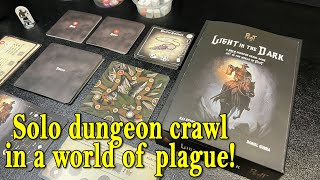
Light in the Dark establishes itself through a strong thematic premise: the player is a plague doctor tasked with healing villages while monsters and bandits stand in the way. The beaked-mask imagery, the herb-collecting mechanic tied directly to village salvation, and the escalating enemy threats create a coherent narrative arc across each session. Reviewers highlight that the plague doctor theme lends gravitas to resource management decisions. Spending an herb at a village is never merely a mechanical action; it represents hope in a diseased world. This thematic coherence extends to the modular quest structure, where each three-stage quest chain guides the player through a narrative of escalating stakes and mounting pressure.
Escalating Peril and Strategic Depth
The game delivers a clear difficulty curve. Early encounters against wolves and bandits feel manageable, but as the quest timer advances, stronger enemies spawn, villages fall to plague or monster attacks, and the player must balance defensive healing against aggressive exploration. The expansion intensifies this through a formal experience and leveling system, but even the base game's simpler enemy scaling creates a rhythm of mounting pressure. Reviewers note that this pacing generates "a pretty good sense of adventure," where careful planning and resource allocation feel like they matter. The game rewards players who can balance short-term survival (engaging in combat only when necessary) with long-term objectives (exploring enough terrain to complete quests).
What Makes Light in the Dark Stand Out
Modular, Replayable Quest Architecture
Rather than following a fixed campaign, Light in the Dark uses a clever mix-and-match quest system. Players draw one starter quest card, one middle quest card, and one ending quest card, shuffling them together to form a unique three-stage adventure each session. This approach yields substantial variety without requiring extensive content. A starter quest might task players with killing four enemies; a middle quest might demand exploration of new terrain; a finale might require healing multiple villages. The Dungeon Dive notes this creates "a pretty interesting" structure, and players report genuine replayability across sessions. This mechanic also ensures that every game maintains momentum and clear objectives without feeling scripted.
Thematic Coherence in a Small Box
The game's production quality consistently impresses relative to its price point. The terrain cards are well-illustrated and create visually compelling maps; the linen-finish cards feel durable; and every component serves a purpose. More importantly, every mechanic reinforces the theme: herbs heal villages, enemy tokens represent growing threats, experience points represent the doctor's growing competence. Watch It Played emphasizes that the marriage of theme and mechanisms is genuinely well-executed. The plague doctor setting remains uncommon in modern board games, giving Light in the Dark a distinctive identity within the crowded solo dungeon crawler space. Small box games rarely achieve this level of thematic integration, making Light in the Dark's accomplishment noteworthy.
Potential Drawbacks
Character Classes That Function Only as Difficulty Modifiers
The game ships with four character options: Rider, Fighter, Supplier, and Explorer. However, their only meaningful differences are starting stat values and a bonus against a specific enemy type. The Dungeon Dive's Daniel points out a thematic disconnect: "the fighter character starts with a lower attack value than the explorer starts with, or things like that." The Explorer also has a lower movement value than other characters, which contradicts the class's name. These are essentially difficulty presets (Rider is easiest, Explorer is hardest), not distinct playstyles. Reviewers express hope that future expansions would introduce class-specific abilities or special powers to differentiate the characters beyond their starting numbers. This absence makes character selection feel hollow despite the apparent variety.
Iconography System That Obscures Rather Than Clarifies
The base game's item cards rely on abstract iconography to convey their effects. Daniel provides a striking example: one item shows "a three with an arrow up, a reroll symbol, and a four with an arrow down." Without opening the rulebook, this is indecipherable. The actual effect: count the value of the higher die rolled twice and ignore the smaller die. None of the iconographic symbols reliably convey this meaning. Reviewers must constantly reference the rules to identify item effects, disrupting the flow of play. While the expansion addresses this by providing full text explanations on new items, those redesigned cards cannot be integrated with the base game's old items without juggling the rulebook. This represents a genuine usability failure that undermines the otherwise smooth play experience, especially frustrating given that fixing it required only adding printed text rather than reinventing the mechanic.
If You Enjoy Light in the Dark
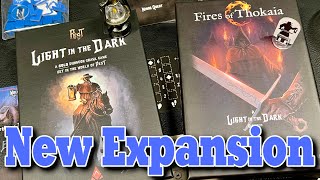
Light in the Dark occupies a unique space: it is a small-box solo dungeon crawler with a thematic emphasis on healing rather than pure combat triumph. Players drawn to similar experiences should consider The Fires of Thaya, the game's own expansion, which significantly deepens and refines the base mechanics. The Dungeon Dive notes that most players, once they experience the expansion, prefer it to the base game and seldom return to the original rules.
Beyond the expansion, fans of solo exploration and resource management in a constrained time frame may enjoy other lean, high-replay-value dungeon crawlers, though Light in the Dark's specific blend of plague-doctor theming, quest-driven narrative, and modular replayability makes direct comparisons difficult. The game appeals most strongly to players who value thematic immersion and solo contemplation over complex systems, and who appreciate small boxes that deliver substantial gameplay without dominating shelf space.
What Reviewers Are Saying
"Overall I think this game is pretty fun, it's it's pretty light but there are also some some good moments and it can be challenging and I think it does create a pretty good sense of adventure."
— The Dungeon Dive
"Light in the Dark is a solo dungeon crawler game with a clever action management, dice-driven combat, and quest-based gameplay where you're a plague doctor collecting herbs to heal villagers and fighting monsters before time runs out."
— Meeple University
"I was immediately attracted by the theme of this game. I think you know, plague doctors are always cool for some reason, I think it's their garb, they they just look dark and mysterious, right, and the fact that it is a small box solo dungeon crawl, these are all things that I really do like."
— The Dungeon Dive