





Malediction Deep Dive
What the Community Thinks About Malediction
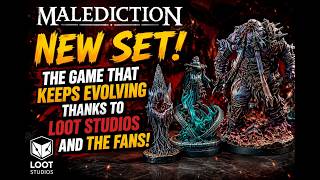
Malediction represents something rare in the tabletop gaming space: a fresh take on two beloved genres that immediately resonates with experienced players. The game has captured attention not just for its mechanical innovation, but for the philosophy behind it. Reviewers consistently praise Loot Studios for understanding what players actually want. Rather than chasing the maximalist approach of larger miniature publishers, Malediction opts for focus, clarity, and accessibility. The sentiment across the gaming community is one of genuine enthusiasm. Experienced players see echoes of Magic the Gathering in the card-driven design and echoes of Warhammer in the tactical movement, yet the blend feels distinctly its own. Those familiar with competitive card games find themselves drawn back to the skirmish element, while miniature gamers discover that the card mechanics add strategic depth without overwhelming complexity. Most importantly, reviewers express that Malediction feels like a complete vision executed with confidence, rather than a system still seeking its identity.
Core Mechanics That Define Malediction
Card-Driven Summoning and Casting
Unlike traditional miniature games where players deploy their entire force before the match begins, Malediction puts decisions in your hands as the game unfolds. Each turn, you spend Echo, the game's resource, to summon units from your deck or cast spells. This mirrors Magic the Gathering's core appeal: you're constantly adapting to the present state of the board rather than committing to a predetermined composition. Your creatures arrive as physical models or standees on the battlefield, making the metaphorical literal. You manage instants and quick spells for reactive play, channeling spells for more powerful effects, and unique unit abilities that create synergies within your custom deck. The system creates meaningful choices at every turn: should you summon a powerful unit now, cast a spell to protect yourself, or hold resources for a better moment? This dynamic decision space keeps both players engaged even when it's your opponent's turn.
Relics as Dynamic Objectives
Malediction's objective system transforms the typical hold-the-point mechanic into something far more dynamic. Husks appear on the map as neutral objectives. When a player's unit moves adjacent to a husk, they can reach in and pull forth a relic of immense power. That unit then becomes bound to the relic, gaining bonuses and granting victory points to its controller. But if that unit falls in combat, the relic drops on the board, becoming a new objective for either player to grab. This creates a perpetual motion of tactical repositioning. The objectives are never truly secured; they dance across the battlefield, following units, creating desperate scrambles when a powerful unit falls. Reviewers note this makes the game less about annihilating the opponent and more about managing a constantly shifting strategic puzzle. The relic system rewards clever positioning and forces tough decisions about whether to push forward or consolidate gains.
The Malediction Experience
Fast-Paced yet Tactical
Malediction plays to completion in under an hour. This is remarkable for a game with as much mechanical depth as Warhammer or Infinity. Reviewers consistently highlight that the game moves quickly without sacrificing meaningful choices. Alternating activations, borrowed from skirmish games like Kill Team, mean you're never sitting idle watching your opponent think through their turn. Instead, you're responding to their moves, planning your counter-play, and staying engaged throughout. Combat is equally swift: you roll a single die, add your attack value, and compare against the opponent's defense. There are no missed shots that kill momentum; even low rolls deal reduced damage. The pace creates an almost party-game energy despite the tactical depth underneath. Games that might take two hours in other miniature systems wrap up comfortably in an hour, making Malediction accessible to players who can't dedicate an entire evening to gaming.
Accessible Despite Apparent Complexity
The rules contain keywords and special abilities, yet reviewers note that the core system is learnable in roughly twenty minutes. This is substantially faster than introducing someone to a dense traditional wargame. The card-based nature means all the important information is printed where players need it; there's no need to memorize stat lines or cross-reference rare special cases. Rules are keyword-driven, making interactions clear and generally intuitive. Even players experiencing their first skirmish game report grasping the fundamentals quickly enough to focus on actual strategy within their first few turns. The game provides both basic decks for first matches and expansion cards for deeper deckbuilding later. This creates a gentle onramp: play with the starter decks, understand the flow, then customize. Reviewers specifically call out that this approach respects both experienced gamers and newcomers, something rarely achieved in the miniature gaming space.
What Makes Malediction Stand Out
Multiple Valid Entry Points
Malediction refuses to dictate how you must experience the game. Every faction box includes digital STL files for 3D printing. For players with access to a printer, the game's cost drops dramatically, since the models are included in the purchase price. Players without a printer can purchase standees that are fully functional and beautifully illustrated. For those who want painted miniatures, Loot Studios has created models that reviewers compare favorably to the output of larger miniature publishers. Crucially, competitive play doesn't discriminate between these approaches. Whether a player shows up with museum-quality painted miniatures, crisp standees, or 3D-printed models, everyone is on equal footing. This design choice removes a barrier that keeps people out of miniature gaming. Many potential players feel intimidated by the expectation to spend months painting before they can play. Malediction says: arrive however you want, the game is what matters. This philosophy is refreshing in a hobby often dominated by showcase aesthetics.
Quality Execution from a Studio Known for Sculpture
Loot Studios built its reputation as a miniature sculpture studio. Their 3D artists are experienced, and this expertise saturates Malediction. The artwork on cards evokes old-school Magic the Gathering from the 1990s and early 2000s, a visual language many experienced players find comforting and nostalgic. The four factions feel visually distinct: blue mages with their control spells, black with graveyard themes, red with aggressive units, white with armored knights and shields. Each faction has a coherent aesthetic that tells a story. The physical production quality is strong; the cards feel premium, the tokens are sturdy, and the presentation suggests a game made by people who care about every detail. Reviewers specifically note that this isn't a quick entry into board games by a miniature company; it's a deeply considered game from a studio that understands both sculpture and mechanics.
Potential Drawbacks
Rules Still in Development
Malediction exists in an interesting space: Loot Studios is actively refining the rules even as players receive their copies. Reviewers who played prototypes noted occasional ambiguities about timing and specific interactions. These aren't deal-breakers, but they suggest the game is still crystallizing. Players came back with questions about edge cases, and some clarifications are still being worked out. For players who dislike any uncertainty about rulings, this can be frustrating. The game provides detailed rulebooks and tutorial videos to minimize confusion, but the fact that clarifications continue to arrive suggests this isn't a finished product in the traditional sense. Players committed to competitive play may need to revisit the rules periodically as the game matures. However, for casual players and those focused on fun rather than rigorous tournament precision, this feels like a non-issue. The core mechanics are sound; it is the small details still being refined.
The Deckbuilding Rabbit Hole
Once players move beyond the starter decks, Malediction offers deckbuilding options. Reviewers were excited by this prospect but also somewhat concerned. With a growing card pool, the potential exists for certain cards or combinations to become dramatically more powerful than others. One reviewer noted seeing potential broken synergies already in their limited preview copies. Whether Loot Studios successfully navigates the ongoing balance act of competitive deckbuilding remains to be seen. This is a particular consideration for players who want the game to remain fun and accessible rather than requiring constant vigilance about the meta-game. That said, Loot Studios listens to community feedback in ways larger companies often do not, suggesting a quick response if particular cards or strategies prove problematic. For now, this is more a concern about the future than a problem with the current experience.
If You Enjoy Malediction
Mage Wars Arena shares Malediction's summoning-based approach and comparable playtime. Players who love Magic the Gathering but find competitive formats exhausting may find Malediction's self-contained skirmish format refreshing. Those who tried Warhammer but found it bloated by rules will find Malediction's streamlined approach appealing. Fans of Kill Team's alternating activations and tactical grid-based combat will recognize familiar DNA here, wrapped around a card game's flexibility. Players who enjoy Infinity but struggle with its metal miniatures and dense rulebook may find Malediction offers the same skirmish appeal with lower barriers to entry. For board gamers curious about miniature gaming but intimidated by startup costs and painting expectations, Malediction removes much of that friction, serving as a bridge between board gaming and the miniature painting hobby.
What Reviewers Are Saying
"This is a tremendous game that is very much card-based, and it is a game that has a magic feel to it, yet it is a very, very beautiful miniature game, or can be done with standees, no matter how you want to do it. It is a tabletop masterpiece."
— Rob's Tabletop World
"It is, it really is. It may as well have a space on the box, it's literally a m-game. It just got everything that I love in those games."
— Board Stupid
"It's just so much fun to share with a friend. This is easily the coolest team skirmish game out there and it's easy to get to the table, that even board gamers who never touch mini games at all should probably try it. It even has standees, so you don't need miniatures at all."
— Tabletop Turtle