










Marabunta Deep Dive
What the Community Thinks About Marabunta
Reviewers broadly agree that Marabunta is clever, well made, and unusually confrontational for a roll and write. They split mainly on whether its tightness is a feature or a frustration. Chairman of the Board calls it one of the best games of its year, praising how the split-and-choose dice system blends with area control. The Dice Tower's reviewers judge it a very well designed game, but one that feels punishing to them personally, even though they both see why it will appeal to a wide audience. All You Can Board came away enthusiastic after a single session and said it wanted to dig deeper, though it also wondered whether a game that always ends close would eventually wear thin. Watch It Played covered it as a news announcement and singled out the split-and-choose mechanism as a criminally underrated decision point worth getting excited about.
Core Mechanics That Define Marabunta
Split and Choose
Each turn the active player rolls six dice and divides them into two groups, along with the event tile for the round. The opponent picks one group to use first, and the splitter takes whatever remains. Reviewers describe the split as the heart of the game. The Dice Tower's reviewers say they feel more stressed as the splitter than the chooser, because the splitter must weigh every possible pick. All You Can Board found the decisions agonizing in the best way, since each split forces you to guess what your opponent will want and then hope the tile and dice combination still works for you.
Tile Placement and Building Out
Dice values go onto a shared board, and each placement either scores, fills a feature, or opens a new option. Players start new areas from a limited supply of anthills, and later dice must connect to what has already been built. Reviewers describe the result as more spatial than a typical roll and write. The Dice Tower notes that you are not only splitting dice but also choosing the event tile, which adds another layer to what you accept. Because of this, a split can be good on paper while still leaving you with an awkward placement.
The Marabunta Experience
Interactive and Dynamic
Reviewers say the game feels like a direct head-to-head contest from the first round. You are writing on a shared board, and your choices both build your position and block your opponent. The Dice Tower describes cutting off paths, dropping blockers, and stealing a majority with a surprise move. All You Can Board liked how much each turn reacts to the other player, so there is almost never a quiet, purely solitary moment. The reviewers agree this is what separates it from more solitary roll and write games.
Nail-Biter
Many reviewers describe games that come down to a point or two. Chairman of the Board recalls a session in which the game was decided by a narrow margin across four regions. The Dice Tower also found that the scoring is tight, so every point matters and the result often hinges on the last few turns. The same tension can be uncomfortable, because the losing player may sense the outcome early. Still, reviewers agree the closeness is part of the appeal for players who like to feel every decision.
What Makes Marabunta Stand Out
A Shared Board for a Roll and Write
The Dice Tower's reviewers highlight that both players write on the same board, which they say very few roll and write games do. This shared space turns the familiar roll and write format into a head-to-head contest. Reviewers see it as a rare hybrid, combining the spatial feel of a route-building game with the numerical tension of a majority-control game. Several reviewers also note that this design makes it a useful pick for players who usually avoid roll and writes but enjoy direct competition.
A Compact Package With Real Presence
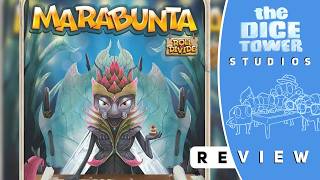
The Dice Tower highlights the dry erase markers and a fitted insert, and notes that the two board sides add variability. Reviewers feel this makes Marabunta easy to bring to the table without a large investment. They also consider the artwork a strong draw, with Getting Games calling it a neat looking game.
Potential Drawbacks
Unforgiving Tightness
The most common criticism is that the game can feel unforgiving. The Dice Tower's reviewers say the split decisions often feel like making a mistake, whether you are the one splitting or the one choosing. They also note that when a game turns lopsided, it is usually obvious to both players well before the end, which can make the losing side feel stuck. Reviewers who enjoy this kind of pressure see it as the point, but players who want more room to recover may find it draining.
Close Games Can Wear Thin
All You Can Board raised a concern about volatility. Its reviewer said that if every game ended in a tight finish, the experience would start to feel repetitive rather than exciting. They wanted to see whether the outcomes vary enough across many plays to keep decisions feeling meaningful. Chairman of the Board, by contrast, found the closeness part of the charm, so this drawback depends heavily on personal taste.
If You Enjoy Marabunta
Reviewers who like Marabunta's direct interaction often point to Make a Bus Route, which The Dice Tower's reviewers name as a roll and write they enjoy for its interactive element and the way it cuts off paths. Through the Desert is another natural pick, since the same reviewers see some of its route building and blocking in Marabunta. For players who like the commitment tension of two-player tug of war, Lost Cities is a good match, as Chairman of the Board describes it as a tug of war with a shared deck where you hold onto cards your opponent wants.
What Reviewers Are Saying
It is tight and and it can feel unforgiving. It could be unforgiving and you can have a pretty good idea that you're out of the game with a fair amount of the game left to go.
— The Dice Tower
I I hesitate to say love yet because I have to play it more but tons of fun
— All You Can Board
I love that type of decision the I split you choose mechanism it's criminally underrated so this game has me excited
— Watch It Played