



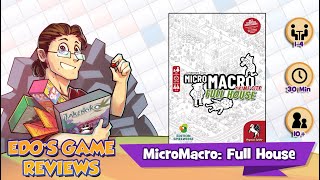


MicroMacro: Crime City – Full House Deep Dive
What the Community Thinks About MicroMacro: Crime City – Full House
MicroMacro: Crime City – Full House has captured the enthusiasm of board game reviewers as a worthy successor to its acclaimed original. The game continues the legacy of its predecessor, which won the prestigious Spiel des Jahrs award, while offering a completely fresh map and new cases to investigate. Reviewers consistently praise it as an engaging, innovative experience that brings something genuinely different to the table. The game appeals to both devoted fans of the original and new players looking for something unique, though it works best for groups that value experience and narrative over traditional competitive mechanics.
Core Mechanics That Define MicroMacro: Crime City – Full House
Visual Deduction and Search
At its heart, MicroMacro is a game of careful observation. Players examine a massive, intricately detailed black-and-white map covering 75 by 110 centimeters. The map contains hundreds of small figures, objects, and details packed into every corner. Each case begins with a card that directs players to find a specific person, object, or crime on this sprawling cityscape. Reviewers noted that the black-and-white aesthetic actually increases difficulty compared to a colored version, forcing players to rely on shape, position, and context rather than color contrast. The map is hyper-detailed and small-scale, creating a genuine challenge of visual scanning and recognition.
Timeline Tracing
What separates MicroMacro from a simple Where's Waldo experience is its sophisticated use of time. Characters and objects appear multiple times across the map at different moments in a timeline. As players solve cases, they follow the paths of suspects, victims, and witnesses through a sequence of events. A character might appear running a red light in one location, then players trace that character backward through the city to discover a robbery, which leads to questions about what was stolen and where the character is heading next. This temporal dimension creates a detective story that unfolds organically as players move their eyes across the map, discovering new information at each stage. It is essentially a game about reading a living, dynamic city at different moments in time.
The MicroMacro: Crime City – Full House Experience
Building Stories Through Deduction
Reviewers consistently described MicroMacro as an experience-driven game rather than a mechanics-driven one. The appeal lies in the collaborative storytelling that emerges from solving cases. One reviewer noted that the game allows players to build stories even when playing without the provided prompts, giving players the freedom to interpret what they see on the map and construct their own narratives about the events unfolding. Each case is deliberately unique, with elaborate and varied crimes that prevent any two investigations from feeling the same. Whether players are following a victim, a perpetrator, or an accidental witness, the sense of discovery remains fresh. The flexibility of play, using the card prompts for structured guidance or ignoring them to create custom stories, means groups can adjust the experience to their preferences and comfort levels.
A Massive Table Presence
The gigantic map is perhaps the game's most striking physical feature. Reviewers emphasized how the sheer size creates an irresistible invitation to play. Even people who walked by a game in progress found themselves drawn in, wanting to help solve the mysteries unfolding on the enormous map. The map must be positioned so all players can see the entire cityscape, which creates a natural gathering point around the table. This visual dominance makes MicroMacro a conversation starter and a natural draw for newcomers to board gaming, who often find the collaborative, non-competitive nature and immediate accessibility immediately appealing. The game essentially becomes a shared activity centered on a captivating visual artifact.
What Makes MicroMacro: Crime City – Full House Stand Out
Progressive Difficulty and Accessibility
MicroMacro is designed to welcome players of varying skill levels and ages. The game includes 16 cases with a clear progression in difficulty. Easier cases feature characters or objects positioned openly and obviously on the map, while harder cases require finding people partially hidden behind buildings or tucked into corners, requiring more careful scrutiny. This scaling allows a group to warm up with simpler cases before tackling more challenging investigations. Additionally, each case includes symbols that indicate content appropriateness for younger players. While the game carries a 12+ rating due to depictions of crime scenes and mature themes, it has proven engaging for adults as well.
A Dynamic Living City
The map itself functions as a character in the game. Reviewers repeatedly described it as depicting a dynamic living city where players witness multiple stages of characters' lives and timelines simultaneously. Rather than seeing events unfold in sequence, players see the past, present, and multiple moments in between all visible on a single static image, creating an almost time-traveling sensation. This innovation, seeing different snapshots of the same characters at different moments and weaving them together into a coherent narrative, is fundamentally different from traditional board game experiences. One reviewer described it as a souped-up Where's Waldo, capturing how the game takes the simple premise of a visual search and adds layers of narrative, temporal complexity, and collaborative storytelling that create something fresh.
Potential Drawbacks
Physical and Social Dynamics
The map's enormous size, while a strength, creates practical challenges. Players must sometimes lean far across the table or bend over for extended periods to examine distant areas of the map, which can lead to neck and back strain during longer play sessions. Additionally, communication is necessary when one player spots something another cannot see; some groups solve this by having players call out coordinates or descriptions, while others rotate who sits where. More significantly, reviewers noted that one player can dominate the game experience if they are the first to identify the starting point of a timeline. Because following a character through the city creates a natural progression where each discovery leads to the next step, the person who finds that initial thread tends to drive the entire investigation. Other players can feel relegated to supporting roles rather than experiencing the full discovery themselves, which may not appeal to groups where participation equity is important.
Experience Over Mechanics
MicroMacro is fundamentally a game about experience rather than strategic decision-making or mechanical depth. There are no complex rules, no resource management, and no competitive scoring. For players seeking games with intricate mechanics, challenging systems to master, or tactical gameplay, MicroMacro will not deliver. The game is cooperative, and while players can technically race to solve crimes first, this feels secondary to the collaborative act of investigation itself. This makes it a poor fit for groups that prioritize puzzle-solving challenge or mechanical complexity over narrative and discovery. However, this same quality, its focus on experience and story over mechanical complexity, makes it ideal for groups seeking an accessible, inclusive, and story-focused activity.
If You Enjoy MicroMacro: Crime City – Full House
If Full House resonates with you, consider exploring games that emphasize visual deduction, narrative-driven gameplay, or cooperative storytelling. The original MicroMacro: Crime City shares the same core experience and may still provide cases you have not yet solved. Sleeping Gods offers a similar story-driven, exploration-focused cooperative experience, though with more traditional board game mechanics. Games that prioritize table presence and visual engagement, or that focus on accessibility and collaborative problem-solving without heavy rulebooks, tend to appeal to the same audience.
What Reviewers Are Saying
"such a dynamic living city because there's various stages that these characters are in and it's almost like you're time traveling in the same map multiple different times with multiple different people which is really cool"
— Copyright Couple
"you basically get a large map and you can almost think of this as you know a souped-up where's waldo you'll have different um you know crimes you have to solve or different stories you have to solve different cases and you basically have to use the map to follow different threads around and solve this case"
— All You Can Board
"it works it's fun I absolutely adore the first game and it's just more of it so nothing new no twists just more amazing art uh really simple but really amazing and highly recommended"
— Gaming with Edo & Jessica