
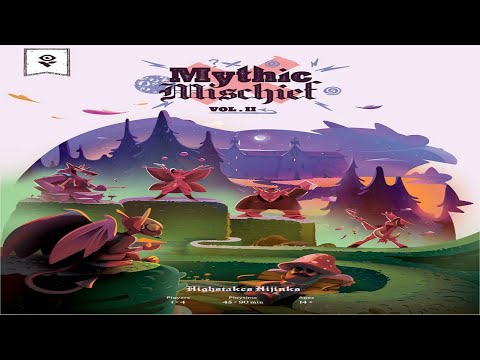


Mythic Mischief Vol. II Deep Dive
What the Community Thinks About Mythic Mischief Vol. II
Reviewers agree that Mythic Mischief Vol. II is a compact, clever abstract game from IV Studio that rewards careful positional thinking. It is a standalone release that reuses the core rules of the original Mythic Mischief, swaps the library setting for a hedge maze, and adds a new roster of factions. The praise centers on the gameplay, while the criticism centers on how well the game scales to larger tables and on the physical product.
Board Games UnLocked treats the release as a faction expansion in a new box. The reviewer says that anyone who did not enjoy the original gameplay will not change their mind here, but fans of the first volume get a useful set of new factions. Board Games UnLocked gives it a nine out of ten and says the gameplay is "the exact same game with great factions."
Tim Chuon calls the game a very thinky, puzzle-driven experience. The reviewer loves its constant pressure and says the game plays best with two. Brains On Games calls it a rules-light strategy game with much heavier strategy underneath, and says the setup, abilities, and spatial problems make it a strong pick for families who enjoy chess-style games.
Core Mechanics That Define Mythic Mischief Vol. II
Action Points Drawn from Dice
Each player has a faction board with action dice, and the dice are not rolled. As Brains On Games explains, the numbers on the dice simply show how many actions a player can take in each category on a turn. Players spend those actions to move their own figures, move opposing figures, shift hedges, or distract the groundskeeper, and they can split their movement among pieces however they like. Tomes add a second layer of resource management. Placing a tome on a board raises the minimum value the dice can drop to at the start of the next turn, and the reviewer describes this as the way players "collect and improve" their boards over time. Board Games UnLocked also highlights the boosting step, noting that a player can add to an action die to reach a higher burrow or distraction value when it matters most.
Asymmetric Factions with Distinct Action Menus
Every faction plays by a different set of abilities while sharing the same underlying goal. The Gnomes can burrow two spaces orthogonally, which lets them move under the groundskeeper, under hedges, and under other figures. The Gargoyles can glide and perch to move an adjacent enemy or hedge alongside them. The Fairies can wander and use Antics to reposition hedges, and their Fairy Ring lets them control another player's figure over several turns. The Werewolves can fling figures and hedges across the board, heave whole hedges, and use Shredder to tear down clutter. Brains On Games notes that players do not have to learn an entirely new play style for each faction, because the abilities work differently while the core loop stays the same. The Gargoyles draw the most criticism. Tim Chuon says the table found them underwhelming and suggests a stronger legendary ability, such as turning other figures to stone, while Board Games UnLocked ranks them last but still praises their mobility.
The Mythic Mischief Vol. II Experience
A Constant Tug of War
The most consistent description of the feel is tension. Tim Chuon calls the game reactionary, because each side must wait to see how the other team reshapes the hedges before it can plan a meaningful turn. Pieces get caught, hedges move, and the groundskeeper's path can shift in a single round. That back-and-forth keeps both players engaged, and the reviewer names it as their favorite part of the design. Brains On Games describes the same experience as a visual spatial puzzle that changes every turn, with no luck and no hidden information beyond the first before-dark setup.
A Spatial Puzzle That Invites Another Game
Reviewers consistently say the game is easy to start and hard to put down. Setup is randomized through before-dark and after-dark cards, which change where the groundskeeper heads and when the after-dark abilities unlock, so no two games look the same. Brains On Games says the game "sucks you in" right after the first play. Tim Chuon calls it a "let's run that back" game with high replayability, and says it is quick to table and teach.
What Makes Mythic Mischief Vol. II Stand Out
Asymmetric Factions That Stay Readable
The factions are the headline feature. Each one changes how a turn feels, but the rules remain compact enough to teach quickly. Brains On Games praises the balance between simple rules and deep choices, and Board Games UnLocked says all of the new factions sit on par with those from the first volume. The reviewer's personal favorite is the Gnomes, whose two sets of movement and the Uproot after-dark ability let them move destination tokens and redirect the groundskeeper. Because the factions are interchangeable with the original release, the roster can be mixed for different matches.
Strongest with Two Players
Tim Chuon argues that the game plays much better at two than at larger counts. With fewer tomes, boost spaces, and miniatures on the map, the table with more players has fewer resources and a slower pace in how abilities evolve. The reviewer also notes that an accidental one-versus-one-versus-one game still worked well, and suggests that a true free-for-all mode could make the game even more fun. For players who want a head-to-head abstract, this makes the release a clear recommendation.
Potential Drawbacks
Downtime and Analysis Paralysis at Full Tables
The most common concern is waiting time. Tim Chuon warns that the game invites analysis paralysis when played in teams, because each team member has several actions, a legendary ability, and a partner to consult. Since the game is reactive, players cannot pre-plan much before the other team moves, which makes long turns feel even longer. The reviewer recommends a house rule of one minute per turn for larger groups.
Re-Theme, Packaging, and Painted Miniatures
Board Games UnLocked raises concerns about the standalone release. The hedge maze theme is less thematic than the library of the original, and the standalone box does not fit into the base game without inserts or a 3D-printed solution. The reviewer also found the prepainted miniatures disappointing because they do not match the character art on the faction boards. Not all reviewers agree on the components. Brains On Games calls the production gorgeous, with textured plastic hedges and charming character figures, so buyers who value visual appeal may weigh these issues differently.
If You Enjoy Mythic Mischief Vol. II
Reviewers draw clear comparisons to several games in the abstract and skirmish genres.
- Chess and Checkers: Tim Chuon recommends the game to anyone looking for a two-player abstract with a chess and checkers feel, and Board Games UnLocked describes its positional play as chess-like.
- Onitama: Board Games UnLocked names Onitama as a skirmish game with enough variety to keep it fresh, and this release offers similar tactical variety through its factions.
- Smash Up: The same reviewer compares the fun of the Gnomes to the appeal of Smash Up, praising both for their playful and unpredictable energy.
What Reviewers Are Saying
"My favorite thing about this game is this constant tug of war that you're playing."
— Tim Chuon
"This is a great, beautiful game. It sucks you in immediately after you play one. You're probably going to want to play again."
— Brains On Games
"The abilities feel very thematic in what you're doing."
— Board Games UnLocked