



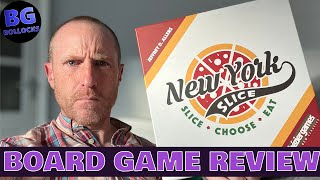









New York Slice Deep Dive
What the Community Thinks About New York Slice
Reviewers agree that New York Slice is one of the most approachable games in the split-and-choose family. John Perkis of Actualol recommends it when friends ask for a light night of games, and Perkis has called it one of their favorite titles to introduce to new players because the pizza theme is immediately appealing. Meeple University treats the design as a reimplementation of Piece of Cake and credits the pizza setting with making an abstract split-and-draft idea easy to sell on a shop shelf.
The praise is consistent, but opinions on length are not. Actualol's top-50 countdown credits the game with packing a lot of decision-making into a short session, while BoardGameBollocks judges it too brief and says a few more rounds would have helped. The Dice Tower's top ten list of four-player games includes it because the splitting feels most interesting when four people compete for the portions. Across channels, the physical presentation is treated as a reason the game earns attention before anyone sits down to play.
Core Mechanics That Define New York Slice
Set Collection
Set collection drives the scoring. Each pizza topping type carries a point value, and the player holding the majority of slices with that topping at game end claims those points, while a tie scores nothing for either contender. BoardGameBollocks describes how the nine-point topping pulls players into a race for control, and reviewers return repeatedly to the tension between eating a slice for its immediate points and keeping it to contest a majority. That eating option is one reason the game supports several strategies. In the BoardGameBollocks session, a player who simply ate pepperoni came second, which the reviewer took as proof that multiple routes to victory exist in such a simple design. Anchovy slices subtract from pepperoni scoring, and combo slices that carry two toppings count as half a point in majority tallies, adding a layer of bookkeeping to every majority plan.
Drafting (Split and Choose)
The defining drafting action is the split. On each turn, one player divides a pizza into as many portions as there are players, the others choose in turn order, and the divider takes whatever remains last. Because the divider picks last, reviewers describe the split as a guessing game about what rivals want. Actualol's John Perkis explains that the divider is "really trying to create interesting decisions for other players and pit people against each other," while the Dice Tower's four-player discussion highlights clever moves such as placing one slice on its own to tempt the player who really wants it. Each special tile is attached to a slice, so the divider also decides which portion carries it, and every choice ripples into the scoring that follows.
The New York Slice Experience
Breezy Pacing
New York Slice feels quick and light from the first round. BoardGameBollocks timed a five-player game at roughly 15 minutes, which left the reviewer wishing for two or three more rounds and feeling the pile of slices disappeared before there was time to anchor a majority. The reviewer summed up the eating of a pizza as a moment that is over almost as soon as it begins. Actualol's John Perkis describes the same brevity more warmly, saying the game packs a lot into a small amount of time, which is why Perkis keeps returning to it. The mood at the table is decisive and brisk, with each turn resolving into a single portion that can be eaten or kept.
Gateway Accessibility
The pizza theme does much of the welcoming work. John Perkis has used New York Slice to introduce newcomers because the theme and the split-and-choose structure are immediately appealing, and the same host has given it as a gift. The Dice Tower's hosts also point to the real-life social pull of a pizza on the table, where the arrival of a second guest makes everyone a little antsy about getting a slice. That social edge gives the game a playful tension before any scoring happens, and it keeps newcomers watching what others take.
What Makes New York Slice Stand Out
Presentation That Sells the Theme
BoardGameBollocks calls the production "one of the best produced games we've seen forever," pointing to a box shaped like a pizza box, slices shaped like real slices, photo-realistic toppings, and rules printed in a menu format. Meeple University notes the same shop-counter charm, comparing the rulebook presentation to a pizza shop menu. John Perkis of Actualol adds that the components "really bring it alive," which reflects a broader view that the physical package does much of the selling. For a game built on a single theme, reviewers see the presentation as the reason the theme lands.
Special Tiles That Change the Calculus
Specials add the second layer of decision-making. BoardGameBollocks praises them for adding a nice lump of flavor to the proceedings, because they give a reason to take a portion that would otherwise be unappealing. The reviewer cites Lick a Slice, which pays a point for each collected slice of the matching type, and Day-Old Pizza, which costs two points at game end and can be attached to a portion to push a rival toward it. Super-Sized Combos double the value of combo slices, which can decide a close majority. These tiles make the split feel like a negotiation with the scoring sheet rather than a simple division.
Potential Drawbacks
A Short Session
BoardGameBollocks is the most direct critic on length. The reviewer says the game ends too quickly, leaving little room to anchor majorities, and that a player content to eat pepperoni can still finish well. That flexibility is a strength in one sense, but the reviewer felt it also means the game lacks depth in the late rounds. Players who want a longer contest of majorities may find the session too thin, while players looking for a light, fast game will see the brevity as the point.
Scoring Overhead and Unclear Type Names
BoardGameBollocks also dislikes the score pad. The final tally, which moves through majorities, specials, and pepperoni and anchovy counts for each player, can take nearly as long as the game itself with six players. The same reviewer points out that the rules refer to pizza types without stating clearly which topping each type is, so players must work out the mapping from the numbers printed on the slices. The Dice Tower's discussion also notes that at six players each person receives only one or two portions at a time, which thins out the splitting decisions that make the game work.
If You Enjoy New York Slice
Players who enjoy New York Slice's split-and-choose drafting will find a close relative in Piece of Cake, the older design Meeple University describes as the same split-and-draft structure with cake instead of pizza. Players who like the way the divider must anticipate what others want should also look at Las Vegas, which John Perkis calls one of their top choices for light games with three to five players because everyone stays involved. Sushi Go and Sushi Go Party cover related ground. Actualol recommends Sushi Go among the lightest games for introducing people, and describes Sushi Go Party as a little more fiddly, so players who enjoy New York Slice's quick turns and drafting tension should find similar satisfaction in choosing from the cards others pass along.
What Reviewers Are Saying
"It's such a great package for a gateway game and this is one that I've given as a gift because I think it just does a great job of enticing people in. But man, I've played thousands of games and this is one that I like to come back to because it just packs a lot into a small amount of time."
— John Perkis, Actualol
"The first thing that we don't like about this game is that it's over too quickly. There's just not enough pizza slices in the game."
— BoardGameBollocks
"How many people have to be standing around that pizza before you start getting antsy? Before you start getting uncomfortable for me, the second person shows up, I start getting antsy."
— The Dice Tower