/pic5497749.jpg)
"I am very anxious to see the Galapagos Islands, -- I think both the Geology & Zoology cannot fail to be very interesting." -- Charles Darwin, Letter to his sister, Catherine in August 1835.
Assist Charles Darwin during the Beagle journey across the Galapagos Islands, discovering new species and researching them in order to improve your knowledge.
During their turn, the active player must choose between two actions:
Research: Put 2 research pieces on 2 different species tiles on the board, gaining the knowledge of air, land or water habitat.
Discover: use the acquired habitat knowledge to place new species tiles on the board, obtaining victory points and evolution, characters and objects cards. Additionally advance the Beagle on its track.
The game finishes when the Beagle reaches the last space of its trip, leaving the archipelago through New Zealand. The players score the evolution points according to the final goal card, adding them to the points obtained during the game. The player with more points in the scoring track wins.
—description from the publisher
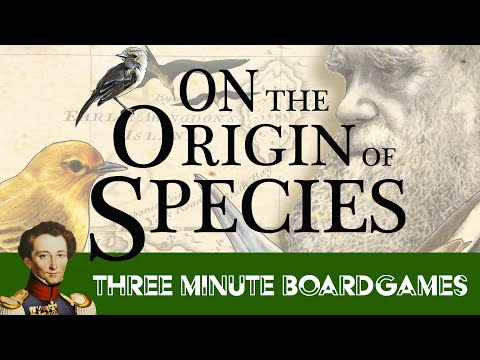

On the Origin of Species: SOLO

- Deceptively deep gameplay
- Compelling gameplay hook from evolving board state
- Well-executed theme appealing to adults and children
- Wonderfully visual and thematic beagle movement
- Not getting a map limits options and can be unfun
- Wish the game shipped with more information on the voyage and species
- Darwin's observations of species evolution
- 1831 voyage of the Beagle
- Players are part of the crew of the Beagle
- Oceans
- Darwin's Choice
Mechanics (from transcript analysis)
- action selection — on each of your turns you will take one of two actions: discover a species or place research cubes.
- Resource Management — Each player starts with eight of these cubes and can place two a turn on different species. ... we want to discover this species it will give us two victory points our choice of these two cards a crew card and advance the beagle one space. it requires us to expend two yellow and two green worth of research cubes from adjacent tiles.
- Set Collection — End game points are scored on collected sets of books.
- Tile Placement — Species are tiles that are placed on the board.
Video topics + discussion points
Quotes (from this video)
References (from this video)
- Nice science core
- Fine game
- Doesn't stand out from other games
- Not hugely memorable
- Lack of interest
- Evolution and science.
Mechanics (from transcript analysis)
- Area Control — Players move around the board and place things.
- Set Collection — Involves collecting sets or achieving certain goals.
Video topics + discussion points
Quotes (from this video)
- role players are deeply frustrating game for me uh for many reasons
- the thing that sort of causes me a bit of I don't know dissonance with the game is the whole narrative that it's about making up a character because for me the important part of making up a character are you know who they are their identity their motivations their drive it's not the six stats they get and that's what this focuses on
- to me that's not character creation uh that's just rolling numbers
- Santa Monica is another pretty yet ultimately forgettable game that I just kind of got rid of because didn't really do much to justify its existence
- I found this a very cynical and very tepid game
- very very forgettable and just totally uninspiring
- Thunderbirds danger zone is a game that makes me a bit sad because Thunderbirds 50th anniversary is one of my all-time favorite games
- with parts it's just not good it's just not a good game
- it's just a waste of a really cool IP
- there were just models were backing up
- most of them are pretty pretty average
- weights Knights post-apocalyptic game it's got some really good writing in it too
- the problem is the mechanics are really arbitrary
- weight nights in particular it just felt so arbitrary who was having a good game and doing well and who wasn't
- core mechanics of the game were just a crap shoot and not that much fun if you ended up on the bad side of it
- and the final game on here is welcome to the Moon the big sequel to welcome to which is like a 10 part rolling right game with a whole bunch of different games in it
- if I'm not enjoying a rolling right game
- was I too harsh on some games uh I probably was but you know this is my opinion
- if you did hear me talk about something and go actually I think you would like this game really interested to know about that sort of stuff
References (from this video)
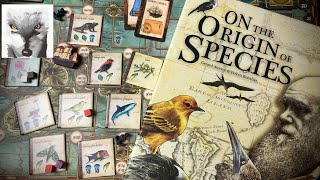
- Beautiful artwork
- Simple rules with lots of depth
- Thematic integration
- High replayability
- Visually stunning
- Fits well with Artana's portfolio of science-based games
- Not ideal for solo play without adaptation
- Retracing Darwin's journey, researching and discovering new species
- Galapagos Islands
- Cytosis
Mechanics (from transcript analysis)
- area control/influence — Placing cubes on species tiles to research them and potentially claim them.
- Objective Fulfillment — Completing Darwin's journal objectives by advancing the beagle marker.
- Resource Management — Collecting and spending resources (feathers, leaves, jellyfish) to discover species.
- Set Collection — Collecting species tiles and books for end-game scoring.
- Tile Placement — Placing discovered species tiles onto the board, potentially replacing lower-level tiles.
- Variable player powers — Beagle cards and character cards provide unique abilities.
- Worker Placement — Placing cubes on species tiles to gain resources or fulfill requirements.
Video topics + discussion points
Quotes (from this video)
- The artwork here is stunning it's beautiful and this is what first drew me to it was the theme the artwork and i've discovered a game with a simple rule set but lots of depth
- it is very competitive so you know you're losing a lot from trying to play this on your own it really is a two three four player game because there's a lot of maneuvering around the game positioning where you're researching species where you're discovering species which species you'll discover in order to win the struggle for the most points
- this game visually stunning
- Thematically you know they they have tried to tie things together i think the way some of the particularly the way some of the cards work and where you get these apex species if you like the the top level ants at the bottom they're level one so there is a thematic level to it and you really do get drawn into it because the artwork is so evocative and it makes you feel like you're discovering things as you pull tiles and reveal them
- i really like this game look out for it i think it would prove to be a good game for game night it's one that you can learn quickly all sorts of levels of experience of players can can get something from this
- this one fantastic and i hope to show you more of artana and genius games look out for them and look out for on the origin of species
References (from this video)
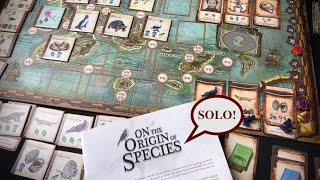
- Quick to set up
- Engaging and replayable
- Beautiful artwork
- The AI (Charlie) plays swiftly and keeps the game rolling
- Mentally engaging ('thinky')
- Can be difficult, especially in solo mode for book collection
- Drawing maps can be detrimental to book collection
- The New Zealand objective can be difficult for solo play if books aren't collected
- Origin of species
Mechanics (from transcript analysis)
- action selection — Players choose actions such as discovering tiles, claiming species, and placing cubes.
- AI Opponent — The game includes an AI opponent named Charlie with simple logic that keeps the game moving.
- Area Majority/Influence — Points are awarded based on who has the most cubes on habitat tiles.
- Boat (Special Ability) — A special ability (boat) that allows players to use resources from any space, not just adjacent ones.
- Dissection (Special Ability) — A special ability that potentially moves the beagle.
- Net (Special Ability) — A special ability (net) that helps in claiming species tiles.
- Objective Fulfillment — Players aim to achieve common and personal objectives.
- Resource Management — Players collect and spend resources (feathers, jellyfish, leaves, blue, green, yellow) to perform actions.
- Scalpel (Special Ability) — A special ability (scalpel) that allows players to claim lower-level species tiles.
- Set Collection — Players collect sets of books (e.g., four green books) for scoring.
- Tile Placement — Players place tiles onto the board, influencing available resources and scoring opportunities.
Video topics + discussion points
Quotes (from this video)
- i think it's very thinky
- the artwork's beautiful so it's always nice to look at
- charlie the ai plays quite swiftly
- we got proper thrashing didn't we
- this game is awesome i really love it
References (from this video)
- Deceptively deep with evolving board state
- Beagle movement provides strong thematic and gameplay cue
- Multiple viable strategies due to objective cards and wild traits
- Good educational appeal for both adults and children
- Compact footprint with approachable core decisions
- Not having a map can limit options and be frustrating for players without one
- May require more background information on voyage and species for full thematic payoff
- Shallow learning curve could under-lead to deeper strategic options for some players
- Evolution, biology, and scientific discovery
- Voyage of the Beagle (1831-1836), exploration of new life forms around South America, Australia, and Galapagos
- Educational, exploration-driven with evolving board state
- oceans
- darwin's choice
Mechanics (from transcript analysis)
- Action economy — Two main on-turn actions: discover a species or place research cubes; limited resources shape decisions.
- area/board placement — Anchors and board regions dictate where actions pay off and scoring opportunities arise.
- Resource Management — Cubes are spent from adjacent tiles to effect discoveries; management is key.
- Set Collection — End-game scoring based on collected books and discovered species cards.
- Tile Placement — Players place species tiles on a shared board to score points and influence future options.
- variable goals — Objective cards with triggers and anchors shift goals across the game.
Video topics + discussion points
Quotes (from this video)
- on the origin of species is a deceptively deep game with some really compelling gameplay
- the beagle moving through the board it's a wonderfully visual device and serves both a gameplay and thematic purpose
- not getting a map limits your options and while i don't think it's a game breaker it can be unfun to be the only player without one
- for a different game about evolution try oceans