/pic5710165.jpg)
P'achakuna takes you on a journey in the heart of the Andes together with your most loyal friend — your llama. The game includes both black and white llamas, with you controlling one color and your opponent the other. White llamas move only through the green valleys, while black llamas scale the barren mountains. Whatever the color, however, you want to visit mountain villages to deliver the dye that they desire, ideally collecting dye for yourself along the way.
In P'achakuna, each player starts with one llama of their color in the center of the board in the white village, with a white dye loaded on its back. The board is composed of hexagonal tiles that are either half valley/half mountain, two-thirds valley/one-third mountain, or vice versa. The tiles are extremely thick so that you can grab the mountain section of the tile and pluck it from the board. Six villages sit on the perimeter of the game board, each corresponding to one of the primary or secondary colors. Each village has a random demand tile in it that shows two colors, one in high demand and one in low demand; neither of these colors can match the color of the village.
On a turn, you may first rotate one unoccupied tile; by paying two dye resources from your personal supply, you can rotate a second tile. You then must move each of your llamas at least one space, but you can move them further if you desire and if the terrain allows them to do this. You rotate tiles to create long paths of valley or mountain so that ideally your llamas can travel far with each move.
If you move a llama into a village, you trade the dye on that llama. If the dye you carry isn't in demand in that village, you simply trade that dye for the dye from the village, say, green for yellow. If the dye is in demand, then you add 1-2 dye of that delivered color to your personal supply (depending on whether the demand is low or high), then you place a dye matching the color of that village on your llama. If you collect a color in your personal supply and don't have it in your scoring track, you can place it in your scoring track. No matter what, you replace the demand tile in that village, making sure the color of that village isn't on the demand tile.
During a turn in a village, you can hand in four dye from your personal supply to acquire a new llama that is then placed in that village with a dye from that village on its back. Each llama moves on your turn, and you can have at most three llamas.
As soon as you have one dye of each of the seven colors on your scoring track, you win.
To hold the demand tiles, the game includes a handmade fabric bag from Bolivia and Peru, which supports the local community.


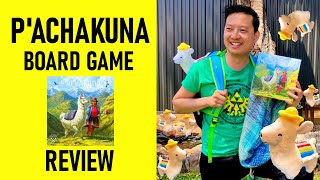
- The dual nature of the hex tiles makes the maze feel challenging and dynamic.
- It is a gorgeously crafted two-player game.
- Fits perfectly into any family board game collection.
- Appreciation for game designers who make two-player board games.
- Has a very simple rule set and is easy to pick up and learn.
- The strategy and decision making that appears in the game is quite deep.
- Takes familiar board game mechanics and elevates them to another level.
- The transformative maze concept allows the game to feel fresh each time you play.
- The victory condition is embedded within the game itself, setting the pace and making it feel like a tight, nail-biting race.
- Future and long-term planning is crucial for success.
- The abstract shapes and map pieces can provide the potential for a little bit of analysis paralysis.
- The maze can look somewhat visually overwhelming on your very first play.
- trading colored dyes to make fabrics
- the Andes mountains
- Hextile resource exchanging board game Settle
- Pick up and deliver game Whistle Stop
- Two player 3D abstract game Santorini
- Whistle Stop
- Ticket to Ride
- Labyrinth
Mechanics (from transcript analysis)
- Action Point Allowance — Paying two extra resources can give you that extra action and flexibility in paving the correct pathway.
- Maze Building — Players are leading their llamas across the Andes mountains to different villages in order to trade different colored dyes. This involves rotating hex tiles to create pathways.
- Pick-Up and Deliver — Players deliver different colored resources to different colored villages to fulfill demand banners.
- Resource Management — Players collect and trade different colored dyes/resources.
- Route Building — Players build uninterrupted paths from one village to the next to deliver resources.
- Set Collection — The player who collects seven different colored resource dyes first wins the game.
- Tile Placement — Players use 3D hexagon shaped tiles that fit together to create a map of pathways.
Video topics + discussion points
Quotes (from this video)
- Pachakuna is a very special game.
- There is an immense satisfaction when you find a way to transport your llama from one side of the board to the next.
- The rotation of the hex tiles constantly causes the board to change and evolve.
- The player who collects seven different colored resource dyes first wins the game.
- There are some incredibly tough decisions when you play a game of Pachakuna.
- This racing element and configuring element in the game just makes this game feel so cool.
- Pachakuna has a nice flow to it where at the start of the game you feel like your options are quite limited.
- The banners help to create an interesting problem to solve and choices to make.
- These game moments do make this game a highly interactive challenge.
- What I adore about Pachakuna is that I always really enjoy when a game comes along where the path to victory isn't a matter of counting up victory points at the end of the game.
- Pachakuna is a really cool game that really forces players to feel a victory condition.
- Pachakuna is a relatively abstract game.
- It is like a machine where each tile is a rotating cog in a clockwork of action on a map.
- Pachakuna really takes that maze creation element and takes it to another level where the maze is constantly changing.
- Pachakuna evokes memories of a board game that I had when I was younger called Labyrinth.
- Pachakuna is a gorgeously crafted two-player board game that fits perfectly into any family board game collection.
- It has this transformative maze concept idea in this game and that allows the game to feel fresh each time you play.
References (from this video)

- Clean two-player abstract with tactile tile-rotation and path planning
- Thematic framing with llamas and Andean villages
- Engaging puzzle of route planning and resource routing
- Prototype aligns closely to final product; Kickstarter campaign is active
- Rules can be fiddly and prone to misinterpretation during teach
- Prototype components may change before final release
- Endgame pacing can be tight in a back-and-forth duel
- Peruvian/Bolivian trading culture with resource collection and delivery
- Andes mountains; traders traverse mountaintops and valleys with llamas in a two-player resource acquisition and delivery race
- abstract with light thematic framing
Mechanics (from transcript analysis)
- Resource collection and trading at villages — Llamas arrive at villages with demand tiles and traders exchange resources to meet demands and score.
- Resource management and tile rotations purchase — Resources can be spent to rotate additional tiles or buy more llamas.
- Set collection / seven colors to win — The objective is to acquire all seven colors of resources to win the game.
- Terrain-based movement — Llamas move along mountains or valleys depending on color, creating terrain constraints that shape routing.
- Tile rotation — Each turn may rotate a board tile to influence movement and route options.
Video topics + discussion points
Quotes (from this video)
- it's an abstract strategy two player only game
- the board is very 3d in that sense
- carbon neutral as possible
- we are playing as traders who are going to be traversing the mountains and valleys
- the object of the game is to collect all seven colors of resources
- the first white resource that you have on your back will never be traded in for anything of value
- this is prototype
- the campaign has successfully funded
References (from this video)
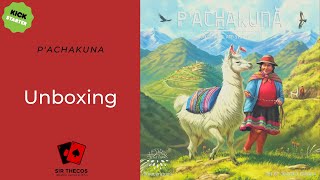
- beautiful cover art
- well-made llama minis and component quality
- sustainable packaging and materials
- compact rulebook and bilingual presentation
- two setup posters for accurate layout
- board/table space appears to be large when set up
- inclusion of plastic bags despite overall cardboard/wood composition
- Llama caravans, village trade, and sustainable production
- Andean-inspired trade routes between villages, with llamas as pack animals
- Resource-driven, light thematic backdrop with a focus on production and exchange
Mechanics (from transcript analysis)
- resource_management — managing llama-related resources for transport between villages
- set_collection — collecting resources and goods to satisfy needs to progress
- tile_placement — placing and arranging tiles to set up routes/landscapes during setup and play
Video topics + discussion points
Quotes (from this video)
- the llama we have seen that really cool
- this bag is large enough to hold the entire game in here
- bags and llamas were made in Bolivia
- everything fits in here
- they actually always try to make everything as sustainable as possible
References (from this video)

- Gave up assembling due to annoying stickers
- Double-sided card setup was frustrating
- Assembly put host off for months
- Unknown
- Unknown
Mechanics (from transcript analysis)
Video topics + discussion points
Quotes (from this video)
- I used to call this a shelf of shame that was a pretty common thing to call it back in the day and I don't never really liked that term because I don't feel shame that I haven't got to these games
- this is mostly work like this is just a backload of things I probably should get to
- people will still be looking for it
- it doesn't matter if the game is like 20 years old people will still be looking for it
- I've painted this one and I spent a lot of time doing it
- there's no point putting them on the channel I think both of them have been out of print for like a decade
- one of the worst kickstarters by one of the worst studios in board gaming history
- Golden Bell Studios did everything wrong you could possibly think of
- purely toxic company run by incredibly terrible people
- it would be kind of a joke that I'd be able to do a three minute video of feudum
- this game has a tutorial video online that's like 40 minutes long
- The Rose explanation video feels like a parody but it's actually how the game is played
- nothing personally to me puts me off playing a game that then sitting down unboxing it and having a craft assignment
- stop making me spend hours assembling your damn games
- this is an uncontrollable mess right now
- I'm a full-time dad and I'm really doing this in the evenings
- I have a finite space and also it just puts pressure and stress on me having a whole bunch of crap there that I know I'm not going to get to
- I'm going to do a big cull
- I will be published by this company but that doesn't mean I'm going to be slavishly devoted to every single game they put out
- I am a sucker for cute animal games like I really am
References (from this video)
- Llama-centric motif with light, family-friendly exploration/resource ideas (speculative)
- Incan-inspired Andes setting (speculative based on llama motif)
- family-friendly, light theme
Mechanics (from transcript analysis)
- unknown — Not specified in transcript
Video topics + discussion points
Quotes (from this video)
- this is incredibly fun