



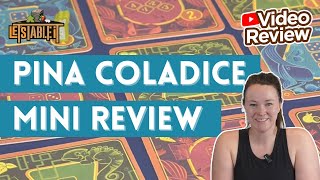








Piña Coladice Deep Dive
What the Community Thinks About Piña Coladice
Coverage of Piña Coladice is limited, and the available discussions are warm about its theme, its components, and how easy it is to pick up. Let's Table It describes a breezy, colorful dice game that plays like Yatsi with tropical flair and strategic twists, and calls it a quick, light game that suits poolside play or a night with friends. Good Time Society met the game as a "jacked up matchup" segment during a grab bag episode, where the hosts and a guest played a full two-player match on camera. That segment is a casual play session rather than a formal review, so its views are impressions formed during play.
The clearest point of agreement is that the game takes familiar dice-rolling ideas and arranges them in a new way. Criticism is light. The reservations that come up center on the drink theme and on rules that were easy to misread during the first game.
Core Mechanics That Define Piña Coladice
Dice Rolling
Each turn starts with a pool of five dice, and a player may roll up to three times. After any roll, the player can set aside as many dice as they like and reroll the rest, or stop and claim a coaster. Good Time Society lists the available claims as pairs, two pair, straights, four of a kind, five of a kind (which the host equates with a Yatsi), dice totals within a stated range, and rolls where all five dice are odd or all five are even. Reviewers treat the choice of which dice to keep and when to stop as the heart of the game. Only one claim is allowed per turn, so a player has to decide whether a partial result is worth taking now or whether another roll is worth the risk.
Claiming a coaster places one of the player's cocktail markers on it and scores the coaster's points. Each adjacent marker the player already owns, whether orthogonal or diagonal, adds a bonus. A claim that touches several of the player's markers can therefore be worth much more than the printed value, which is why reviewers describe placement as a second decision layered on top of the rolls.
Limited Points
The score track also sets the finish line. Reviewers describe three ways a game can end: a player places their last marker, a player connects four markers in a row, which Good Time Society calls an immediate win, or a player reaches 20 points. The two channels describe the 20-point finish differently. Let's Table It says reaching 20 ends the game. In the Good Time Society playthrough, the players applied a final-turn rule in which the other player gets one more turn and the highest total wins. Anyone learning the game should check the rulebook for the exact wording. Because the threshold is visible to everyone, each claim also changes how close the other players are to ending the game.
The Piña Coladice Experience
Familiar Yet Fresh
Reviewers describe the feeling of a dice game that players already know, delivered with a new structure. Let's Table It says the mechanisms are ones players recognize, but the way they are combined feels fresh. The Yatsi comparison is the reference point throughout the discussions. The Good Time Society guest described the game as a step beyond Yatsi, because the rolling is familiar while placing markers on coasters adds a board-placement layer that a score sheet does not have.
Light, Bright Table Play
The tone is breezy and social. Let's Table It calls the game a light title that fits summer play, and points out that coaster-style tiles make it easy to take outdoors. The Good Time Society players laughed through their session, teased each other over lucky and unlucky rolls, and treated the match as entertainment as much as competition. Near misses drive much of the play. The session turned on a single inside straight draw, and a long-shot final roll succeeded at the end, which the table greeted with disbelief.
What Makes Piña Coladice Stand Out
Components and Theme
The look of the game draws the most praise. Let's Table It says the drink markers are unique to each player and adorable. Good Time Society repeatedly commented on the cocktail meeples, which range from a margarita to a highball and a mason jar. The coasters carry the combinations players are trying to make, so the theme and the mechanism share the same surface.
Scaling Across Player Counts
Let's Table It says a lot of thought went into scaling the game for different player counts. Each tile has different sides with more or fewer placement slots, and players use the side that matches their group size. Good Time Society's two-player match used a randomly assembled 4x4 grid of coasters. The host noted that three- and four-player games give each coaster two spaces, which makes the two-player game more ruthless because players can block one another directly.
Potential Drawbacks
The Drink Theme
Let's Table It points out that the game contains no alcohol, but that the idea of mixing drinks might not appeal to everyone. The reviewer presents this as a matter of taste rather than a flaw in play, and the praise for the look and components suggests the theme is a large part of what reviewers enjoy.
Rules Clarity and Dice Luck
The Good Time Society playthrough shows that some rules are easy to misread. The hosts discovered mid-game that the odd, even, and total claims require all five dice, not a subset, and the host apologized for not making that clear earlier. Whether a die knocked off the tray still counts also prompted debate. Luck is a large factor in the outcome. One player went several rolls without a useful claim, and the hosts joked that the same three kept coming up.
If You Enjoy Piña Coladice
Good Time Society makes the most direct comparison. The host says that if you have ever played Yatsi, Piña Coladice is the next step in that Yatsi evolution, because it keeps the same roll-up-to-three style and adds coaster placement and alternate ways to end the game. Players who enjoy the rolling and combination-chasing of Yatsi are the audience the reviewers point to.
What Reviewers Are Saying
"The drink markers are unique to each player and so adorable. The gameplay feels familiar yet new at the same time. There are mechanisms we all know, but they are combined in a way that feels fresh."
— Let's Table It
"There has been a lot of thought put into scaling this game so that it plays well at various player counts. You'll use different sides of the tiles with more or fewer placement slots depending on the player count."
— Let's Table It
"I really like this one. I think it's a fun little family weight game. And again if you've ever played Yatsi, this is I think the next step in your Yatsi re evolution."
— Amy Don, Good Time Society