

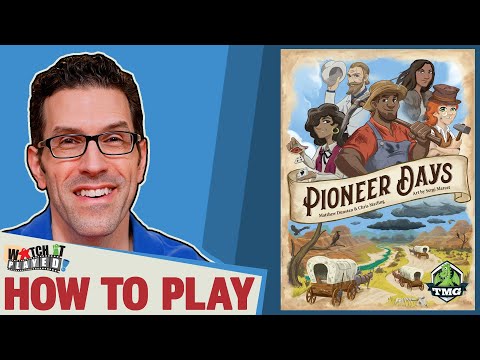









Pioneer Days Deep Dive
What the Community Thinks About Pioneer Days
Reviewers tend to describe Pioneer Days as a dice drafting game with a Western frontier theme, published by Tasty Minstrel Games in 2017. Several channels frame it as a lighter cousin of The Oregon Trail, with settlers packing their wagons and facing the hazards of the trail. Across the videos, the praise centers on the dice mechanic. Reviewers keep returning to the way every die in the pool does double duty, giving the player a choice that is both an action and a risk management decision.
The criticism is less about the design and more about the swing that comes from the disasters. Rolling Dice & Taking Names describes a session in which all four disaster tracks triggered near the end of the game and undercut the end-game scoring. The same reviewer says the loss "left that ketchup taste in my mouth," and then adds that a replay would show whether the impact repeats. That tone, a mix of genuine enthusiasm and caution about variance, runs through most of the discussion. Reviewers who rate the game highly, such as Adam in Wales across a live stream of the game, describe it as one of their favorites in the Tasty Minstrel catalog.
Core Mechanics That Define Pioneer Days
Dice Drafting
The game begins with dice drawn from a bag and rolled into a shared pool. According to Getting Games, players pull one more die than there are players, roll them, and then each player drafts a single die per round. Each die face points to one of six actions on the board, and the drafter can take the action, take the money tied to that spot, or recruit a townsfolk card associated with the space. Adam in Wales summarizes the same loop: players roll dice, take turns selecting one from the pool, and each selection generates an action. The unchosen die matters too. Whatever die is left over advances the matching disaster track, so the player who drafts last faces a different set of consequences than the player who drafts first.
Adam in Wales points out that the dice are not only a selection tool. A drafted die can be used to power a different action on the board, including dealing with a peril, collecting income, or taking a special action card. This is the feature reviewers call satisfying, because the choice of which die to take carries both an immediate benefit and a defensive consequence.
Resource Management
Pioneer Days is built around scarce goods. Players collect silver, wood, medicine, cattle, equipment, and gold nuggets, and they spend them to meet the demands of the disasters. Raids cost half of a player's silver, famines require silver for cattle, diseases require medicine for townsfolk, and storms demand wood for wagons. Reviewers emphasize that these costs fall on everyone, so the planning is about how much to stockpile before a disaster arrives. Rolling Dice & Taking Names describes stockpiling medicine as the most reliable way to claim bonus points late in the game, which shows how a single resource can serve both survival and scoring.
The Pioneer Days Experience
Mounting Tension From the Unchosen Die
The defining feeling in these videos is the slow pressure of the disaster tracks. Every round, the die nobody wanted moves a track closer to its effect, and players must decide how much of their economy to protect. Adam in Wales describes the outcome as costing all players resources, which makes each round feel like a negotiation with the table's leftovers. The tension builds gradually, and the reveal at the end of a track is where the game's mood changes from planning to damage control.
Satisfying Choice and Thematic Momentum
The positive side of the experience is the sense that each draft is a meaningful decision. Reviewers highlight the moment when a player finds a die that powers two different plans at once, such as earning income while also addressing a peril. The Western theme supports this by making the drafts feel like practical decisions on the trail, not abstract scoring moves. Game Night Picks frames the game as a concert of spontaneous joy and tension, reflecting how the lighter theme and the sharper disaster mechanics pull against each other.
What Makes Pioneer Days Stand Out
Dice That Serve Multiple Purposes
Reviewers consistently praise the way a single die can do several jobs. In Adam in Wales, the dice are described as the engine of the whole game, driving the board, the perils, and the special actions. That versatility keeps the draft interesting even late in a round, when the remaining options are less attractive.
Townsfolk Tableau With One-Off and Scoring Effects
The townsfolk cards are the second feature that reviewers single out. Adam in Wales explains that each townsfolk card has an immediate effect and also provides end-game scoring bonuses. Many of those effects are one-off abilities that trigger when the card is placed. Adam notes that this makes Pioneer Days a tableau-based game in a limited sense, since the benefits are not always recurring, but the choice of which card to add still carries real weight. The rewarding part for players is building a set of cards whose bonuses reinforce one another by the end of the game.
Potential Drawbacks
Variance From the Disaster Tracks
The most common concern is that the disasters can be decisive. Rolling Dice & Taking Names describes a game in which all four disasters triggered at the end and erased the scoring advantage that the reviewer had built. The reviewer acknowledges that the opponent played well, but still says the outcome left a bad taste. Players who dislike swingy endings may find this difficult to accept.
Costly Recovery Late in the Game
A second concern is the expense of recovering from disasters. Rolling Dice & Taking Names points out that players must spend resources to recover, and those resources might have gone toward end-game bonuses. Reviewers who value efficiency may find that the disasters pull resources away from the points they are trying to score, which can make the final rounds feel more reactive than planned.
If You Enjoy Pioneer Days
Players who enjoy Pioneer Days's dice drafting mechanic will find similar satisfaction in Grand Austria Hotel, where a shared dice pool drives every placement and each die choice reshapes the board. The pool-and-select rhythm is the common thread that reviewers highlight.
Players drawn to the Western theme and the frontier survival tension will find a related experience in Old West Empresario, another Tasty Minstrel Games title that shares the publisher's focus on thematic decisions with clear consequences.
Players who want the original inspiration can explore The Oregon Trail. Reviewers describe Pioneer Days as reminiscent of that trail, with its roll-of-fortune hazards, supply management, and the constant threat of illness, flooding, and raids.
What Reviewers Are Saying
"In Pioneer Days, players roll dice and then take turns to select one from the pool, each generating some sort of action. The remaining dice result advances a disaster track which will eventually cost all players a number of resources."
— Adam in Wales
"Every person will draft a single die in each round, and the dice will let you do one of three different things when you draft."
— Getting Games
"And it all four of them triggered, and it completely wrecked my end game scoring. It left that ketchup taste in my mouth that I just could not swallow."
— Rolling Dice & Taking Names