










Queendomino Deep Dive
What the Community Thinks About Queendomino
Reviewers consistently treat Queendomino as the natural next step after King Domino, the Spiel des Jahres winner from designer Bruno Cathala and publisher Blue Orange Games. The shared view is that it keeps the tile-drafting core of its predecessor and adds currency, buildings, knights, and towers. That addition turns a light family game into a midweight Euro, and reviewers disagree mainly on whether the extra layers are worth the cost.
The most enthusiastic voice comes from TheGameBoyGeek, who previewed the game at Gen Con and called it "essentially a gamer version of King Domino." TheGameBoyGeek sees it as a great next step for players who already know the drafting engine. The Board Games UnLocked discussion is more divided. One participant prefers it to King Domino because it demands the kind of planning the original never asks for, while another finds the original more satisfying and feels the knights and towers do not balance well. A later Board Games UnLocked session played a full game to a close finish, and the group's final scoring showed how many different paths to victory the buildings allow.
The Dice Tower places Queendomino at the heavy end of the King Domino spin-offs, describing it as the thinkiest of the line and noting that it pushed the series to a weight the later releases have not matched. Adam Porter, Adam in Wales, a game designer who reviews with a product-design focus, calls it a light-to-midweight Euro that rivals many titles in that space. Actualol goes further and says the game is "the right level" for players who find King Domino too thin. Meeple Mountain offers only a Gen Con booth tour, but its description of Queendomino as a decision-making game with a heavier strategy feel matches the tone of the longer reviews.
Core Mechanics That Define Queendomino
Tile Placement
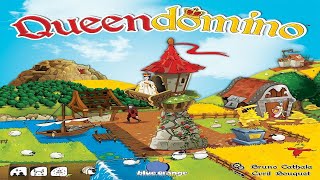
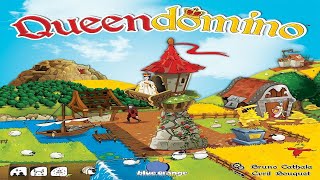
Tile placement remains the physical heart of the game. Players add dominoes to a personal grid, and reviewers stress that adjacency and orientation still decide the outcome. Adam in Wales explains that the spatial puzzle of building a clean square while matching terrain and avoiding gaps is "a gentle challenge and a pleasant activity," and that the chunky pieces and illustrations by Cyril Bouquet make the resulting kingdom look delightful. What changes in Queendomino is that placement now serves a second purpose. Reviewers describe the red terrain as the place where buildings go, so every tile choice also sets up a future purchase.
Tile Drafting
The drafting system is the feature reviewers return to most often. Each domino taken from the display also determines turn order for the next round, so a player weighs which tile scores best against where it places them in the sequence. Adam in Wales describes the design challenge of tiles numbered by value and laid out in order, and notes that this is the mechanism that "caught the attention of critics and award panels." Queendomino keeps that tension intact while adding the knights and coins that give each choice a second cost.
The Queendomino Experience
Tactical Tension
Reviewers describe a steady, low-grade fight throughout the game. The contest for the Queen is the clearest example. TheGameBoyGeek describes towers being built to win the Queen, and then a last-turn swing that decided TheGameBoyGeek's one play: "fighting over the Queen is awesome." Players can also burn down an opponent's building when they are not holding the Queen, so a turn often becomes a decision about what the other player is about to buy. The feeling is less about cutthroat conflict and more about constantly reading the board for what the other player is likely to need.
Satisfying Payoffs
Reviewers also talk about the pleasure of an engine clicking into place. The knights generate coins that are spent on buildings, and the buildings in turn produce points, so a well-timed knight placement can feel like a small windfall. Board Games UnLocked describes the frustration and reward of collecting taxes when the amount is large enough to change the purchase in front of you. Players who build the right combination of towers and buildings often describe a turn that suddenly seems to make everything else fall into place.
What Makes Queendomino Stand Out
Buildings That Support Different Plans
Reviewers praise the buildings for opening strategic paths that the original King Domino never offered. TheGameBoyGeek describes their own game as a big-route plan with large connected fields, while the opponent built a board of small single fields and bought buildings that scored for each one. Both approaches won in different ways. The Board Games UnLocked hosts also noted that a player can ignore the red buildings entirely and still win, which keeps the buildings from becoming a single correct path.
A Central Economy Built on Old Ideas
Adam in Wales highlights the combination of a central currency, income from knights, majority scoring, and set collection bonuses as the game's clearest step forward. Adam in Wales argues that the design takes a familiar tile game and adds layers that feel cohesive rather than bolted on. The swing in weight is part of the appeal for players who want a sharper decision space, even if it costs some of the original's charm.
Potential Drawbacks
Knights and Towers Feel Unbalanced
The most detailed criticism comes from the Board Games UnLocked discussion. One participant argues that knights are overpowered because they generate coins and points at the same time, while towers "don't really do anything for you" unless they are paired with a building that rewards them. Another points out that the dragon, which can destroy a building, is rarely worth using. Their suggestion was that the Queen be worth a fixed number of points at the end of the game, which would make towers as attractive as knights.
Weight and Rules Overhead
Several reviewers agree that the added complexity has a cost. Adam in Wales describes Queendomino as "an enjoyable midweight Euro" that struggles to stand out from its peers, and Adam in Wales notes that the expansion Age of Giants makes the game involved enough to rival Carcassonne. Board Games UnLocked lowers their rating for the same reason: "the more rules, the more chances you have to mess something up." The game is still approachable for experienced players, but reviewers do not recommend it as a first step for children or casual families.
If You Enjoy Queendomino
Players who enjoy Queendomino's drafting and tile-based engine will find a similar satisfaction in King Domino, the original that Queendomino builds on, and in King Domino Origins, which uses the same core rules in a prehistoric setting with three modes of increasing complexity. Players who appreciate Queendomino's building-driven scoring and tension will enjoy Carcassonne, which Adam in Wales compares directly as a tile-placement game of similar weight. Players who like the feeling of a shared market and competing for the best plays will find a comparable tension in Calico and Canvas, which Board Games UnLocked mentions as games sitting in a similar space. For players who enjoy the more strategic side of engine building, Crusaders: Thy Will Be Done offers the same satisfaction of a combo that clicks into place, drawing on the same kind of engine-building payoff as Queendomino.
What Reviewers Are Saying
"Fighting over the Queen is awesome. You're building the towers trying to get her on your side because you get a discount, and at the end you can put her in the field."
— TheGameBoyGeek
"It's not a ten because it has the more rules, the more chances you have to mess something up. I'll give it an eight though, it's still very good."
— Board Games UnLocked
"Queen Domino is an enjoyable midweight Euro but it struggles to stand out from its peers in that category. The simpler King Domino shines in a more naive family market, standing out because of one ingenious central mechanism and some delightful presentation."
— Adam Porter, Adam in Wales