/pic3008003.jpg)
Game Info
Year
1992
Collection
Ratings
Creator Score
Mechanic profile
Not enough video data yet
Vibe profile
Not enough video data yet
Description
In an interesting departure from his normally computational-heavy game structure, Reiner Knizia put together this negotiation game. Players are represented on the board by a group of politicians moving through a network of committees, and need to seek support from their competitors to advance upward toward the Senate. Supporting an opponent gains you prestige, needed in quantity at the end of the game. Once all five Senate positions are filled, the game is over, and only players who have a politician in the Senate are eligible to win. Of those players, whoever has the most prestige wins.
Ask a Rules Question
All mentions
Browse transcript mentions, sentiments, pros/cons, mechanics, topics, quotes, and references.
Total mentions: 3
This page: 3
Sentiment:
pos 2 ·
mix 1 ·
neu 0 ·
neg 0
Showing 1–3 of 3
Video Hq0wLTwatDA
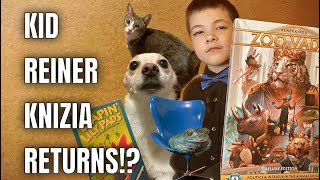
Board Game Animal Analysis at 1:34 sentiment: mixed
video_pk 38603 · mention_pk 232971
Click to watch at 1:34 · YouTube ↗
Overall sentiment (raw)
mixed
Pros
- Opens a rich space for creative reinterpretation by re-skinning a classic theme into animal-driven contexts, inviting fresh design thinking
- Encourages explicit discussion of paradox mechanics and how time travel metaphors can be translated into tangible gameplay signals
- Provides a meta-narrative framework that can engage both designers and players by inviting commentary on the design process itself
- Highlights the value of explicit design constraints to catalyze inventive problem solving, rather than simply recreating a known experience
Cons
- Lacks concrete historical game data, which makes precise evaluation of feasibility and balance speculation-heavy
- The animal re-skin may dilute the original thematic gravity if not carefully aligned with mechanics and visual design
- Risk of overcomplicating the design conversation with abstract concepts that obscures practical playtesting realities
- Reliance on meta-narrative devices could alienate players who prefer tight, mechanics-first experiences over storytelling interventions
Thematic elements
- Moral and strategic decision making under time pressure, with an emphasis on paradoxical causality
- Ancient Rome context reinterpreted through an animal kingdom lens
- Meta-narrative design discussion, using time travel as a narrative engine to explore how themes travel across genres and settings
Comparison games
none
Mechanics (from transcript analysis)
- narrative progression through agent-driven actions — Participants advance a shared storyline by choosing actions that push the timeline forward, while also revealing information that can retroactively alter past events.
- paradox-aware scoring and tension management — A scoring or influence system designed to reward players for creating coherent yet paradoxical outcomes, balancing foresight and surprise.
- role-based agency and factional objectives — Players assume distinct roles with unique goals, guiding their decisions and influencing the direction of the evolving narrative rather than pursuing a single objective.
- thematic re-skin and modular storytelling — The discussion centers on adapting a known thematic core to a new setting (animal-based themes) as a design exercise, while preserving core play dynamics through flexible modules.
Video topics + discussion points
No key topics recorded for this video.
Quotes (from this video)
- could you possibly recreate quo vadas to a more relatable theme like for instance animals
- animals doing things you'd normally expect people to do is kind of our whole thing here
- this is a once in a lifetime opportunity
- wait how did you just do that
- always nice to see you guys here
- they look like canines but not quite, close enough for me
References (from this video)
No references stored for this video.
Video OUNghnQV_LI
Chairman of the Board Discussion at 8:43 sentiment: positive
video_pk 11908 · mention_pk 90012
Click to watch at 8:43 · YouTube ↗
Overall sentiment (raw)
positive
Pros
- free-flowing, breezy feel
- great for quick, competitive sessions
Cons
- depends on player interaction; may be less favored by solo players
Thematic elements
- negotiation and progression toward scoring
- ancient Rome
- clever, fast-paced negotiation
Comparison games
none
Mechanics (from transcript analysis)
- Negotiation — fast, free-flowing turns where players bargain for position
- resource/score management — managing actions and points as you advance
Video topics + discussion points
No key topics recorded for this video.
Quotes (from this video)
- my favorite game of all time
- Head and Shoulders Above the Rest as my favorite game of all time
- the solo mode might be one of the best renditions of a solo mode I've ever played
- a quite nice filler game that flew under the radar
- definitely got a nice flow
- it's breezy and quick
- the artwork is fantastic
- Hidden Gem treats
References (from this video)
No references stored for this video.
Video AI1omwj64kE
Going Analog Discussion at 21:56 sentiment: positive
video_pk 10964 · mention_pk 109573

Click to watch at 21:56 · YouTube ↗
Overall sentiment (raw)
positive
Pros
- tight tension and classic negotiation feel
- signature deep-player interaction; a game that rewards long-term planning
Cons
- can be overly confrontational for casual players
- older design may feel archaic to new audiences
Thematic elements
- negotiation, alliances, and strategic card play
- antique Rome; senators and political maneuvering
- classic negotiation with modern updates
Comparison games
- El Grande
- Quo Vadis
Mechanics (from transcript analysis)
- Card-driven action selection — cards influence moves and power dynamics; deck management affects pacing
- negotiation and alliance-building — players bargain, form and break alliances to secure political power and emblems
Video topics + discussion points
No key topics recorded for this video.
Quotes (from this video)
- Silos is all about area majority and being in the right spot at the right time because the UFO is moving around the board and you have to predict where it's going.
- It's basically a meeting of a strategy game and a pure party game; it's hilarious.
- The Cosmic Silos Trilogy—Silos, Ego, Orbits—launched as a bundled Kickstarter with big box content.
- El Grande is a classic; Silos flips the idea by making the card actions feel like a slot machine, more frequent and dynamic.
- I love the retro Quan Moria art; it's quirky and visually striking.
References (from this video)
No references stored for this video.
Transcript Navigation
Showing 1–3 of 3