







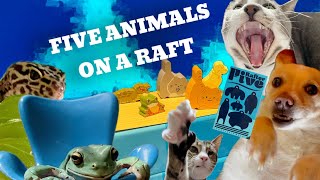
Rafter Five Deep Dive
What the Community Thinks About Rafter Five
Reviewers largely agree that Rafter Five, the small-box dexterity game from Oink Games, packs far more tension and fun into its size than its box suggests. Players build a raft on top of the game box, lift one of the wooden rafters on each turn, slide a raft card underneath, and place a treasure chest on the growing structure. The Chairman of the Board channel placed it near the top of its ranking of recent releases and called it a brilliant dexterity game, a notable admission from a channel that generally does not enjoy dexterity games. Board Game Animal described it as a ton of fun for family game night and said the designers at Oink manage to cram a remarkable amount into one little package.
The most skeptical voice comes from BoardGameBollocks, which argues that the design offers little that is genuinely new. That reviewer treats the tiny box as the game's party trick and points to Via Pettie and Riff Raff as earlier designs that cover similar ground. Even so, BoardGameBollocks concedes that the game rewards a bit of real skill and works well as a cheap, quick dexterity filler. The disagreement across these channels is less about whether Rafter Five is fun than about whether its novelty justifies a permanent place on the shelf.
Core Mechanics That Define Rafter Five
Stacking and Balancing
Stacking and balancing is the physical core of Rafter Five. The five wooden rafters rest on a starting card placed atop the inverted box, and each turn a player lifts one rafter, places a new raft card beneath it, and sets the rafter back down. The structure grows steadily, and every addition shifts its weight. Board Game Animal emphasized that keeping treasure chests on the ever growing raft takes exquisite levels of balance and foresight. Reviewers also explain the consequences clearly: if a collapse sends a player's own chests into the sea, that player reclaims them, but opponents' chests that fall go onto a penalty board, and the first player to fill that board with other players' chests loses.
Risk Management
Oink Games layered a second decision on top of the physical challenge. Because a chest that falls off a player's own placement is simply reclaimed, the real question is where a chest will tip and who will be forced to disturb the raft next. BoardGameBollocks describes this as a sort of reverse victory point mechanism, in which players try to hand opponents the points that will eventually lose them the game. A precarious placement can pressure an opponent into a collapse, but it can also backfire if the raft gives way on the wrong turn. Reviewers suggest that weighing those odds, rather than the sheer steadiness of a hand, is what gives each turn its bite.
The Rafter Five Experience
Nervous Tension Around the Table
Reviewers describe a shared, physical suspense that builds as the structure grows. Board Game Animal opens its video with a playful skit in which a character places a piece with growing alarm, and the chatter of "steady, steady" captures how the table reacts to every wobble. Chairman of the Board says the game is an absolute blast precisely because each turn asks players to add weight without tipping the raft. The moments when a rafter is lifted and everyone holds their breath are the ones reviewers return to when describing why the game sticks in memory.
Lighthearted Group Fun
The other dominant feeling is easygoing laughter. The Chairman of the Board channel says the game is so much fun to teach that whoever learns it will enjoy it, and it expects the game to become a permanent part of its collection. Board Game Animal presents it as a reliable filler for families with kids. Both videos play up the banter around who is most likely to topple the raft, and that friendly needling is part of the appeal. Rather than cold calculation, reviewers describe a game that invites teasing and shared groans whenever a chest slides toward the sea.
What Makes Rafter Five Stand Out
A Reverse Victory Point Twist
Reviewers repeatedly single out the way the game flips the usual goal. BoardGameBollocks notes that players can deliberately place their own treasure chests where they are likely to cause an opponent's structure to collapse, which forces the opponent to take penalty points. That reviewer says this gives the game a little bit of skill on top of what would otherwise be a pure dexterity exercise. The Chairman of the Board channel describes the same tension from the other side, noting that a player who drops five opponents' treasure chests loses the game. This twist is what reviewers say separates Rafter Five from a simple tower-stacking exercise.
Quick Teaching in a Tiny Box
The second standout is how readily the game teaches and how easily it fits into a busy evening. Board Game Animal calls it a small game with a surprising amount of depth, and the Chairman of the Board channel says it is easy to teach to whoever sits down at the table. BoardGameBollocks acknowledges that the very small box is the game's most obvious selling point, and the short playing time and simple turn structure make it a natural choice for groups who want something quick between heavier games. Reviewers agree that this combination of portability and fast learning is a large part of why the game earns repeat plays.
Potential Drawbacks
Limited Novelty
BoardGameBollocks is the most critical voice on this point. The reviewers argue that there is not really anything new here, and that the game is another dexterity design whose main appeal is the small box. They point to Riff Raff as the design that Rafter Five borrows most heavily from and say Riff Raff does the same job better, with a wooden ship that is more impressive as it moves around the table. The reviewers acknowledge that Riff Raff costs more, so Rafter Five remains the cheaper option for a quick dexterity fix. For players who have seen similar designs before, the game may feel like a familiar idea in a clever package.
Dexterity Over Strategy
The second concern is that the decisions in Rafter Five are thinner than its physical challenge. The Chairman of the Board channel says it generally does not like dexterity games, which makes its enthusiasm for this one the exception rather than the rule. BoardGameBollocks describes the skill as a little bit of skill on top of a dexterity mechanism, which suggests the strategic layer is modest. Players who prefer mechanisms, engine building, or long-term planning may find the decision space narrower than the steady hands the game demands.
If You Enjoy Rafter Five
BoardGameBollocks names Via Pettie as a game that is sort of similar to Rafter Five, and it identifies Riff Raff as the design that Via Pettie borrows most heavily from. Players who enjoy the tension of a balancing structure and want a quick dexterity filler should look at Via Pettie first, since it shares the same spirit of physical risk and small-scale play. Those who want the same balance challenge executed more impressively, with a wooden ship that moves around the table, may prefer Riff Raff despite its higher price. Both games offer the same kind of shared, nervous laughter that makes Rafter Five a reliable choice for game night.
What Reviewers Are Saying
"I think this is a brilliant dexterity game and that is quite a weird thing for me to say because I generally don't like dexterity games, but this one is just an absolute blast."
— Chairman of the Board
"There's not really anything new here. It's just another dexterity game whose party trick is that it comes in a really really small box."
— BoardGameBollocks
"This is Rafter 5 from Oink Games, a small little dexterity game where you have to move the rafters in order to keep your treasure chests on the ever growing raft, which takes exquisite levels of balance and foresight on how to plan out your ever growing raft. It's a ton of fun as a filler game on Game Night with the whole family."
— Board Game Animal