/pic5910914.jpg)
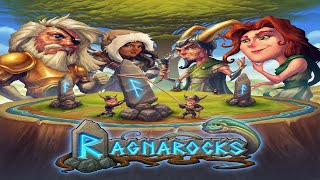
Ragnarocks is a 2-player area control game designed by Gord! - the designer of Santorini and Santorini: New York. In Norse mythology, humans exist in the land of Midgard - a place in the center of the world tree and connected to the nine realms. Among these nine realms live gods and goddesses, serpents and spirits, and all manner of mythical and mystical creatures.
In Ragnarocks you take on the role of a Viking clan using Runestones to mark your clan’s claims of land. In the advanced game, your clan worships one of these powerful beings from another realm who lends you their power to help you outwit rivals and claim territories for your clan.
At the end of the game, the clan who controls the most territory in Midgard wins!
A player's turn consists of a move phase and a summoning phase.
During the move phase you move one of your active Vikings any number of spaces in a straight line.
During the summoning phase you summon a runestone and place it on any space along a path following a straight line from the location of the Viking you moved. Whenever a summoning creates an enclosed area containing only vikings of a single clan, that area becomes settles and belongs to the player whose clan occupies it.
When all vikings have settled, the player who controls the most territory wins.
—description from the publisher

Ragnarocks: Discussion
- The base vanilla game without player powers is more enjoyable.
- The runestones look cool (kickstarter edition has clear turquoise ones).
- Player powers are unbalanced and leave a lot to be desired.
- The 3D terrain production is a mess and causes physical instability.
- The artwork is described as hideous and atrocious.
- Scoring can be difficult to track with the terrain and runestones.
- It doesn't quite stack up to Santorini.
- Some player powers are clearly better than others.
- The Viking miniatures are not great.
- Viking conflict
- Norse mythology
- Santorini
Mechanics (from transcript analysis)
- Action Point Allowance — Players move a Viking and then summon a runestone.
- Area Control — Players try to block opponents and enclose areas to score points based on the size of the enclosed space.
- player powers — Asymmetrical player abilities that alter gameplay, though the reviewer finds them less refined than in other games.
- Worker Placement — Players move Vikings (workers) on the board.
Video topics + discussion points
Quotes (from this video)
- while I don't think this game is bad I don't think it's quite as good
- in this game I actually prefer playing without player powers like and in Santorini I think that's the worst way to play
- the player Powers leave a lot uh you know like to be desired
- the 3D train didn't work you don't need it at all
- this one didn't quite hit as well uh as Santorini did
- Santorini just has that one extra layer of complexity that maybe it's just a little bit better
- I'm not as wowed by it
- I actually first just really despise this this artwork
References (from this video)

- thematic and tactical
- well-regarded designer lineage (Santorini connection)
- mythic, land-rich strategic clashes among clans
- Viking-era conflict and land disputes
- myth-inspired, competitive grand-scheme battle
- Santorini
Mechanics (from transcript analysis)
- Area Control — Players contend for ownership of areas by surrounding them with pieces.
- placement/movement — Clans deploy and move pieces to secure zones.
- stone/runestone resource flavor — Runestones drive levered effects and claims.
Video topics + discussion points
Quotes (from this video)
- this game is so fun and it's really easy to learn how to play
- adorable robot minis
- rich narrative with intuitive yet unique game mechanisms making every game a new adventure
- i love role play i can't wait for this campaign-style game
- beautiful and clean abstract game
- epic cataclysm that shakes the foundations of the entire circadians world
- secret personality with specific victory conditions
- the only thing i love more than somewhat abstract 3d worker placement is something else
References (from this video)
- moodful art and strong theme
- engaging combat pacing
- rule familiarity required
- mythology-inspired combat in a cityscape
- area-control, post-apocalyptic metro
- thematic, mid-heavy
Mechanics (from transcript analysis)
- Area Majority — control districts to gain influence and points
- tile/land placement — build a map with varied terrain for scoring bonuses
Video topics + discussion points
Quotes (from this video)
- "it's Mad Max on steroids where you just killing up folk in your car"
- "this is the addiction show"
- "Stone Age is my favorite worker placement game"
- "it's a trick taking game"
- "Unmatched Slings and Arrows... Shakespeare going to war"
- "be sure to check out moving out"
References (from this video)
- Gorgeous book and presentation
- Strong narrative flavor and Viking vibe
- Newer IP; may require a learning curve for folks new to Viking skirmish games
- Norse myth-inspired combat with magic elements
- Viking-themed skirmish fantasy
- Mythic and adventurous skirmishes with terrain and three-dimensional play
- Saga
Mechanics (from transcript analysis)
- Skirmish-scale combat with collectible model kits — Small forces with terrain-based tactics and narrative choices
- Three-dimensional terrain and modular building — Landscape shaping and terrain elements to enhance strategic play
Video topics + discussion points
Quotes (from this video)
- Gaslands is a very cool game and it's like 20 bucks
- it's going to be probably more accessible to more people certainly
- I really like the kind of bidding system about how you who goes first
- you can't take Kill Team rules for most models too which is cool
- it's almost like X-wing Star Wars X-wing
- Gaslands is a very cool game and it's like 20 bucks and you go to town
- Kill Team is the way to go... it's the next logical step
- it's not about swapping a lot of weapons as much anymore