



Ransom Notes Deep Dive
What the Community Thinks About Ransom Notes
Reviewers who cover Ransom Notes respond to it mainly for its laughter and creativity, and they tend to judge it by how the table reacts rather than by who wins. Rolls in the Family placed it on a list of favorite party games and described the ceiling for how hard a table can laugh during it as very high, placing it alongside Telestrations. The host and their brother Daniel treat it more as an activity than a contest, skipping the suggested scoring and playing until everyone is finished.
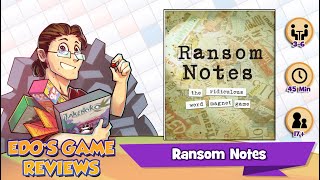
On Gaming with Edo & Jessica, Edo calls the game a hit with their family and describes it as a real crowd pleaser, framing it as a mix of magnetic poetry and Apples to Apples, where the aim is to produce the best statement in response to a card. The review stresses how accessible it is, since it is easy to play and easy to teach.
The publisher spotlight from Tabletoptiktok presents Ransom Notes as a party game built around the funniest response, and it is singled out as a standout among the smaller titles from Very Special Games. Across these reviews, the shared picture is a light, social game whose appeal depends on the group that plays it.
Core Mechanics That Define Ransom Notes
Word Building From a Fixed Magnet Pool
The central constraint is the word magnet pool. Each player receives a set of magnetic words of the kind found on refrigerators, and every answer must be built from those words alone. Rolls in the Family explain that this produces a sort of broken English, because players often have to route around a missing word. They give the example of wanting to say a simple word but having only a phrase like "yellow fire sphere" available. Edo points out that the magnets do not need to form perfect sentences and carry no punctuation, which lowers the bar for getting an answer onto the table. The restriction defines the decision space: players must decide which words in their pool can carry the joke.
Storytelling Through Prompt Cards
Each round begins with a prompt card that presents an outlandish situation or a statement to answer. Edo describes the range of cards as including a tweet, a political complaint, a question about surviving a zombie apocalypse, and a request for money to start a food truck. Players answer the prompt improvisationally, using the magnets to shape a short statement or explanation. Rolls in the Family describe a similar prompt in which a player must explain something to aliens who have just arrived on Earth. The prompts supply the premise, and the table supplies the performance.
The Ransom Notes Experience
Creativity Under Constraint
Reviewers describe the satisfaction of finding an unexpected route to a punchline inside a narrow vocabulary. Rather than treating the limited pool as a frustration, they present it as the source of the comedy. Edo summarizes the idea by noting that the restrictions on words still leave a lot of room for invention. Rolls in the Family add that the strongest moments happen when a player works around the limits in a way the rest of the table did not expect, and that a well-executed answer earns genuine admiration as well as laughter.
Group Laughter and Shared Reactions
The most consistent feeling in these reviews is group laughter. Once answers are shared around the table, the reactions carry the game, and reviewers describe moments of hilarity that build as each person reads out what they made. Edo reports that the game went over well with a group spanning three generations, including children as young as eight. Rolls in the Family are more cautious about the social side, saying the game is very group dependent and works best with people who are comfortable being silly together. In their view, the energy rises most with close friends or family, and it can fall flat with strangers.
What Makes Ransom Notes Stand Out
Witty Answers Over Prepackaged Jokes
Reviewers repeatedly contrast Ransom Notes with Cards Against Humanity. Rolls in the Family say some games prepackage their jokes, with Cards Against Humanity as the most popular example, while Ransom Notes gives each player the chance to supply the punchline. Edo describes Cards Against Humanity as a similar format in which players fill in blanks, and says Ransom Notes asks players to spend more time being creative. For reviewers who value witty responses, that difference is the main reason the game stands apart.
Easy to Teach Across Generations
The game is praised for how quickly it can be learned. Edo says it is easy to play and easy to teach, and that their family took to it without much explanation, also describing how the judge is chosen: the box is spun, and the player where it lands decides the best statement, with the option of a unanimous veto if the table disagrees. Rolls in the Family note that their older brother has become especially dominant at the game, which suggests it rewards skill across ages. They also mention an expansion that raises the supported player count to ten, giving larger groups more room to join in.
Potential Drawbacks
Mature Prompts Need Curation for Families
The most frequently raised concern is content. Rolls in the Family point out that the game is labeled for ages 17 and up and that it includes magnets and prompts that are more mature or inappropriate. They recommend reviewing the prompts before play and removing any that could surprise a mixed-age table, since a prompt that is harmless to adults can be awkward with parents and grandparents present. Rolls in the Family say they wish a family edition had been released alongside the adult version. Edo takes a more relaxed view, having played it with children and noting that a few magnets are questionable, but suggesting that adults at the table can screen the words, and that behavior at the table matters as much as the cards.
Price Relative to the Box Size
Edo notes that the game is not inexpensive, placing it at roughly 40 to 45 dollars for a fairly small box, explaining that the price reflects the large number of magnetic words included, which supports many rounds of play, but buyers who expect a compact game may find the cost surprising. The concern is about value perception rather than quality, and the review presents it as a factor to weigh against the number of plays a group expects to get.
If You Enjoy Ransom Notes
Players who want shared hilarity rather than a competitive contest should consider Telestrations. Rolls in the Family place both games among the most laughter-filled experiences in their collection, and both reward players who embrace silly interpretations.
Apples to Apples suits groups who like the social judging of the best response, and Edo describes Ransom Notes in that same family of party judgment games. Cards Against Humanity is the reference point most reviewers raise, and players who want to build their own punchlines rather than read prepackaged jokes may prefer Ransom Notes for that reason.
What Reviewers Are Saying
"It's very creative. It gives you, some games kind of prepackage their jokes, the most popular one being Cards Against Humanity, which I am not a fan of at all. Don't get Ryan started. Whereas this, it's like you get the opportunity to come up with the punchline."
— Rolls in the Family
"Easy to play, easy to teach, and the what's nice about it is you do have some restrictions with the words, but that enables a lot of creativity."
— Gaming with Edo & Jessica
"You're pulling a bunch of magnetic tiles out of a bag and you get what looks to me like a mini cookie tray, and you have a topic and you're using these tiles to basically make the funniest response."
— Tabletoptiktok