



Rise of the Wastelands Deep Dive
What the Community Thinks About Rise of the Wastelands
Rise of the Wastelands has caught the attention of board game reviewers for offering something unexpectedly nuanced: a post-apocalyptic civilization game that looks like it will be dominated by combat but actually rewards clever resource management and objective racing. The Hungry Gamer notes that the game "is a game that's a little bit not what you expect," drawing explicit comparisons to Scythe as a title where players build expectations based on aesthetic but discover a more cerebral game underneath. Across channel reviews, there is consistent appreciation for the production quality and mechanical depth, though some find the faction powers underwhelming and the exploration phase too brief.
Core Mechanics That Define Rise of the Wastelands
Tech Trees and Power Progression
Advancement through technology is central to the gameplay loop. Players unlock new abilities and upgrade their units through a branching progression system, which directly impacts combat effectiveness. The Hungry Gamer describes this as a constant decision point: "are you going to upgrade your extractors first or are you going to upgrade your Combat First are you going to be able to get to where you can move faster first." This creates meaningful strategic tension where players must choose what aspect of their civilization to mature first, with each choice shaping the trajectory of their game. Board Gaymes James highlights tech trees specifically as a mechanic that resonates: "Tech trees, I'm totally all for."
Power Card System and Combat Decisions
Combat in Rise of the Wastelands is mediated through power cards drawn dynamically during battles, creating what the Hungry Gamer calls "a very clever" system. Each unit's combat value is resolved through these cards, but the real decision tree lies in card play itself. The Hungry Gamer elaborates: "every time you do a combat you get to draw a new one and then play whatever you want is it suddenly makes a very hard choice of do I want to play this card to the thing or hold it for a better combat value later on." This mechanic transforms combat from a purely deterministic exchange into a hand management puzzle. The review calls out a specific example, the ballistic missile card: "you're able to do a superior attack at something up to five range away but what's very clever about it is as you're getting those and every time you do a combat you get to draw a new one and then play whatever you want." This creates interesting decisions even outside formal combat.
The Rise of the Wastelands Experience
Building and Escalating Tension
The game follows a natural narrative arc of escalation. Early turns involve exploration and resource gathering as players scout the post-apocalyptic landscape and establish production capabilities. The Hungry Gamer describes a "very good ramp up to the game" where "usually in the beginning there are several turns where people are exploring and they're getting some resources and then suddenly boom then you're going at it you're attacking each other you're fighting." This creates a satisfying crescendo where peaceful building phases give way to confrontation, mirroring the thematic journey from scavenging to dominance. Tom Vasel of The Dice Tower characterizes the overall experience as "dudes on a map in the future going around and building things up," emphasizing the constructive rather than purely aggressive nature of play.
Push-Your-Luck Exploration with Meaningful Choices
Exploration in Rise of the Wastelands presents players with a decision matrix every time they uncover a new tile. Each exploration event offers a guaranteed safe outcome but also tempts players with a risky push-your-luck option. The Hungry Gamer is enthusiastic about this mechanic: "I really enjoy that and with the exception of the cards that are something out there for you to fight they're all going to be like that so you can take the free thing or you can push it and I always enjoy that it makes for an interesting hard Choice every single time that you explore." The push element creates constant tension, and the Hungry Gamer notes this encourages sustained exploration: "it also helps with the push to explore more because you're going to want to keep exploring because you're going to want to get these things."
What Makes Rise of the Wastelands Stand Out
Clever Power Card Design Creates Unique Combat Tension
The power card system distinguishes Rise of the Wastelands by placing strategic decision-making at the heart of combat resolution. Rather than rolling dice or comparing static stats, players must choose which powerful card effects to deploy when. This layer of play prevents combat from becoming rote and rewards players who think ahead about which cards they hold. The Hungry Gamer calls this "very simple it's very easy but it makes the game super super interesting when you go into combat because again you have to make a tough choice in the moment which I really do enjoy." The fact that cards are drawn fresh each combat means no two battles feel identical, and holding or playing cards becomes a tactical puzzle layered atop the game's strategic resource management.
Strong Production Despite Meeple Components
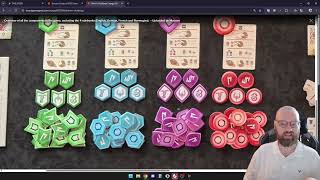
Despite using meeples rather than the full miniature set, the prototype has impressed reviewers with its visual coherence and craftsmanship. The Hungry Gamer emphasizes: "I have seen video that has Miniatures and the version that I have is meeples and things and even just this meeple version I think looks great I think they've done some very neat looking meeples. I like the way you are building things up the way the little buildings slot in together they slot into your City to the point to where I actually prefer this to what I've seen of the Miniatures version." The double-layer board and tactile building mechanics contribute to a production experience that feels premium even in prototype form. Board Gaymes James notes the "cool little chunky piece" and "multi-layered board" as reasons the game caught their eye, highlighting screen-printed wood pieces that add visual depth.
Potential Drawbacks
Exploration Event Pool Depletes Too Quickly
Once players have explored most of the board, the exploration phase loses its most interesting decision space. The Hungry Gamer identifies this as the biggest quibble: "the first and the biggest one for me is I like those explor cards so much there's just not enough of them it makes sense you go exploring flip over a tile once that tile's explored it's been explored but I find those cards so interesting that I'm bummed every time I've played that after the tiles are out that's it there's no more of them that really interesting part of the game has gone away." This creates a pacing concern where the game's most tension-filled moments of decision-making can evaporate partway through the session, leaving the latter half focused more on combat and point racing.
Objectives Sometimes Grant Free Points to Aligned Strategies
The objective system, while creating a race mechanic, occasionally rewards players simply for following natural development paths. Objectives ask players to accomplish goals like "have three units out on the board on different tiles" or "have all your extractors upgraded" or "have all the buildings built into your city." The Hungry Gamer notes: "sometimes people just going to get free points because they were already built a certain way." While this isn't always problematic (players might have been pursuing these goals anyway), it can create moments of unearned victory point distribution that some players find unsatisfying. However, the reviewer acknowledges this is subjective: "I know a lot of players are bothered by that kind of scoring system" but confesses "I actually kind of enjoy it."
If You Enjoy Rise of the Wastelands
Players drawn to Rise of the Wastelands should explore Scythe, the game it most closely echoes in structure and design philosophy. Both are thematically driven civilization-builders where combat feels present but secondary to economic optimization and objective achievement. The Hungry Gamer explicitly makes this connection: "it's a game that's a little bit not what you expect, in the way that Scythe is not what most people expect."
Mosaic and Clash of Cultures also appeal to similar sensibilities. When UndeadVikingVideos discusses their personal preferences in the civilization game space, they highlight Mosaic as a favorite precisely because it abstracts the civilization concept away from traditional warfare. Mosaic treats civilization-building as a more purely economic puzzle, much like Rise of the Wastelands emphasizes production chains and territory control over direct combat. For players who prefer a lighter, more streamlined approach to building empires, Mosaic delivers the conceptual satisfaction without the heavier mechanical overhead.
Clash of Cultures (second edition) appeals to players who want civ-game depth with a tighter time commitment than Scythe or Rise of the Wastelands. The comparison suggests that if Rise of the Wastelands resonates for its tech trees and escalating board state, Clash of Cultures will scratch the same itch through a different mechanical lens focused on cultural and technological advancement in competition.
What Reviewers Are Saying
"I think there's a very good ramp up to the game usually in the beginning there are several turns where people are exploring and they're getting some resources and then suddenly boom then you're going at it you're attacking each other you're fighting and it's a lovely kind of buildup to get to that point."
— Hungry Gamer
"What's very clever about it is as you're getting those, every time you do a combat you get to draw a new one and then play whatever you want. It suddenly makes a very hard choice of do I want to play this card to the thing or hold it for a better combat value later on, and I just find it very, very clever, it's very simple, it's very easy, but it makes the game super super interesting when you go into combat."
— Hungry Gamer
"Dudes on a map in the future going around and building things up. There's a lot to like about this game. Cool production, too."
— The Dice Tower