




















Rum & Bones Deep Dive
What the Community Thinks About Rum & Bones
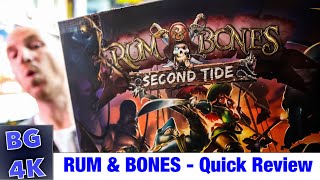
Reviewers tend to describe Rum & Bones as a pirate skirmish game built on a MOBA template. Tom Vasel of The Dice Tower frames it as a game where ordinary pirate crews run at each other and fight inside their ships, a view that other reviewers echo in different words. The consensus favours the second edition. Both reviewers who discuss the history say the first printing was weaker, and the later edition is the one most people recommend seeking out. BoardGameBollocks says the revised version fixed many of the original problems and now sits among its favourite skirmish games.
Agreement is strongest on the miniatures and the two-player experience. Disagreement appears mainly around complexity. The Discriminating Gamer notes a thick rulebook and a real learning curve, and raises questions about how much dice randomness and multiple character roles might affect balance. Reviewers who love the game tend to treat those points as the price of a deep, replayable skirmish rather than as a reason to avoid it.
Core Mechanics That Define Rum & Bones
Dice-Driven Ship Combat
Combat is resolved through dice. BoardGameBollocks describes matching rolled dice against different scores to deal damage, which keeps individual fights tense without requiring long calculations. Movement is also dice-based. The Discriminating Gamer highlights how the dice shape where a character can go and how points are allocated, which makes each turn a balance between what the roll allows and what the player wants to achieve. The Flip Side, hosted by Sam and JT, centres its description on the ships themselves, where the goal is to destroy the other crew's masts before they destroy yours.
Character Upgrades and Progression
Each player takes control of a faction and a group of named characters, and those characters can be improved over time. BoardGameBollocks points to the upgrade system as the reason the game feels like it develops across sessions, giving players a sense of progression as they play. Upgrades turn a one-off skirmish into a campaign of sorts. Each game involves a different selection of heroes and a different set of threats, including external monsters such as the kraken, so the upgrade path never repeats exactly.
The Rum & Bones Experience
Pirate Spectacle
The atmosphere is the first thing most reviewers mention. JT of The Flip Side says the fights feel like the ship battles of the Pirates of the Caribbean films, and that the table recreates that cinematic energy. The miniatures do much of the work here. Ships clash across a board, and the threat of external creatures keeps the scene from settling into a simple duel. The result is a game that rewards players who enjoy spectacle as much as strategy.
Playful Skirmish Romp
Other reviewers describe the tone as lighter and more playful. BoardGameBollocks calls it a really enjoyable romp, and says the game changes from one session to the next because there is so much content to draw on. That mix of unpredictability and familiar combat gives the game a loose, friendly feel. Players who want a tightly controlled tactical puzzle may find it looser than expected, but reviewers who enjoy the chaos tend to come back to it.
What Makes Rum & Bones Stand Out
A Strong Two-Player Miniatures Game
BoardGameBollocks places Rum & Bones among its favourite skirmish games and describes it as one of the best two-player miniatures games available. The game can accommodate more players, but reviewers consistently treat the head-to-head format as where it shines. The Dice Tower makes a similar point from the other side, observing that the game never took off as a big group game because it works so well as a two-player contest.
Character Variety and Replay Value
Reviewers repeatedly come back to the number and variety of characters. BoardGameBollocks says the game is different every time it is played because there is so much content, and the sheer range of heroes is what makes each session feel fresh. Multiple factions and character roles mean that a player who has mastered one approach can always find a different crew to try. That breadth is one of the main reasons the game keeps reappearing on tables after the initial purchase.
Potential Drawbacks
A Substantial Rulebook and Learning Curve
The Discriminating Gamer describes the rulebook as thick and potentially daunting, and warns that the learning curve is real. Players who expect a quick start should plan for a few games before the mechanics feel natural. Reviewers who have pushed through the early sessions generally find the structure rewarding, but the investment is noticeable. The same review also raises questions about balance, given the role of dice randomness and the number of distinct character roles.
Out-of-Print Editions and Limited Availability
Both editions are out of print, which The Dice Tower highlights as a practical hurdle. Reviewers recommend the second edition when it can be found, but finding a copy at a sensible price is not always easy. The first edition is widely considered the weaker release, so buyers who only find the earlier version may come away less impressed than those who play the revised game.
If You Enjoy Rum & Bones
Players who enjoy Rum & Bones's dice-driven ship combat and its character upgrades will find similar satisfaction in Blood Rage. Board Game Coffee draws that comparison directly, placing the two games side by side as points of reference for competitive miniatures fighting.
What Reviewers Are Saying
"This game here is a MOBA style game where you have your basic old boring pirates running at each other and fighting each other in ships."
— Tom Vasel, The Dice Tower
"Rum and bones is essentially a two-player game you can play it with more but it is one of the best two-player miniatures games you can get."
— BoardGameBollocks
"And it's just a really fun frolicy type of pirate game where it definitely basically feels like Pirates of the Caribbean on any of those fight scenes."
— JT, The Flip Side