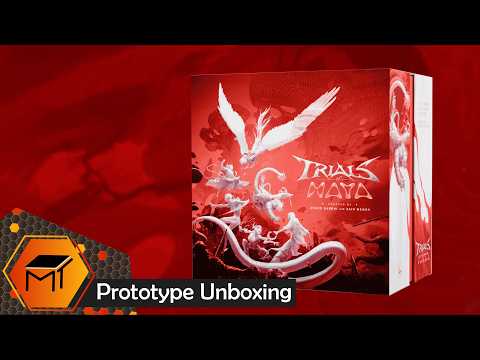



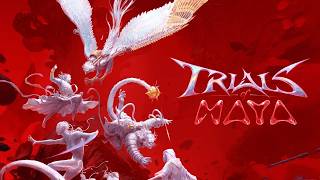
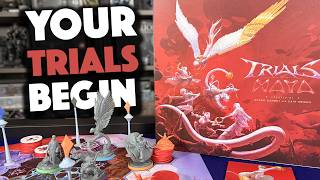


Trials of MAYA box art

Trials of MAYA

Game Info
Year
2026
Players
2-4
Age
12+
Playtime
40 min
Publisher
MAYA Universe
Complexity
2/5
Collection
Ratings
Creator Score
Mechanic profile
Waiting on more creator content
Vibe profile
Waiting on more creator content
Description

An expandable card game set in the MAYA universe where players compete in trials using faction decks

Description

An expandable card game set in the MAYA universe where players compete in trials using faction decks

Ask a Rules Question
All mentions
Browse transcript mentions, sentiments, pros/cons, mechanics, topics, quotes, and references.
Total mentions: 21
This page: 21
Sentiment: pos 16 · mix 1 · neu 1 · neg 0
Mentions per page
Showing 1–21 of 21
Video ec3DibkYgnc BoardGameCo News at 7:34 sentiment: neutral
video_pk 156105 · mention_pk 434390
BoardGameCo - Trials of MAYA video thumbnail
Click to watch at 7:34 · YouTube ↗
Overall sentiment (raw)
neutral
Pros
none
Cons
none
Thematic elements
  • Arena combat
  • Maya narrative universe
Comparison games
none
Mechanics (from transcript analysis)
  • Card Drafting — Players manage cards as they fall off the tableau, giving them energy.
  • minion management — Players manage various minions, choosing whether to aggro them or not.
  • Tableau Building — Players place cards into their tableau, which then fall off to provide energy.
  • team-based play — Offers 2 vs 2, 1 vs 1, and minion hunting modes.
Video topics + discussion points
No key topics recorded for this video.
Quotes (from this video)
  • We have so many skirmish miniature games today.
  • The cards you play down are both determining the actions you do, but it's also determining the combos you can take as you retrieve them and execute combos from your various characters.
  • The milk spoils every round. So, you got to be very careful as far as the efficiency of your engine as you build up your own little uh steam producing uh machine.
  • My excitement I guess it vibes. Call it vibes. Sometimes it's just vibes that you're like, "Oh my gosh, this game looks so fun."
  • Think Gloom Heaven, but while being very different, you have a giant overarching adventure you're going through.
  • The art looks great, the lore looks great.
  • This is my most played well, my most played big box game for sure that I have this year.
References (from this video)
No references stored for this video.
Video Hwm2ydzRQas Rahdo Runs Through Analysis at 7:10 sentiment: positive
video_pk 155931 · mention_pk 433620
Rahdo Runs Through - Trials of MAYA video thumbnail
Click to watch at 7:10 · YouTube ↗
Overall sentiment (raw)
positive
Pros
  • Very striking colors
  • Stylized artistry
  • Asymmetric heroes
  • Cool card play system
  • Reminiscent of MOBAs
Cons
none
Thematic elements
  • Hero-based combat
Comparison games
  • Dota
  • League of Legends
Mechanics (from transcript analysis)
  • asymmetric heroes — Features asymmetric heroes fighting against each other.
  • Card Play — A card play system where cards are slid over each turn, playing a new card, and the slid card provides energy to pay for costs.
  • Combat — A hero-based combat game.
Video topics + discussion points
No key topics recorded for this video.
Quotes (from this video)
  • Maybe I'm just stupid.
  • I FIND THIS I THIS UNPLAYABLE BEYOND TWO PLAYERS.
  • This game to me is a couple's game.
  • I find it an absolute nightmare above two players.
  • it goes so long. It's such a long game.
  • So I think there's so much more to discover when you're playing it, too.
  • So, with that and also the time issue for me, I think two is the only way to play it.
  • the same game but longer.
References (from this video)
No references stored for this video.
Video OThbbs4ZR28 BoardGameCo Review at 8:46 sentiment: mixed
video_pk 153488 · mention_pk 428022
BoardGameCo - Trials of MAYA video thumbnail
Click to watch at 8:46 · YouTube ↗
Overall sentiment (raw)
mixed
Pros
  • Very well done MOBA-style game.
  • Clever system with character back-and-forth and card line building.
Cons
  • Too many games of this genre already that are not getting played.
Thematic elements
  • MOBA-style game
Comparison games
  • Onward
  • Rome and Bones
  • Guards of Atlantis
Mechanics (from transcript analysis)
  • Card Drafting — The host mentions the way you build your card line.
Video topics + discussion points
No key topics recorded for this video.
Quotes (from this video)
  • 10 Penny Parks is already much better just with the Innovation expansion alone.
  • I'm curious whether playing full through the full arc and I have both the base game and animal doctor rising and expansions. I'm curious if playing through the full arc is going to be like yeah, this is an amazing game and I need to play it all the time or if it'll be like no, that was good.
  • My gut instinct is that I think it's going to be a game that I play and then move on I think I'll clear up a full campaign once I'm done with it.
  • Cascadia Alpine Lakes is a good example there.
  • My son's like, 'Can we Can we finish it?' But he actually wants to start it again. So now we started again to go through it and I've been enjoying that.
  • And overall, uh I'm enjoying diving back into it.
  • I've always had a soft spot for Machi Koro.
  • Machi Koro Legacy, if you if you have an unopened or unplayed, I should say. I don't care if it's opened. If you have an unplayed copy of Machi Koro Legacy, I would like to buy from you.
  • speaking of Legacy games. I hope to play Red Cathedral Legacy.
  • This is one that I was always excited when I saw it on crowdfunding. It's been on my list to pick up.
  • There'll also be a spirit train preview going up on the channel. That campaign has like, you know, a few days left to go.
References (from this video)
No references stored for this video.
Video -GeC825uPAg Meeple University Top List at 2:33
video_pk 151897 · mention_pk 426008
Meeple University - Trials of MAYA video thumbnail
Click to watch at 2:33 · YouTube ↗
Pros
none
Cons
none
Thematic elements
  • Based on a book
Comparison games
none
Mechanics (from transcript analysis)
Mechanics unknown.
Video topics + discussion points
No key topics recorded for this video.
Quotes (from this video)
  • It is not a new game. game. This is by Looping Games is 1998 iss.
  • this was another great experience.
  • loosely speaking it's worker placement but it's got a couple of types of workers.
  • the timing there is critical.
  • it's really interactive and really brutal if you're not watching like you need to invest make sure you have astronaut at the right time at the right place sometimes giving up the action that you really want so that you can have some opportunity to do your like action otherwise if you don't have the astronaut in the right place you are going to I mean not for the game but basically like you can't do anything
  • highly recommend it.
  • Game number one for me is Omens by Hashet Games.
  • This is a team versus team game.
  • it plays very quickly in that way because you're not dealing with very many cards.
  • but it's a different way of thinking.
References (from this video)
No references stored for this video.
Video L8HYDVLkgdc Board Games UnLocked Review at 0:12 sentiment: positive
video_pk 128734 · mention_pk 366191
Board Games UnLocked - Trials of MAYA video thumbnail
Click to watch at 0:12 · YouTube ↗
Overall sentiment (raw)
positive
Pros
  • Unique and engaging card play system.
  • Highly asymmetric and unique hero characters.
  • Innovative mechanics like relic cards, spell cards, and reaction spells.
  • Satisfying character progression and upgrade system.
  • Dynamic and valuable minions.
  • Good balance between strategy and accessibility (not too sweaty).
  • Good two-player mode that doesn't require controlling multiple heroes.
  • Prototype quality was good, indicating potential for a great final product.
Cons
  • Plastic chips for health are not as satisfying as weighted poker chips.
  • Suction cups on tower bases sometimes don't stick.
  • Miniature sizes are too large and get in the way.
  • Rulebook is split into multiple books (rulebook, reference, game modes), which can be inconvenient.
  • Some edge cases in rules (e.g., 'flying' keyword interactions) are not completely clear.
  • Wish for more variety in skills or traits for characters.
  • Wish for modular maps for more variety.
Thematic elements
  • AI simulation battle game where the AI collects data.
  • Audio narrative done by Hugo Weaving.
Comparison games
  • Onward
  • Cloudspire
  • Guards of Atlantis
  • POW World
  • Tom Cruz movie (unnamed, about AI predicting crime)
  • Magic the Gathering
Mechanics (from transcript analysis)
  • Card-driven actions — Actions are determined by cards that slide down a track, influencing availability and initiative.
  • Chip health system — Utilizes a system similar to Chip Theory games for tracking health.
  • Deck Building — Players can customize and build their character's decks.
  • Energy System — Cards have an energy cost to use, and energy is gained when cards slide off the track.
  • Minion control — Players can control NPC-like units to fight.
  • Minion HP bank — Damage dealt to minions is stored in an HP bank, which can be used as currency to summon and control minions.
  • MOBA-style skirmish — A genre of game that involves players controlling heroes in a combat scenario, often with tower defense elements.
  • Player respawn — When a character dies, they respawn, and their tower takes damage based on the number of deaths.
  • Reaction Spells — Spells that can be played in response to opponent's actions.
  • Relic cards — Slot upgrade cards that can provide modifiers or actions.
  • Spell cards — Cards that offer special abilities or affect the board state.
  • tower defense — Involves trying to destroy the opponent's tower.
  • XP system — Experience points are gained through objectives and used to upgrade characters and skills.
Video topics + discussion points
No key topics recorded for this video.
Quotes (from this video)
  • It seems to have gotten a lot of buzz.
  • In my experience, the games that I'm getting constantly hammered with for marketing tend to not actually be that good.
  • Trials of Maya falls into the ladder. It this game does have a lot of stuff going for it.
  • This is not the case. This game, I think, does a lot of stuff that is really, really cool.
  • Trials of Maya is fascinating because it feels kind of like all of those, but yet still feeling unique uh and stands on its own.
  • The heroes are probably the coolest part of this entire game.
  • The deck crafting rules are actually incredibly simple.
  • This game has managed to do something that, you know, some other uh games of this type have have failed to do in that it's really not that complex. It's very simple.
  • This is probably one of the coolest and more unique aspects of this game is that if you play a cards, well, whenever you're playing cards, you have to think of a couple things. the lower your energy yield is going to be, the faster you're going to go in initiative because later on when these cards fall off, you're only going to gain that much energy.
  • I really love the uh the relic system in this game.
  • This game actually has reactions that if someone does something, you could if you save the energy similar to Magic the Gathering where if you saved your mana that now could, you know, some people could look into that and think, okay, he kept a lot of energy. Is he wanting to do something on his next turn with a really high energy cost card or does he have a a reaction like a counter to me?
  • I love that stuff. I think it is so cool and underutilized in a lot of games.
  • I really think that the card play in this game is honestly its bread and butter.
  • The characters are absolutely amazing.
  • I think that they have somehow managed to balance a really fun puzzle high, you know, high strategy but not sweaty.
  • Um, I think is purely production is that I am playing on a prototype.
  • So, I hope that that's fixed.
  • I do wish that you didn't have to stick with their traits.
  • I think that that's neat. I think the minions are extremely serviceable. They're valuable, but they're not in the way, which is a really good thing.
  • Overall, this was a game I was completely blown away by uh for its prototype.
  • I would give this a nine if this came out with honestly as is with obviously better production.
  • This one I think would just be way easier to get to the table because it's not as sweaty and it has a better two-player version than Guards where you don't have to control two heroes.
References (from this video)
No references stored for this video.
Video LfDsAZcihEg Man vs Meeple Review at 0:00 sentiment: positive
video_pk 124667 · mention_pk 357447
Man vs Meeple - Trials of MAYA video thumbnail
Click to watch at 0:00 · YouTube ↗
Overall sentiment (raw)
positive
Pros
  • MOBA inspired gameplay with tabletop adaptation
  • Expandable system with deck building
  • Customizable player boards and character upgrades
  • Strategic card play with timing elements
  • Multiple game modes available (Siege, Head Hunter)
  • Unique minion spawning and health token system
  • Engaging objective-based XP gain for character progression
  • Well-produced components with practical storage solutions
  • Varied character abilities and playstyles
Cons
  • Prototype components had some issues (wobbly suction cups)
  • Can be complex with many decisions to make
Thematic elements
  • MOBA inspired battle game
  • Maya narrative universe
Comparison games
  • MOBA
  • TCG
  • LCG
Mechanics (from transcript analysis)
  • Action cards — The meat of the game is these action cards. Everything that you'd expect to do in a MOA game. You're moving, you're attacking, you're pushing, you're pulling, you're doing other status effects on players like poisoning them or whatever. All of that is done through these action cards.
  • Card play system — It's all built around an interesting card play system as well, which is another thing you're going to be doing on your board is playing your cards.
  • Deck Building — There is some deck building elements to the game. Like a lot of these expandable games, you can come into it by building your own deck.
  • Energy System — Every single one of these cards has an energy value that it costs to use the card on your turn, but it also has an energy value down in the corner. When it falls off, you get that energy for the next round.
  • Experience points — You're going to be gaining experience through objectives and spending them on these things, making a lot of decisions as you play the game.
  • Minion Spawning — You can use those tokens to then summon and spawn your own minions with health from that pool.
  • objectives — You're going to be playing with objectives out and there's going to be some objectives that maybe specifically start out based on the scenario. There's going to be some that are random objectives sit out in front of you and on your turn if you've completed one, you can complete one objective a turn a round.
  • player board upgrades — The player board is fully upgradable. You're going to have all these sections of the board. You're going to start with some skills that you can upgrade over the game. You're going to start with some health values, defense values, energy values that can all be upgraded throughout the game.
  • Push and pull — Because you have that push and pull mechanic. You can place the high ground, push someone into the high ground or low ground, deal extra damage.
  • Skill upgrades — You start with three skills you can unlock and they can go all the way up to a level two skill, which is like a very strong version of that.
  • terrain — There's high ground and low ground, at least on this map. And that affects the damage that you might do.
  • Trait system — There are these traits. There's these symbols, and a lot of the cards will potentially be more powerful based on the number of traits you have active.
Video topics + discussion points
No key topics recorded for this video.
Quotes (from this video)
  • Definitely MOA inspired. It's going to give you some of those vibes or at least as much as a tabletop game, I think, can.
  • Everything as you kind of play through is very customizable.
  • The meat of the game is these action cards. Everything that you'd expect to do in a MOA game.
  • So the earlier you can get those skills unlocked, the more you're going to be able to lean into your character strengths.
  • The production value overall is really nice. It has a very elegant look.
References (from this video)
No references stored for this video.
Video 1-sn287k5wU BoardGameCo Playthrough at 0:03 sentiment: positive
video_pk 124672 · mention_pk 357451
BoardGameCo - Trials of MAYA video thumbnail
Click to watch at 0:03 · YouTube ↗
Overall sentiment (raw)
positive
Pros
  • Multiple play modes available.
  • Potential for deck building.
  • Strategic character and minion actions.
  • Moba-style gameplay with tower destruction.
Cons
none
Thematic elements
  • Champions are plucked and run through simulations, battling with minions and attacking opponent's towers.
  • A simulated living thing named Maya is running trials.
Comparison games
  • Street Fighter
Mechanics (from transcript analysis)
  • Action Point Allowance — Players have a limited number of actions or energy to spend per turn.
  • Area Control — Control of specific zones on the board is implied through movement and positioning.
  • Card Drafting — Players select cards to play each round, influencing turn order and actions.
  • Deck Building — Players can build their own decks of cards.
  • Health management — Characters and towers have health pools that must be managed and depleted.
  • Leveling up — Characters can gain experience and level up, improving their abilities.
  • Skirmish — A game focused on small-scale battles between units.
  • tower defense — Players must defend their towers while attacking the opponent's.
Video topics + discussion points
No key topics recorded for this video.
Quotes (from this video)
  • Ultimately our main goal as we play through this uh scenario over here is to take down the health of the opponent's towers.
  • The first time a champion dies, you deal one damage to your tower. The second time you deal two and onwards and so forth.
  • Flight is basically in the game. Height always means you deal plus one damage and flight is considered to be higher than anything else.
  • This is so crazy. All right. I have to figure out like doing this correctly, but I can.
References (from this video)
No references stored for this video.
Video YWi0-53Kfr0 Meet Me At The Table Rules Teach at 0:07 sentiment: positive
video_pk 124669 · mention_pk 357449
Meet Me At The Table - Trials of MAYA video thumbnail
Click to watch at 0:07 · YouTube ↗
Overall sentiment (raw)
positive
Pros
  • Highly asymmetrical characters offering unique play experiences.
  • Deep deck construction allows for significant customization and replayability.
  • Engaging initiative and tiebreaker system that adds strategic depth.
  • Meaningful character progression through experience points and upgrades.
  • Modular battlefields for different player counts and game modes.
  • Elimination of dice-based luck in core actions, focusing on player planning.
  • Cool mechanics like sliding cards for energy and programmable turns.
Cons
  • Quality of chips in the prototype could be improved; they may spill out when stacked high.
  • Suggestion to potentially include a five-point chip for easier tracking of higher damage/health totals.
Thematic elements
Comparison games
none
Mechanics (from transcript analysis)
  • Action Point Allowance — Players spend energy to play cards, and energy is gained by sliding cards off the board. Upgrades can increase bonus energy gained.
  • area control/influence — Minions can be placed on the board to assist the player, and players can take over neutral towers.
  • asymmetrical player powers — Each character has unique passive powers, traits, and starting decks, making them play very differently from one another.
  • Card Play — Players use cards from their hand to perform actions, modify existing actions, or trigger special effects. Cards have energy costs and initiative values.
  • Combat — Players can deal damage to minions or the opponent's tower, with effects like 'rip' (discarding cards) and 'drain' (reducing stats) mentioned. Terrain (high/low ground) can affect damage dealt.
  • Deck construction — Players can construct their own decks by adding cards beyond the starter decks, aiming for synergies and different playstyles. The deck size can be adjusted, though smaller decks are noted as potentially more efficient.
  • Initiative tracking — Players play cards face down to determine turn order based on initiative values, with a tiebreaker system in place.
  • Objective Completion — Completing objectives grants experience points, which are crucial for character progression.
  • Player Progression — Characters gain experience points which can be spent to upgrade hand size, energy gain, health, and unlock new abilities or symbols.
  • Resource Management — Players manage energy gained from cards to play other cards and manage their hand of cards.
  • Set Collection — Some cards and abilities rely on collecting or matching specific symbols (e.g., Nog, relic keeper, fleet shot) or having certain relics.
Video topics + discussion points
No key topics recorded for this video.
Quotes (from this video)
  • This is a MOA style game that can be played 1 v one, 2v2, or up to four players in a battle royale type sit scenario.
  • Every character does come with a preassembled 24 card deck.
  • This game is a deck construction game where you can have another set of these are all cards that are not part of the starting decks that you can use to fit into the other decks to your other deck and create a completely different way to play each of the characters.
  • The core concept behind Trials of Maya is over several rounds, your goal is to take out your opponent's tower.
  • I love the fact that there's not a very there's a tad bit of luck, but there's also the programming in this game where you want to program your stuff to be able to gain the most benefit from the cards that you can.
  • I love the fact that every character is so asymmetrical in the way that they play.
  • One of the things I think they do need to improve on is the chip of the game, the quality of them.
  • I love the sliding cards and then everybody flipping over a card and then that is kind of how you're programming your turns to go forward.
References (from this video)
No references stored for this video.
Video Y-2Ymc869mY Hungry Gamer Review at 0:08 sentiment: positive
video_pk 124673 · mention_pk 357452
Hungry Gamer - Trials of MAYA video thumbnail
Click to watch at 0:08 · YouTube ↗
Overall sentiment (raw)
positive
Pros
  • Intensely promising production for a prototype.
  • Good-looking miniatures.
  • Doesn't take up a ton of table space despite a large box.
  • Different scenarios and character interactions lead to high replayability.
  • Not overly complex for the amount of variety.
  • Decently snappy playtime.
  • Unique card-sliding mechanic for energy/powering abilities.
  • Heroes play differently.
  • Appreciates the lore and world-building.
Cons
  • Large box size will take up significant shelf space.
  • Significant learning curve and not forgiving to new players or those trying new characters.
  • Does not change the MOBA genre.
  • Not likely to convert players who dislike MOBA-style games.
  • Wish it had a solo mode or bot support for team play.
Thematic elements
Comparison games
  • Guards of Atlantis II
  • Cloudspire
  • Omicron Protocol
  • Uprising: Curse of the Last Emperor
Mechanics (from transcript analysis)
  • Card Play — Playing a card onto the left side of your player board determines energy for activating other cards.
  • Deck Building — Each hero has a deck of cards.
  • hero abilities — Each hero plays differently and has unique powers.
  • Leveling up — Gaining experience allows players to level things up and gain access to new skills.
  • Minion combat — Chasing down minions provides XP and has a neat mechanic where the killer can spawn a minion later.
  • Objective Fulfillment — Players pursue different objectives, which cycle in and out.
  • Tableau Building — Cards are slid under your tableau to power up abilities.
Video topics + discussion points
No key topics recorded for this video.
Quotes (from this video)
  • This is a MOBA style game... and that's not my jam.
  • It is clearly coming from a different cultural base and that is just interesting as heck to me.
  • The way that you're powering up your other abilities by the card that slides off the tableau. That's cool. That makes it so interesting.
  • For a prototype, this thing is spectacular.
  • It doesn't take up a ton of space on the table and I always really, really appreciate that.
  • So, for a game with the amount of variety that I think it has in it, it's not overly complex and I really do enjoy that.
  • It's a big old box and it's probably going to be bigger. So, this is going to take up a lot of space on your shelf.
  • I don't think this is changing the genre.
  • Would I put this on my shelf if I already had those two? My answer is yes. I would because it's doing something that I think is clever and it feels different and it looks different.
  • I wish it had a solo. And not just a solo, I wish it had a solo that could also be a bot.
References (from this video)
No references stored for this video.
Video bKU7qGpBN6Q TheGameBoyGeek - Hi Quality Hi Energy Board Game Reviews Review at 0:16 sentiment: positive
video_pk 124671 · mention_pk 357450
TheGameBoyGeek - Hi Quality Hi Energy Board Game Reviews - Trials of MAYA video thumbnail
Click to watch at 0:16 · YouTube ↗
Overall sentiment (raw)
positive
Pros
  • Beautifully sculpted miniatures for champions.
  • Double-sided player boards with strategy tips and backstory.
  • Unique card-driven combat system with initiative tracking.
  • Dynamic board with different terrain types affecting gameplay.
  • Interesting minion aggro mechanic.
  • Satisfying upgrade system for champions.
  • Multiple game modes catering to different player counts and styles.
  • Teamwork mechanics in 2v2 mode allow for shared information and strategy.
Cons
none
Thematic elements
  • Epic high fantasy universe
  • Maya
Comparison games
none
Mechanics (from transcript analysis)
  • action phase — Players take turns performing actions such as activating cards, moving, attacking, or defending.
  • Card Driven Combat — The core of the game revolves around playing cards for various abilities, costs, and benefits in combat.
  • Deck construction — In advanced play, players can construct their own decks of cards based on champion traits and available cards.
  • Initiative tracking — Players gain energy from sliding cards off their board, and this energy gain influences initiative order for turns.
  • Minion Aggro System — Minions can become 'aggro' to players who end their turn next to them or damage them, leading to retaliatory attacks.
  • Movement and terrain — Movement on the board is affected by terrain types like walls, high ground, low ground, and voids.
  • Objective Fulfillment — Players can earn experience points by completing various objective cards.
  • Relic Activation — Players can play relic cards that provide ongoing upgrades or benefits when activated.
  • Spell Casting — Spells can be cast by spending energy to achieve various effects, like enhancing attacks.
  • Team Play Mechanics — In team modes, teammates can share resources, view each other's hands, and coordinate actions.
  • Tower Control/Destruction — In siege mode, teams aim to destroy the opponent's towers, which can be damaged directly or indirectly by killing enemy champions.
  • Upgrading Champion Abilities — Experience points can be spent to upgrade champion stats, energy gain, or unlock new skills.
Video topics + discussion points
No key topics recorded for this video.
Quotes (from this video)
  • Hello my friends, it's the Game Boy Geek here.
  • This is a crowdfunding preview, so all the art and components you see here are not final.
  • So, as you can imagine in a game with tactical card driven combat, initiative is very important.
  • The other team is trying to destroy your two towers and you're trying to destroy their two towers. The first team to do that wins.
  • If you ever completely kill a minion, well, you can actually spawn it as an ally minion on a future turn.
  • And also, with you and your teammate, you are allowed to look at your teammate's hand and sort of work together like that.
References (from this video)
No references stored for this video.
Video iIzaDBLFJJQ Board Gaming Ramblings Review at 0:06 sentiment: positive
video_pk 123675 · mention_pk 354440
Board Gaming Ramblings - Trials of MAYA video thumbnail
Click to watch at 0:06 · YouTube ↗
Overall sentiment (raw)
positive
Pros
  • Interesting customization options through deck building and in-game upgrades.
  • Adaptive gameplay due to changing objectives and card order affecting actions.
  • Variety in heroes with different playstyles and decks.
  • The experience point system for upgrades is an interesting way to customize.
Cons
  • Deck building might be less appealing to players not interested in that aspect.
  • Can be quite long, though play time may decrease with familiarity.
Thematic elements
  • tower defense
Comparison games
  • Magic the Gathering
Mechanics (from transcript analysis)
  • action selection — Cards determine available actions, and playing cards can change the available actions and player order.
  • Deck Building — Players can build or use pre-built decks of cards, which are a smaller pool than in games like Magic the Gathering.
  • Objective Fulfillment — Players race to claim objectives each round to gain experience and other benefits.
  • Player Progression/Upgrades — Experience points are used to upgrade the player board in various ways, including energy gain, health, and card abilities.
  • Resource Management — Players manage resources such as cards, experience, and energy.
  • tower defense — The core gameplay revolves around defending a tower from an opponent.
Video topics + discussion points
No key topics recorded for this video.
Quotes (from this video)
  • Hello everyone. This is Johannes and you are watching Board Gaming Ramblings.
  • It's not like everything will be changed but they are allowed to change whatever they want.
  • If you didn't enjoy the video, you can still subscribe, because we do a lot of different videos.
References (from this video)
No references stored for this video.
Video ON2nHOxd4aY BoardGameCo Rules Teach at 0:02 sentiment: positive
video_pk 122986 · mention_pk 353216
BoardGameCo - Trials of MAYA video thumbnail
Click to watch at 0:02 · YouTube ↗
Overall sentiment (raw)
positive
Pros
  • Multiple game modes (Siege 1v1, Siege 2v2, Head Hunters).
  • Deck building element allows for customization.
  • Experience points are crucial for upgrades and provide multiple benefits.
  • Minions can be turned into player's own units.
  • Champions have unique abilities and attributes.
Cons
  • Prototype copy, subject to change.
  • Attacking towers can be risky due to tower counter-attacks.
  • Conditions like 'root' can hinder movement.
Thematic elements
Comparison games
none
Mechanics (from transcript analysis)
  • action selection — Players choose cards to play onto their player board each round, which determine actions and initiative.
  • Area Control — Players can gain control of areas on the map to spawn in those locations.
  • Combat — Players can attack other champions, minions, and towers. Damage to towers is a win condition. Minions attack back if attacked.
  • Combat Conditions — Conditions like 'bleed' (true damage) and 'root' (reduces movement) can be applied to players.
  • Deck Building — Players have signature cards for their character and can build their deck from cards related to their attributes, with rules on deck size and card copies.
  • Hand Management — Players draw cards up to their hand limit and can discard unwanted cards at the end of their turn.
  • Objective Cards — Players can claim objective cards each round to gain experience points.
  • Resource Management — Players must manage energy to activate cards and perform actions. Unspent energy carries over.
  • Set Collection — Players collect 'heads' from defeated minions, which can then be used to summon those minions for their own team.
  • upgrading — Players can spend experience points to upgrade their character's health, defense, energy gain, and abilities.
  • Variable player powers — Each champion has unique attributes and signature cards, leading to different playstyles.
Video topics + discussion points
No key topics recorded for this video.
Quotes (from this video)
  • This is a sponsored preview and this is a prototype copy in front of me. So all rules, components, things like that are subject to change.
  • players are going to be playing as different champions and they are all very unique and they have certain attributes that will determine what cards are in their deck.
  • you have to be sure to manage your energy as well because you're only able to activate as many cards as you have energy to activate them.
  • when that minion is killed, whoever lands the killing blow is going to be able to collect it as a head of that minion and then in the future be able to summon it for their own team.
  • as soon as one player depletes another player's tower chips of their entire health, that's when they're going to win the game.
  • the experience is extremely important.
  • Trials of Maya is going to be a very head-to-head skirmish game where players are going to have to be focusing on multiple things at once.
  • it really is a judgment call with how much energy you have available to you and how many actions you're able to do each round.
References (from this video)
No references stored for this video.
Video K2c6ARE6AE8 BoardGameCo News at 11:25
video_pk 122999 · mention_pk 353243
BoardGameCo - Trials of MAYA video thumbnail
Click to watch at 11:25 · YouTube ↗
Pros
none
Cons
none
Thematic elements
Comparison games
none
Mechanics (from transcript analysis)
Mechanics unknown.
Video topics + discussion points
No key topics recorded for this video.
Quotes (from this video)
  • Asmodee's buying the uh Welcome To brand and the company. Apparently, it has 3 million plus plays.
  • Whenever you have like a degree of news in the tabletop hobby, but not in board games. Like none of the board game sites that I've seen have covered this.
  • The problem when you're not transparent with your audience, the problem when you let people figure it out and guess themselves, is sometimes they go to 2 + 2 = 4, when really 2 + 2 = 4.5 in this particular situation.
  • Steamforged did release an update I already talked about. Yes, you know, we have it covered. Sorry about that. It's going to be taken care of. It's one of those many things that doesn't look good and probably isn't good, but it doesn't necessarily mean that all the boats are falling over at least not yet.
  • Got 5 is strangely addictive. I've been playing it so much. It is a little bit insane.
  • Overall I thought Opera Magna was very well done.
  • I do like it more than White Castle, that's for sure.
  • Overall I enjoyed it. It hit every box. It was a great game. I just didn't feel the wow factor personally. I gave that a 3.5.
  • My Island was a disappointment. I I wanted that game to be more for me. It wasn't unfortunately.
  • Gloomhaven which I also have been going through a lot. Again, it's another one I want to do a 12 by 12 review of.
  • Certain games are just you know, my jam.
References (from this video)
No references stored for this video.
Video 8L_fN7cZ9AY The Brothers Murph Playthrough at 0:16 sentiment: positive
video_pk 119394 · mention_pk 336214
The Brothers Murph - Trials of MAYA video thumbnail
Click to watch at 0:16 · YouTube ↗
Overall sentiment (raw)
positive
Pros
  • Strategic decision-making regarding energy and card costs.
  • Engaging tactical maneuvering with various movement and combat abilities.
  • Unique champion abilities offer varied playstyles.
  • Possibility for deck construction beyond basic decks.
Cons
  • Initiative can be crucial, leading to potentially unfavorable back-to-back turns.
  • Misplaying initiative can lead to being in a disadvantageous position.
Thematic elements
  • simulation battles to destroy opponent's tower
  • a simulated world
Comparison games
none
Mechanics (from transcript analysis)
  • Area Control — Players can place fortifications that create colonies, influencing combat and providing advantages.
  • Card activation — Energy is spent to activate cards, which then allow players to perform actions shown on the card.
  • Combat — Includes direct tower attacks, minion combat with damage and health tracking, and champion elimination.
  • Deck construction — Players can deck build or deck construct their decks beyond the suggested basic champion decks.
  • Hand Management — Players draw cards up to their hand limit and manage their hand for strategic plays.
  • Player Mat Upgrade — Gaining XP allows players to upgrade their player mat for better abilities, health, and energy.
  • Projectile Attacks — Some attacks have range, allowing players to attack from afar.
  • Push/pull mechanics — Abilities allow players to push enemies into other units or spaces, or pull units towards them.
  • Rooting — An effect that can immobilize or reduce movement of units.
  • Tableau Building — Players use a card system that shifts, allowing for actions like attacking, moving, and drawing cards.
Video topics + discussion points
No key topics recorded for this video.
Quotes (from this video)
  • We're in the simulation. Get ready for battle.
  • This is a a kind of a simulation battler game where uh in within the story of the world where we're kind of Maya's running tree of Maya.
  • You want to be the first one to do that.
  • Each round will go through several phases in order.
  • This is a simulation battler game where uh in within the story of the world where we're kind of Maya's running tree of Maya.
  • All right, so, um, we'll go ahead and start with the refresh phase.
  • So, um, how forward, how aggressive do I want to be?
  • So, our little starting, uh, tower here.
  • Um, so we'll say first of all, prototype stuff, prototype components, prototype everything.
  • This is where I can do upgrades.
  • This is interesting because I basically get to control them.
  • Oh, no. You're not going to be quite quite dead.
  • I was I was maybe a little too confident
  • Yeah. So, you know what? That situation. I'm going to actually have them push you cuz you just won't move which means it will hit this for three because maybe I can like lower their health and then maybe I can kill them.
  • Yeah. I think you're probably still going to get me dead, but
  • My question is how much on my turn? How much def damage did I do?
  • Man, so tough.
  • It's a lot of decisions, you know, the initiative, the the actions that are provided, any passive effects, on and on.
  • I really, really want to destroy.
  • I don't think I can get you though.
  • So, the thing is your tower can attack back, but it attacks back at the end of your turn.
  • So, the initiative, the the actions that are provided, any passive effects, on and on.
  • You took down my tower's health by like half in one turn there.
  • This was but a simulation. Nothing bad actually happened anyway.
References (from this video)
No references stored for this video.
Video XqbdEFb30OY Meeple University Rules Teach at 0:06 sentiment: positive
video_pk 119026 · mention_pk 335313
Meeple University - Trials of MAYA video thumbnail
Click to watch at 0:06 · YouTube ↗
Overall sentiment (raw)
positive
Pros
  • Focus on player actions driving the game.
  • Satisfying victory through destroying enemy towers.
  • Ability to sway minions to fight as allies.
  • Strategic depth in card activation and energy management.
Cons
none
Thematic elements
  • Champions battling in arena combats for Maya's knowledge and understanding
  • the land of Naay, under the super sentient Maya network
Comparison games
none
Mechanics (from transcript analysis)
  • Card activation — Players activate deactivated cards by paying an energy cost and sliding the card up to take actions.
  • Combat — Actions include moving, drawing cards, increasing defense, pulling/pushing entities, and attacking enemies or minions.
  • Deck construction — Players have a deck of cards, either pre-built or built using the game's deck construction rules.
  • Energy management — Energy is used to pay for card actions, and is gained based on what's in the lower right corner of cards during the 'slide' phase.
  • Equipment/Relics — Relics can be equipped to action card slots, adding their effects to the activated card.
  • Initiative tracking — Players reveal action cards and use energies to set the initiative order, with ties broken by a tiebreaker track.
  • minion management — Neutral or enemy minions can be damaged to gain their hit points and heads, and then spawned as friendly minions.
  • Objective Completion — Players can gain experience by meeting objectives on the objective mat, with points awarded for being the first to mark it.
  • Spellcasting — Players can play spell cards from hand, paying energy costs and resolving effects.
  • Status tokens — Attacks can deal status tokens like root (cancels movement) and bleed (suffer damage when activating a card).
  • Terrain effects — Different terrains on the map can have effects, and connected groups of matching hexes are called zones.
  • tower combat — In siege mode, players have towers that can attack, and towers lose health from conventional attacks or when a champion dies.
Video topics + discussion points
No key topics recorded for this video.
Quotes (from this video)
  • And hi everyone, it's Stella.
  • And Tarrant, welcome to Maple University.
  • To Maya, the players are mere pawns and data points.
  • This is also your current maximum value for both health and defense.
  • The rest of your board has three passive abilities available immediately, and several upgradeables, which begin inactive.
  • To begin, there will be two starter objectives, and others from the deck, for a total of four objectives in a two-player game, or five objectives with more.
  • For now, arrange players only on the tiebreaker track, not initiative.
  • Players slide all their cards to the right, and for the ones which are discarded, players gain energy based on what's in the lower right, and resolve on exit effects in initiative order if there are any.
  • Any ties are broken by the tiebreak track with the tiebreak winner pushing to the back of the queue.
  • If your champion is off the map, return it to an empty space as close to one of your spawn points as possible.
  • Completely finish with one minion before starting another if you have more than one.
  • The core of the game is in the player's actions.
  • Take any number of actions with your champion, most of which will come from spending energy to activate the action cards in your tableau.
  • You may activate a deactivated card.
  • I'll talk more about the action phase in the next section.
  • You may play a spell from hand.
  • For reaction spell, you may play this only out of turn in response to a trigger.
  • You may equip a relic from hand.
  • You may use a champion's active skill or ability.
  • You may gain experience.
  • A key part of your battle will be swaying minions to fight as allies on your side.
  • When you damage a neutral or enemy minion, you take its hit points to your bank.
  • And when you land the final blow, you also get to take its head.
  • At any time during your turn, you may spawn a friendly minion by putting a head you've collected on top of any number of banked hit points and spawning next to one of your spawn points.
  • Some attacks deal status tokens.
  • Read your champion's abilities and strategy tips carefully as these will drive your style of play.
  • In the siege, all spawn points are contestable, and at the end of the round, you claim any spawn point where your team has strictly more entities on its adjacent spaces than the enemy or the neutrals.
  • When they damage minions, any hit points they take go to a shared hit point bank.
  • There is also never friendly fire.
  • In a siege scenario, your aim is to destroy the enemy tower.
  • These are out of the game. They are not banked.
  • Secondly, when a champion loses all health, it dies and is removed from the board.
  • The champion will respawn with full health in that player's next respawn step, keeping everything on your board except for negative statuses and relics.
  • In the siege, the first player or team to destroy all opposing towers is the winner.
References (from this video)
No references stored for this video.
Video QZ32REAaBWo Rob's Tabletop World Review at 0:36 sentiment: positive
video_pk 112064 · mention_pk 322809
Rob's Tabletop World - Trials of MAYA video thumbnail
Click to watch at 0:36 · YouTube ↗
Overall sentiment (raw)
positive
Pros
  • Very good prototype quality
  • Unique MOBA system
  • Strong integration of book theme into gameplay
  • Intense and unnerving story
  • Likely to be interesting on Gamefound
  • Deserves to be funded
  • Wonderful and unique game
Cons
none
Thematic elements
  • prediction of the future
  • futuristic, involving a supercomputer in the form of a tree
Comparison games
  • League of Legends
Mechanics (from transcript analysis)
  • Area Control/Objective — The core objective is to destroy the opponent's base while defending your own.
  • Card Play — Players use cards to pay for actions and abilities, with energy costs and effects described.
  • Combat — Players can move, attack, and defend using their champions and minions.
  • Deck construction — The game involves constructing decks, and players will be able to acquire more characters for expansions.
  • Energy management — Players manage energy to pay for card costs and activate abilities.
  • Minion Movement — Players control minions that move on the board, and these can be captured and used by the opponent if defeated.
  • MOBA — The game is described as a MOBA, similar to League of Legends, involving combat and strategic objectives.
Video topics + discussion points
No key topics recorded for this video.
Quotes (from this video)
  • So, you're going to want to look for it, and I believe it is coming to Gamefound, if I'm not uh 100% correct. But, it is based on a book, and it's called Trials of Maya.
  • From from looks of prototype, boy, uh I think you're going to want to get this, cuz the prototype's really good.
  • It feels like the book. And I really think this is something that you'll find very interesting on Game Fan.
  • The story is so unique and so out there a little bit. And it it it it kind of unnerves you a little bit and I I like that.
  • Wonderful wonderful unique different type of of of of game and story and I keep saying that but that's what we need nowadays.
References (from this video)
No references stored for this video.
Video HEerilhGSPc Meet Me At The Table Unboxing at 0:06 sentiment: positive
video_pk 111307 · mention_pk 320377
Meet Me At The Table - Trials of MAYA video thumbnail
Click to watch at 0:06 · YouTube ↗
Overall sentiment (raw)
positive
Pros
  • Multiple ways to play (1v1, 2v2, 2v4, potential solo/co-op)
  • Deep tactical gameplay with many options
  • High replayability due to character variety and deck construction
  • Engaging theme and lore
  • Interesting mechanics like rotating card slots for energy gain and dynamic objectives
Cons
none
Thematic elements
  • Arena-based expandable card game
  • Mayan narrative universe
Comparison games
  • League of Legends
  • Dota
Mechanics (from transcript analysis)
  • Area Control — The game involves controlling zones on the board, with objectives and abilities tied to specific areas.
  • arena combat — The game is described as arena-based, where champions command different characters in battles.
  • Character progression — Characters can be upgraded during the game by spending experience points on skill cards and passives.
  • Deck Building — Players create decks from 24 to 40 cards, initially recommending using a provided deck but allowing for custom creation.
  • expandable card game — The game is an expandable card game where players can build and customize their decks.
  • initiative bidding — Cards played have an energy cost and an initiative value; the lowest initiative number goes first, influencing turn order.
  • Minion control — Players can defeat minions and potentially take control of them to use as allies.
  • Modular Board — The game uses different areas and zones that can be placed on the board to create varied battlefields.
  • Objective Completion — Players complete objectives to gain experience points, with some objectives being continuously available and others drawn from a deck.
  • Player vs. Player (PvP) — The game supports various PvP modes including 1v1, 2v2, and a 2v4 battle royale/bloodbath mode.
Video topics + discussion points
No key topics recorded for this video.
Quotes (from this video)
  • This is an arena-based expandable card game in the Mayan narrative universe.
  • Trials of Maya is considered what would be a MOBA-type game.
  • Having the high ground is apparently very, very important.
  • Every character is going to be played completely different, giving us this unique way of playing when you play the game multiple times.
  • So, it's kind of a yin-yang type maneuver here. Do I want to keep the more powerful card out to be able to do damage and do the what it does or do I want to get rid of it so I can get some more energy to be able to play other cards out.
  • It's kind of cool that you're not sure exactly what's going to be coming out during the game. But then you can plan your turn around that potentially to gain some experience to power up your characters.
References (from this video)
No references stored for this video.
Video uSSwLwc4bLg Game Night Picks - Pair Of Dice Paradise Top List at 11:41 sentiment: positive
video_pk 105883 · mention_pk 305115
Game Night Picks - Pair Of Dice Paradise - Trials of MAYA video thumbnail
Click to watch at 11:41 · YouTube ↗
Overall sentiment (raw)
positive
Pros
  • Combines rapid decisions of a multiplayer battle arena with spatial puzzle of a tactical tabletop game.
  • Striking art and design
  • Expandable system
Cons
none
Thematic elements
  • commanding champions in card-driven combat
  • arena
  • Maya narrative universe
Comparison games
none
Mechanics (from transcript analysis)
  • Area Control — Across different arenas.
  • Deck Building — Players command champions with customizable decks.
  • expandable card game — An arena-based expandable card game.
  • Hand Management — Managing energy, chaining card combinations.
Video topics + discussion points
No key topics recorded for this video.
Quotes (from this video)
  • It may look like a nature documentary on the surface, but it often feels more like a knife fight over the last bag of trail mix.
  • The result is an engine builder where your engine is temporary, and the workplace is structurally unsound.
  • Players still need to fit cats into their boats, complete lessons, and manage awkward shapes without leaving too many empty spaces. But now you're not only rescuing cats, you are rescuing the particular cats that leave your opponent staring at an island and reconsidering your friendship.
  • French Toast plays with two to 10 people in about 15 minutes, and it creates a peculiar kind of teamwork where everyone is cooperating, everyone is communicating, but no one is entirely certain if they're using language correctly.
  • I am fascinated by any game that is confident enough to combine area control, professional wrestling, and treacherous shellfish treacherous shellfish in the same box.
References (from this video)
No references stored for this video.
Video 7xQFZ_DkXXg Rob's Tabletop World Discussion at 2:17
video_pk 102405 · mention_pk 292202
Rob's Tabletop World - Trials of MAYA video thumbnail
Click to watch at 2:17 · YouTube ↗
Pros
none
Cons
none
Thematic elements
Comparison games
none
Mechanics (from transcript analysis)
Mechanics unknown.
Video topics + discussion points
No key topics recorded for this video.
Quotes (from this video)
  • I made 15 videos last week. Which is inhuman.
  • It's just one thing after another. I mean, there's just no end.
  • You need to take a look at it. It's Pokémon with armaments.
  • I'm just by myself. I'm not like some of these marks that that, you know, have little helpers or guys that just want to be famous or fake you know. I just go out there and I do my stuff, you know? And I do it to the best of my ability. That's all I can do.
  • I'm grateful for it. I'm grateful for you guys.
  • I'm not a big massive Euro gamer. So, you know, I stayed away from a lot of stuff. But it's stuff that I think I'm going to like and usually I'm pretty right about those things.
  • If you do that, that's that's the best thing that you could ever do for me.
References (from this video)
No references stored for this video.
Video VCHI9EWN2i0 Rahdo Runs Through Preview at 0:02 sentiment: positive
video_pk 100037 · mention_pk 278131
Rahdo Runs Through - Trials of MAYA video thumbnail
Click to watch at 0:02 · YouTube ↗
Overall sentiment (raw)
positive
Pros
  • Interesting and imaginative characters with distinct feelings.
  • High style and imagination in presentation.
  • Excellent card play system that is detailed and requires forward thought.
  • Card play simplifies turn actions while rewarding planning.
  • Good interplay between initiative and energy gain.
  • Minions add to tempo and strategic options.
  • Deck construction allows for significant customization and replayability.
  • Multiple heroes with unique abilities and playstyles.
  • Variety in game modes (Siege, Headhunters).
  • 2v2 Siege mode is highlighted as the best form for teamwork.
  • Headhunters mode offers a PvE-focused experience.
  • Satisfying puzzle for players who like preparatory elements.
  • Excellent on its own, even without engaging with the Mayaverse lore.
Cons
  • Moravi, the glass cannon, can be easily killed.
  • Going later in turn order due to high energy cards can be disadvantageous.
  • Tiebreaker system can lead to unfavorable turn order.
  • Some actions can be difficult to afford or execute optimally.
  • Player can 'bone themselves' by making suboptimal moves.
  • A minion placement (engram) can hinder movement options.
Thematic elements
  • Simulated battles within a shared world called the Mayaverse
  • Inside a living supercomputer running a simulation
Comparison games
  • League of Legends
  • Dota
Mechanics (from transcript analysis)
  • Area of Effect Attacks — Attacks that can hit multiple enemies, especially piercing attacks.
  • Card Play — A strategic card play system where cards are played from hand, provide energy, and determine actions.
  • Damage Over Time (Bleed) — A status effect that deals damage when activating cards or taking actions.
  • Deck construction — Players can alter and construct decks for heroes using a variety of cards.
  • Defensive Buffs — Players can gain defense tokens, often based on adjacent enemy units or specific cards.
  • Engrams/Idols — Stationary objects that can be placed on the board, acting like turrets or dealing damage.
  • hero abilities — Each hero has unique abilities, stats, and potential upgrades.
  • Initiative system — The energy values of played cards determine the initiative order for the round.
  • lane battler — Gameplay involves progressing through lanes to destroy opponent towers, similar to MOBAs.
  • Minion control — Players can defeat minions and take control of them, creating new allies or using them for objectives.
  • movement manipulation — Cards and abilities affect character movement, including jumping and special movement types.
  • Objective Cards — Players can achieve objectives to gain XP, which can then be used to upgrade abilities.
  • Relic cards — Special cards that can be attached to card slots, providing ongoing effects.
  • Status Effects (Root) — A status effect that reduces movement.
  • Tower Defense/Offense — Players aim to destroy the opponent's towers.
Video topics + discussion points
No key topics recorded for this video.
Quotes (from this video)
  • The card play system is my favorite thing in this game.
  • The variation alone is enough to keep you coming back.
  • This game is excellent on its own and it is going to be really satisfying for people who like these competitive strategy games.
  • The 2v2 siege is really the best form of it because you've got, you know, a four-player game. You've got teams of two, and you are really having to work together, not just planning ahead, but also uh with a lot of uh utilizing teamwork with your teammate against your opponents.
References (from this video)
No references stored for this video.
Video _XTwLtVsYUk Drive Thru Games Review at 34:22 sentiment: positive
video_pk 84105 · mention_pk 213194
Drive Thru Games - Trials of MAYA video thumbnail
Click to watch at 34:22 · YouTube ↗
Overall sentiment (raw)
positive
Pros
  • Runs very well with minor configuration changes.
  • Has a nice cell-shaded look.
Cons
  • Requires some setting changes to run optimally.
Thematic elements
Comparison games
none
Mechanics (from transcript analysis)
Mechanics unknown.
Video topics + discussion points
No key topics recorded for this video.
Quotes (from this video)
  • Here we've also got the good old games Doom 1 Doom 2.
  • Yeah, so you know, it's Doom.
  • It works.
  • And while we're talking about it, same idea here with Heretic and Hexen.
  • this is just Doom fantasy.
  • And then here we have System Shock 2.
  • But, it's it's a remaster of System Shock 2, so it's a little bit updated.
  • But it runs good just like basically right out of the box there.
  • And this is last one this Pico-8.
  • So, what Pico-8 is, it's almost like it's own little console.
  • But then, you get like hundreds and hundreds of games for free.
  • these little like Gameboy S games.
  • This top screen runs at 120 Hz.
  • So, if I'm just playing like, you know, retro games or something, I don't worry about it.
  • And if I'm especially if I'm playing the dual screen games here, then if you set this to 120, this bottom screen is like a little bit weird cuz the screen technically can't go to 120, but it kind of fakes it out.
References (from this video)
No references stored for this video.
Transcript Navigation
Top
Showing 1–21 of 21
Game Deep Dive