10 Hot Board Games Topping 10 Different Categories - High Rollers




Transcript
If you're looking for this month's hottest board games, well, then join us as we explore the top trending titles in a collection of captivating categories. The list may change each episode, but every game remains a top performer in its category because these are this month's high rollers. And this month's list of primo playable performers begins with a hot game that is getting colder by the minute. Dominant Species. Now, originally released back in 2010, Dominant Species is a heavyweight strategy game about six animal classes trying to survive while an ice age steadily transforms the world around them. Players assign action pawns to adapt, migrate, spread their species, and compete for dominance across different terrain. It may look like a nature documentary on the surface, but it often feels more like a knife fight over the last bag of trail mix. And Dominant Species has remained a respected, demanding design for years.
And now, it's getting a new reason to reenter the spotlight because the publisher All Play has recently announced a new edition as part of its Master Works line of heavyweight Eurogames with Ian O'Toole involved to do its art, graphic design, curation, and development. Every detail about the new edition isn't known yet, and stuff may change, but a modern production of this cold-blooded classic is enough to make Dominant Species one of this month's hottest games. And a piping hot new game that I've recently played is Falling, a resource management and engine building game for one to four players who climb through an ancient tower that is in the act of crumbling floor by floor over the course of the entire game. A players install devices on various floors of the tower to generate resources and salvage treasures. But, at the end of each round, as the title of the game promises, the structure collapses further and further down. Every floor [clears throat] descends, and anything that falls off the bottom returns to its owner's personal board with an even larger payoff. So, you're constantly deciding how high to climb up, where to place your machinery, and how much value you can squeeze out of it before gravity repossesses the entire building. The result is an engine builder where your engine is temporary, and the workplace is structurally unsound. But, the
gameplay, the gameplay remains tight and rewarding throughout. If you enjoy this type of game, I definitely recommend checking this one out because I, for one, will definitely be playing Falling again if the opportunity to do so falls in my lap.
But, what game has everyone else been playing? Well, the answer to that, of course, continues to still be Flip Seven. And since Flip Seven has been covered many many times before in many a video, let's take a look a little further down the list of games that recently been played a lot to a game that I think could definitely be considered an oldie but a goodie at this point, and one that is continuing to collect plenty of plays, Splendor. In Splendor, players lead merchant guilds who collect gem tokens then use those tokens to acquire development cards. And those cards are worth more than just points because each one also supplies a permanent gem bonus that reduces the cost of future purchases. This creates a clean, satisfying climb. Gather tokens, buy a card, use that card to buy something better, and eventually attract nobles who have apparently been monitoring your jewelry portfolio from a discreet but judgmental distance. Each turn consists of just one action, which keeps the game moving while making every choice still feel important, which I think, in turn, makes Splendor important because this game has been doing what it's doing since 2014, and it's continued play count is a reminder that a game doesn't need to constantly reinvent itself when its original loop remains polished and approachable, much like Flip Seven, actually, which makes
me realize that we will probably continue to see Flip Seven among the most played games on this list for a very very long time to come.
Okay. This month's crowdfunding heavyweight is actually last month's crowdfunding heavyweight because shortly after last month's episode aired, viewer and friend of the show Rusted Beetle reminded me that I completely overlooked the crowdfunding campaign for Game Changer Home Edition, which is based on Dropout's comedy game show where the players begin each episode without actually knowing what game they're about to play. The home version adapts three of the show's recurring formats: Bingo, Name a Number, and Sam Says. And it's designed to reproduce the show's moments of watching people discover the rules to the game at the same time that those rules begin causing them problems. As Rusted Beetle noted for me to see, the campaign for Game Changer Home Edition finished with more than 47,000 backers and over 6.7 million dollars pledged.
Don't know how I missed that. Regardless, for its spectacular performance and its attempt to bring controlled television into the home. Game Changer was technically last month's crowdfunding champion, which I am sharing with you now, demonstrating that the Game Changer campaign has been here the whole time.
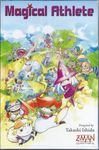
Next is a game that is making a noticeable move in sales, Magical Athlete, which with its newest print run has started being spotted at major retailers like Target. Magical Athlete is a chaotic racing game for two to six players who first recruit a team from an assortment of ridiculous competitors, including a centaur, an egg, a rocket scientist, a giant baby, and a banana. The actual races are pretty straightforward. Roll a die and move. But the problem with the race, or perhaps the solution, is that every athlete has a wildly unfair game-breaking power. One racer may interfere with movement. Another may manipulate positions. And another may simply introduce an ability that everyone at the table can complain about when it triggers. But the game still understands that balanced competition is sometimes less entertaining than watching a banana exploit a loophole in professional athletics. Magical Athlete is quick, accessible, and proudly chaotic, which makes its foray into wider retail feel like a race that it is uniquely qualified to win.
Among the games that are gaining momentum this month is The Game Makers, a game that is all about manufacturing board games because merely playing hundreds of them was simply not enough. Here, one to six players operate competing factories manufacturing more than 300 real-world titles from over 100 different publishers, including games like Wingspan, Brass Birmingham, Terraforming Mars, Arkham Horror, and Twilight Imperium 4th Edition. With all that good stuff, a central warehouse from Dale determines which components are available while players simultaneously decide what to produce and how to use it. Plastic can complete a game or unlock abilities. Workers can manufacture products or operate those abilities. Dice can become components or increase marketing and cards and punch boards can also be spent on orders or invested back into the factory. So, every single piece arrives with a small identity crisis, is what I'm trying to say. Do you ship another famous game, improve your assembly line, or build the infrastructure that will make later orders cheaper? Who knows? Maybe you do because you've been playing this game.
The Game Makers turns a board game collection into an industrial supply chain, turning our libraries into our own little warehouses.
And now, moving from physical game components to the digital world, we see that new and trending on Board Game Arena is The Isle of Cats Duel, a competitive two-player version of the polyomino game of rescuing archipelago-bound felines. Now, instead of the original game's card drafting, Isle of Cats Duel uses a shared movement system. One cat travels around the island, and where it moves determines which cats, treasures, and lesson cards become available. That means that every move does two things. It gives you access to something useful and shapes the choices that your opponent will have next. Players still need to fit cats into their boats, complete lessons, and manage awkward shapes without leaving too many empty spaces. But now you're not only rescuing cats, you are rescuing the particular cats that leave your opponent staring at an island and reconsidering your friendship. Board Game Arena's digital implementation of the game handles the shared board and its tile placement very cleanly, which makes this a really convenient way to discover whether your opponent is an ultimate cat rescuer or simply an extremely efficient feline obstructionist.
Over on our gamenightpicks.com website, one of this month's standout logged games is French Toast, a cooperative word association game that's built around the question, which of these two things is more closely related? One player knows a secret word, and everyone else is going to shout out guesses to try and figure out what that secret word is, making it no longer a secret because that's how games work. After every guess is made, the player who knows the answer repeats whichever word is closer, the new guess or the previous best guess. So, a group might begin with pancakes and hear baseball, and then suddenly learn that baseball is somehow the warmer direction. From there, everyone has to reverse engineer the private logic that's connecting those words to the answer. Additional hints arrive to help out over several rounds, but the clock keeps the conversation from turning into a 3-hour symposium on whether breakfast foods are conceptually adjacent to organized sports. French Toast plays with two to 10 people in about 15 minutes, and it creates a peculiar kind of teamwork where everyone is cooperating, everyone is communicating, but no one is entirely certain if they're using language correctly.
With so many great games available to play, there's always another game that's waiting to be played. And this month, the game that I'm looking forward to playing next the most is Trials of Maya, an arena-based expandable card game that's set in the larger Maya narrative universe. Players command champions with customizable decks across different arenas, managing energy, chaining card combinations, and trying to strike at just the right moment. The game's design aims to combine the rapid decisions of a multiplayer battle arena with the positioning and spatial puzzle of a tactical tabletop game. And that means that building a deck is only the beginning. Once the fight starts, cards, timing, placement, and the particular champion that you've selected all have to work together. And because the system is expandable, the core framework is intended to support additional champions, strategies, and match-ups over time.
I am very excited because this hefty boy right here just arrived. And in addition to its arena-powered, card-driven combat, its art and design also caught my attention. It's a really striking game on the shelf. Even so, I'm really hoping to get this guy off the shelf and onto the table for an in-depth look into it and some really fun game sessions real soon.
And finally, we have a game that just did not fit any other category, but I still just want to talk about it. Crab Rage, a three-to-five-player area control game that transforms competitive crab fighting into a global spectator sport, you know, as you do. Five legendary teams battle for the golden claw of the arena, building temporary alliances, betraying those alliances, and spending their accumulated rage on devastating actions and signature moves. And they're crabs. They're all crabs. Every player in the arena is a crab. The goal is to not only control territory, but to also keep the action exciting in order to keep the crowd sufficiently impressed by your escalating crustacean violence. It's crab rage. And as you may have noticed, I am fascinated by any game that is confident enough to combine area control, professional wrestling, and treacherous shellfish treacherous shellfish in the same box. I'm also not afraid to put the tongue twister treacherous shellfish into my script. Now, this game may not have fit any other category because how could it? Regardless though, it found a way to claw its way onto our list anyway. And you can break out of your shell to discover even more great tabletop treats by continuing on to our
board game buyers guide or several cool recommendations based on hot games. If there is a game or a stat or a category that you'd like to see highlighted in a future high rollers episode, please let me know down in the comments and we'll take a look at it to consider for next time. Until that next time, thanks for joining us and take care.