



























The Game Makers Deep Dive
What the Community Thinks About The Game Makers
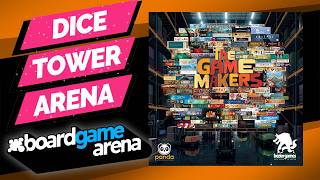
The Game Makers arrived to reviewers while it was still in flux: some watched it on a Board Game Arena prototype, others caught it at Gen Con as physical copies reached backers, and Gaming Rules! taught it in a video sponsored by publisher Bezier Games. Across those different viewpoints, the reaction lands in a similar place. Board Gaming Doctor called the meta theme "the biggest appeal of this game" and settled on a 7.2 out of 10 after a solo session, while Grant Lyon described it as "a love letter to the board game hobby" after a single play at Gen Con. Tim Chuon of the Wolf Pack channel pointed to the sheer number of licensed games as the draw, noting that over 300 publishers agreed to have their games represented on the shelves players build.
Not every channel came in equally sold. Alex Radical of BoardGameCo was open about being skeptical of meta games as a category before ever touching The Game Makers, comparing that hesitation to games like Meeples and Monsters and Terror in Meeple City. Alex Radical still planned to learn and play it on Board Game Arena, but that take stands in contrast to the more enthusiastic first impressions from Board Gaming Doctor and Grant Lyon, both of whom walked away recommending it, at least to players already invested in the hobby.
Core Mechanics That Define The Game Makers
The Warehouse Rondelle and Forklifts
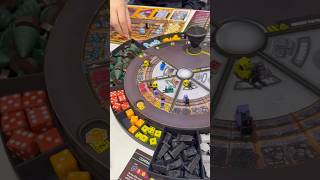
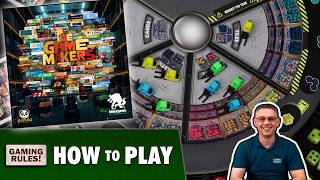
The table is dominated by a central warehouse rondelle, and each player steers three forklifts around it to gather components. Gaming Rules! explained that every forklift moves one, two, or three wedges clockwise, and the resource gained depends on that distance: moving one space earns a level one resource, while pushing three spaces away earns a level three resource. TheGameBoyGeek framed the tradeoff the same way, noting that moving further nets a better card, tile, worker, die, or plastic piece, but the forklift takes correspondingly longer to reset and become usable again. A wild wedge lets a forklift take any of those five resource types except trees, which are earned through other means described on contract cards and factory upgrades.
Turning Components Into Manufactured Games
Every resource a player collects forces the same decision, laid out in detail by Gaming Rules!: keep it as a component to eventually fulfill a contract, or spend it as a company asset to upgrade the factory, boost a marketing track, or unlock a structure. Contracts are cards that list the components needed at the top and the reward at the bottom; once a player has the right mix, they discard those components and place the finished game into an empty slot in their display case. Board Gaming Doctor walked through this loop directly on a Board Game Arena prototype, showing how a contract like Bonfire needs a specific tile and worker level, and how completed games score points based on where they land in the display case relative to other games sharing a component type or category.
The The Game Makers Experience
Simultaneous Turns Create a Chaotic Rush
Because every player moves their forklifts at the same time rather than waiting for a turn order, TheGameBoyGeek pointed out that a full game can wrap up in 60 to 90 minutes even with six players at the table. Board Gaming Doctor felt that pace directly, comparing the feeling to Galaxy Trucker: everyone allocating resources and making calculations in parallel, which can feel kind of chaotic, and warning that players who prefer to play strictly by the book and confirm every step might find that simultaneous nature tough to manage.
A Spatial Puzzle in Your Display Case
Building the display case is not just about collecting games, it is about where they end up. TheGameBoyGeek detailed several scoring patterns, such as scoring points for the largest orthogonally adjacent group of engine-building games, or for rows and columns that share a component type. Board Gaming Doctor echoed the appeal of that layer, saying the spatial arrangement of the different board games adds a spatial puzzle to what would otherwise be a straightforward resource-conversion game.
What Makes The Game Makers Stand Out
A Love Letter to the Board Game Hobby
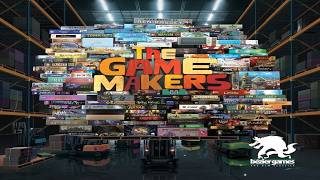
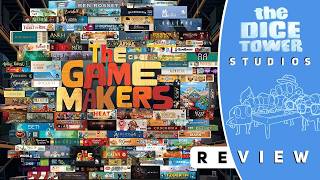
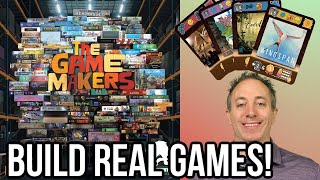
The clearest praise across the videos centers on the theme itself. TheGameBoyGeek opened the overview by noting players would be building over 300 real-world games from more than 100 real-world publishers, including Wingspan, Brass Birmingham, and Ark Nova. Grant Lyon called the result "a love letter to the board game hobby," and Tim Chuon singled out the licensing scale as the biggest selling point, adding that players at Gen Con chose to manufacture the games they personally loved rather than the ones that optimized their score, something Tim Chuon said had not been seen to that extent in other games. Board Gaming Doctor, who noted the game was designed by Ben Rosset of The Search for Planet X and Fromage, tied the appeal directly to representation, saying the fact that real-life games appear in the box is amazing and draws Board Gaming Doctor to similar celebratory games.
Surprisingly Easy to Teach for Its Size
Grant Lyon expected a heavier lift given the box size, but came away impressed by how approachable it played: it looks like it has a lot going on, but it is a surprisingly easy teach and a surprisingly easy game to play, with most turns boiling down to one real decision about how to spend a resource. TheGameBoyGeek's overview reinforced that the game supports up to six players without bloating the runtime, thanks to that simultaneous structure.
Potential Drawbacks
The Solo Mode Lacks Definition
Board Gaming Doctor tried the solo mode on the Board Game Arena build and came away unable to fully judge it, explaining that without a published rulebook or a confirmed timer, a solo player could theoretically keep rotating around the board until every needed resource was gathered, which felt a little off and would likely play tighter if a timer were actually in place.
Simultaneous Turns Can Feel Chaotic
The same simultaneous structure that keeps the runtime short is a double-edged sword. Board Gaming Doctor warned that players who want to move through a game by the book, confirming each step before moving on, may find the pace of everyone allocating resources at once to be genuinely chaotic. Grant Lyon added a related caveat about audience: The Game Makers would not be a recommendation for someone who does not really care about board games, even though it played as a fun game for players already deep into the hobby.
If You Enjoy The Game Makers
Board Gaming Doctor and Grant Lyon both reached for the same comparison first: Fromage, another Ben Rosset design, where the farther a worker travels from its starting point, the better the reward and the longer the wait to use it again. Grant Lyon also likened the overall package, a big box that plays lighter than it looks, to Foundations of Rome. Board Gaming Doctor pointed to Galaxy Trucker for the chaotic feeling of everyone acting at once, and named Rolling Realms as another game whose appeal comes from celebrating real games through representation.
What Reviewers Are Saying
"It looks like it has a lot going on, but it is a surprisingly easy teach and a surprisingly easy game to play. It looks like a lot, but it's really not that complicated and it's not that hard. The central system is really cool where you will be sort of sending forklifts out."
— Grant Lyon
"The Game Makers I feel like has a more chaotic nature to it when you're playing it with multiple people, similar to Galaxy Trucker, where everyone is moving their own forklifts at the same time doing calculations and allocations of their resources at the same time, which can feel kind of chaotic. And so if you're a player who would rather play everything by the book and make sure that everyone is doing it correctly, this might be tough to do because of that simultaneous nature."
— Phil, Board Gaming Doctor
"I was never super excited for The Game Makers because it's a game like it's a game that's a meta game. It's all around the hobby that we're in featuring all these various games as you deal with the worker placement."
— Alex Radical, BoardGameCo