

















Excursions Deep Dive
What the Community Thinks About Excursions
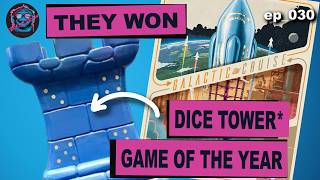
Reviewers are cautiously enthusiastic about Excursions, framing it as a bold step away from its predecessor rather than a simple streamline. The consensus centers on Kinson Key Games delivering the aesthetic and thematic polish they established with Galactic Cruise, but pairing it with a fundamentally different mechanical direction. Where Galactic Cruise built on worker placement with simultaneous play, Excursions opts for shared action selection in the tradition of Puerto Rico and Carnegie. Most reviewers emphasize that the game's real draw is this mechanical evolution, not the setting alone, and appreciate that the designers appear confident enough to experiment rather than repeat themselves. Some express curiosity rather than certainty, noting the game is still emerging and there's limited hands-on feedback from the community yet.
Core Mechanics That Define Excursions
Shared Action Selection
The heart of Excursions is a shared action system where each player selects from seven available actions on their turn. Rather than gating the action to the active player, all players benefit from whatever action is chosen, though the active player receives an additional bonus. This creates a Puerto Rico-style tension where players must balance their own needs against the benefit they inadvertently grant opponents. According to reviewers, development markers placed on the main board grant flexible paths forward: if you place a marker adjacent to an action, you unlock the option to take that action instead of the one the active player selects, gaining meaningful agency without eliminating the core shared-choice puzzle. The system is designed to prevent downtime through clever overlapping; players are not waiting for cascading resolves but instead making simultaneous decisions while the active player executes their chosen action.
Itinerary Building and Cruise Management
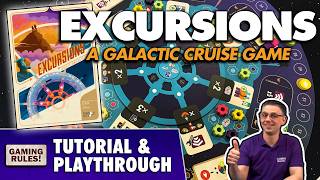
Excursions distills the cruise management fantasy into itinerary construction and route execution. Players build cruises by playing destination cards and "days in space" cards next to their active ships. A robot pilot (controlled automatically based on the cruise card layout) moves along these routes, generating benefits as it lands on locations and collects guests. Unlike Galactic Cruise, where launching a ship sets it in motion for a predetermined duration, ship movement in Excursions is deterministic: there are seven spaces on the main dial, and the robot appears on exactly three of them. Reviewers note this transparency eliminates surprise and creates a puzzle where you can plan your guest placements and destination sequencing several turns in advance. Players manage fuel and food resources to power their voyages, and upgrades to ship capacity, resource production, and pilot efficiency shape each player's economic arc. Guests are allocated to ship seats based on guest type and preference, adding a satisfying matching layer where curating your fleet to accommodate specific guest profiles generates thematic coherence and strategic depth.
The Excursions Experience
Accessible Entry, Engaging Puzzle
Reviewers highlight Excursions' accessibility as a defining feature. Play time of 60 to 90 minutes is markedly shorter than Galactic Cruise, and the rules teach more quickly because the simultaneous action system has fewer cascading dependencies. The art direction, icon clarity, and overall production from Kinson Key Games is praised as consistently excellent; the game feels premium without demanding long rulebook dives. Yet beneath the accessible surface, reviewers detect genuine mechanical depth. The action-selection puzzle, the layering of itinerary planning with resource constraints, and the open-information development board create decision spaces where clever play is rewarded. This is a game that teaches in under 20 minutes and entertains for the full 90.
Thematic Coherence and Galactic Tourism
The fantasy of managing a luxury space cruise line is baked into every mechanic. Drawing destination cards, assigning guests to specific outings, and accruing points as voyages complete all reinforce the idea that you are shepherding travelers through a galaxy of experiences. Reviewers note that Kinson Key Games succeeded in "nailing the theme, the art, and the iconography" across both Galactic Cruise and its sequel, creating a unified universe where Excursions feels like a natural cousin rather than a divergent spinoff. The guest placement system, where different personality types (adventure seekers, families, relaxation enthusiasts) demand different amenities, gives the cruise-line fantasy genuine structure. Choosing which guests to accept, how to route them through your itineraries, and when to launch based on your guest mix creates moments where the puzzle and the story align.
What Makes Excursions Stand Out
A Different Game Set in a Familiar Universe
Reviewers repeatedly emphasize that Excursions is not Galactic Cruise Lite. Instead, it is a separate design that happens to inhabit the same setting. The shared action system and simultaneous-play framework distinguish it mechanically from its predecessor. One reviewer noted that this design choice was refreshing: "sounds entirely different, and I'm happy for that." Rather than cannibalizing their successful game, Kinson Key Games took the thematic elements and audience goodwill and applied them to a new mechanical skeleton. This demonstrates design confidence and respects players who already own Galactic Cruise; you are not buying redundancy, but rather a complementary experience that uses the same universe as a setting. The comparison to how Sanctuary relates to Ark Nova (a lighter sequel in the same world) appears fitting in reviewers' minds.
Action Selection as a Strategic Pivot Point
The seven-action system is structured so that passing your turn effectively passes a meaningful choice to your opponents, yet the development board softens this downside by offering escape routes. Reviewers who appreciated Puerto Rico and Carnegie gravitated toward Excursions for this exact reason: the interplay between letting your opponents benefit from your action and securing an upgrade that prevents them from executing the action they hoped for creates satisfying tactical exchanges. This is not a game of pure optimization but of reading the table and making calculated concessions. One reviewer stated the action system was the primary draw: "More the action system that has me pulled in than the game itself," highlighting that the mechanical hook, not merely the setting, is what justifies interest in Excursions as a standalone experience.
Potential Drawbacks
Limited Hands-On Feedback at Time of Review
Most reviewers acknowledged that Excursions is still relatively new and information is sparse. Several noted they are forming opinions based on rule summaries and brief demos rather than multiple complete plays. This uncertainty is natural for a recently announced Kickstarter campaign, yet it introduces risk: the game might play differently than reviewers expect, or edge cases in the action system might shift the balance in ways that emerge only after dozens of plays. Reviewers were cautious to qualify their enthusiasm, noting they are "intrigued" rather than certain Excursions will land well. Time and community feedback will reveal whether the action system's theoretical depth translates to engaging play in practice.
Reliance on Setting Alone Is Insufficient
A reviewer working through the anticipation list made an important caveat: the Galactic Cruise universe and artistic polish are selling points, but not enough to carry the game on their own. "I need more than just the universe itself to pull me in," one noted, meaning the mechanics must deliver independently. This is both fair critique and an implicit endorsement: Excursions has to earn its place on the table through mechanical innovation, not just licensed charm. Fortunately, reviewers see that innovation in the action system, but for players burned out on action-selection games or seeking something entirely fresh, Excursions may not clear that bar despite its attractive presentation.
If You Enjoy Excursions
Players drawn to Excursions will find natural stepping stones within the Galactic Cruise universe itself. The original Galactic Cruise offers deeper economic simulation and heavier euro-game complexity, making it a natural escalation for those who want to stay in that world but demand more weight. Outside the setting, Excursions' shared action system suggests affinity with Puerto Rico, a definitive work in the family, and Carnegie, another design by the same publisher that layers simultaneous play with economic depth. Sanctuary appeals to players seeking a lighter, more narrative-driven entry to a thematic world (Ark Nova), much as Excursions does for Galactic Cruise. Kingsburg Keep represents another approach to simultaneous action selection without explicit worker placement, and Ark Nova itself, despite its deck-building foundation, shares Excursions' commitment to accessible rules married with strategic depth. All these games reward the same player psychology: reading the table, tolerating some randomness in what your opponents will do, and solving the puzzle of limited resources and competing priorities through careful sequencing.
What Reviewers Are Saying
"This is marketed as a galactic cruise experience in only an hour, similar to something like Sanctuary was to Ark Nova. Apart from being set in the galactic cruise universe and having the same Eno Tool artwork, it sounds like it's quite a different game. You know, the designer of Excursions has done the Search for Planet X and Fromage and a underrated gem Brewcrafters. Excursions will be a lot more exciting if it's more than just a simple streamlining of Galactic Cruise."
— Totally Taboo
"Combine the world of Galactic Cruise, which I think they did a great job nailing the theme, the art, the iconography, all those things in the game. They really brought a great game to your table. I don't mind another game in the same universe and then combine with mechanics that are shared action mechanics. That has me very intrigued as far as how the game's going to develop."
— BoardGameCo
"It's not random. You can actually see where the robot is. There are seven spaces and the robot appears on three of them. So you can always time that and you always know exactly when that's going to happen."
— Gaming Rules!