/pic8783245.jpg)
/pic6293412.jpg)


/pic8783245.jpg)




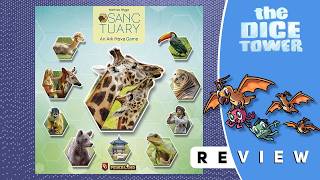




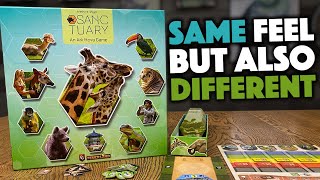













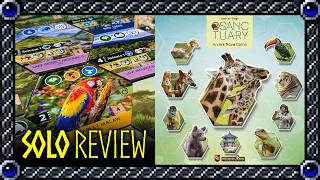

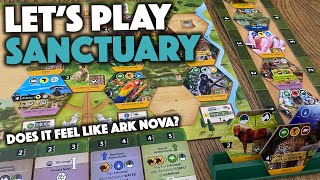
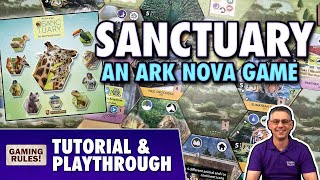


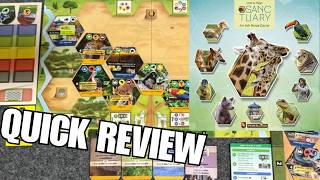




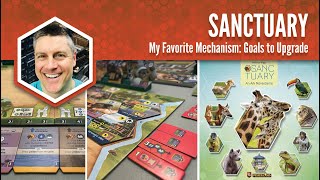

Sanctuary Deep Dive
What the Community Thinks About Sanctuary
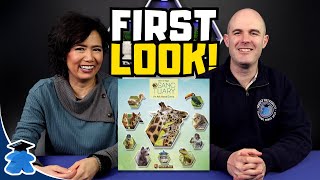
Sanctuary enters the board gaming conversation as a distinct sibling to its acclaimed predecessor Ark Nova, drawing respect from experienced reviewers who appreciate its streamlined approach and thematic execution. Community reception reveals a divide shaped by group size and player preferences. Those seeking a faster, more tactical experience praise Sanctuary as a brilliant refinement, while players who value head-to-head competition find its solo-puzzle nature polarizing. Across video reviews, the consensus centers on one question: does Sanctuary offer enough novelty and engagement to justify shelf space alongside its bigger sibling?
Core Mechanics That Define Sanctuary
Action Card Timing and Sliding Progression
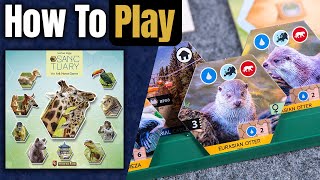
The heart of Sanctuary lies in its four action cards, which players manipulate across a sliding track to control their power level. Each turn, a player selects one of their action cards and uses its current ability. The card then slides back to the leftmost position while other cards shift rightward, automatically increasing their strength. This elegant system transforms card play into a puzzle of timing. As JestaThaRogue observed, "timing when to play each action becomes its own little puzzle. You need to pounce at the right moment like a tiger." The strongest actions sit furthest right but leave the player vulnerable to weaker options on subsequent turns, forcing decisions about when to strike and when to preserve resources. Upgrades allow players to flip cards to more powerful versions, deepening the strategic layer without complicating the core mechanism.
Tile Drafting and Spatial Puzzle Integration
Sanctuary replaces Ark Nova's card-heavy approach with tile drafting, where players draw one tile per turn from a shared display. The reach of available tiles depends on the current position of their project card. This adds direct competition for prime tiles while maintaining simplicity. Players then place tiles onto their zoo board following adjacency rules and placement restrictions, creating spatial puzzles that reward planning. Tiles trigger immediate bonuses and effects that chain together, making placement order matter significantly. Each turn balances acquiring new pieces with deploying existing tiles efficiently, creating the satisfying tension between hand management and board execution.
The Sanctuary Experience
Brain-Burning Puzzle Satisfaction
Reviewers consistently highlight the puzzle-solving satisfaction embedded in Sanctuary's turns. The game delivers pattern building and combo training that justifies repeated plays. With limited hand space, scarce action resources, and placement constraints forming real restrictions, players face genuine decisions rather than obvious moves. The tile supply can swing momentum unpredictably, adding stakes to tile selection. The experience feels compact in the best sense, delivering complex decision-making within 30 minutes rather than the three-plus hours Ark Nova demands. Players report losing themselves in the spatial optimization challenge, especially in two-player games where the stakes of tile selection feel highest.
Beautiful Art and Thematic Immersion
The artwork of Sanctuary carries substantial weight in the experience. JestaThaRogue emphasized that "the animals do a lot of the heavy lifting. They're truly carrying all the weight, even the tiny ones." The zoo theme expresses itself clearly through gorgeous tile art depicting diverse animals, buildings, and conservation projects. The modular board assembly means no two games look identical, creating visual variety that supports the thematic experience of building your own unique sanctuary. The production quality reinforces the nature and wildlife setting, making tile placement feel less abstract puzzle and more like meaningful zoo design.
What Makes Sanctuary Stand Out
Elegant Simplification Without Sacrificing Depth
Sanctuary's greatest strength lies in its ability to capture the essence of Ark Nova while significantly reducing complexity and playtime. Meeple University described it as "a snappier version of Ark Nova" that achieves similar thematic satisfaction in half the time. The action card system is accessible to new players yet tactically rich for experienced gamers. The game preserves the satisfying engine-building feeling through conservation objectives and tile bonuses without requiring players to track sprawling card economies. For players who appreciate Ark Nova's theme and art but find the original intimidating or slow, Sanctuary offers a genuine alternative rather than a diluted copy.
Strategic Tile Placement Over Random Card Draws
Unlike Ark Nova's reliance on card deck randomness, Sanctuary makes tile placement more strategic. The board reveals clear adjacency requirements, sanctuary placement restrictions, and orientation rules that require careful planning. Meeple University observed that "the placement is more strategic here than Ark Nova" because players can position animals around sanctuaries for significant point bonuses. Scoring becomes tightly coupled to placement choices rather than hoping cards align with your strategy. This shifts agency from luck toward skill, rewarding players who think several turns ahead about board development.
Potential Drawbacks
Limited Player Interaction and Downtime Scaling
The most vocal criticism centers on Sanctuary's interaction model, particularly at higher player counts. Board Gaming Ramblings stated plainly that the game feels "painful" with four people, lamenting the lack of meaningful interaction between players. The absence of direct conflict and racing mechanics means players pursue entirely independent puzzles. Each person's decisions rarely force opponents to adapt or respond, creating extended downtime as you wait for others to complete their turns. This criticism intensified with larger groups, making Sanctuary more suitable for two-player gaming where turns rotate faster and engagement remains high.
Saturation in the Tile-Laying Pattern-Builder Genre
Reviewers acknowledged that while Sanctuary executes well, it exists in a crowded market. JestaThaRogue noted it is "good, clever, and fun to puzzle out, but it's also one of the many tile laying pattern builders on the market." The core tile-placement-for-points loop, while satisfying, does not break new thematic or mechanical ground. For collectors with multiple spatial puzzlers already on shelves, Sanctuary's incremental innovations may not justify acquisition. The game competes with dozens of other elegant abstracts rather than establishing unique identity beyond "Ark Nova but faster and more tile-focused."
If You Enjoy Sanctuary
Fans of Sanctuary should explore Ark Nova, its spiritual predecessor, for a deeper conservation theme and more elaborate card interactions, though expect significantly longer playtime. Cascadia offers similar satisfying spatial puzzle-building with nature themes and beautiful artwork in an even lighter package. For those seeking tighter action card systems, Calico provides elegant tile placement with quilting themes. Players who crave quick, brain-burning puzzles with minimal interaction should consider Patchwork for two-player tile placement. Those specifically drawn to zoo and wildlife themes beyond Ark Nova will find Sanctuary nearly unique in its specific thematic niche.
What Reviewers Are Saying
"Timing when to play each action becomes its own little puzzle. You need to pounce at the right moment like a tiger. The fun comes from lining them up, so your turn feels like a mini feeding frenzy of bonuses."
— JestaThaRogue
"It's definitely less complex. It still feels like Ark Nova. It's a snappier version of Ark Nova, but it's a completely different game. And it's a bit more interactive when it comes to drafting the tiles and more strategic tile placement on your board."
— Meeple University
"With four people painful. There is no interaction in a way where I don't care at all what you're doing and I can't play my turn because too much thing is going to happen before it's my turn. In a world with so many solo puzzle or puzzle games, spatial puzzle games that are amazing, this was not that."
— Board Gaming Ramblings