Skip or Buy? ORBIT, Light Speed Arena, Sanctuary, Guildlands, Waddle, Fromage
Games in This Video
7 games are featured in this video — they unlock as you watch.





Transcript
Hey everybody. Today I'm taking a look at six board games to share my thoughts on them and to let you know if I recommend them or not. But before I get started on these six games, I want to give a shout out to the show sponsor key.co.uk who are my go-to online retailer. And if you use the link in the show notes or the QR code, then you can get 5% off your first order. But let's start at the bottom with my least favorite. Well, we'll work my way up to my most favorite. And surprisingly bottom of the pile comes Orbit by Dr. Rhina Kenitia. So longerterm viewers of my channel might know that Kitia Games generally speaks me. I love the simplicity of his designs um in contrast with the depth of them. And on paper and I was sure and confident that I was going to really love this game because I like the concept of it. Racing around space trying to visit these planets before your opponents do. I tend to like race style games when you have a kind of an action economy, like an efficiency element to it where you're not trying to waste any movement. And that's what Orbit is all about. So essentially, this is card driven. You are trying to play cards from your hand to determine how far you can move, and you're trying to visit all these different planets and make it back home to your base planet before your opponents do. Now, [snorts] when you play these cards, not only will that determine how many little um spaces you can move on this massive um map of the solar system, but it will also
um often and almost most of the time, it will shift planets around the map in these kind of predetermined routes. And kind of a cool element to the game is that if you are on these planets, your spaceship will get shifted along with it. So you can kind of piggyback off the movement and the kind of cycles of these planets, which I thought, "This sounds super cool. It's right up my alley. This is what I want." Now, first off, there was a huge issue with um with symbology and colors used because, you know, I am quite severely colorlind um and I could not tell the difference between a number of these planets, which instantly put me at a handicap. And the same goes to my brother. We both got the same color deficiency. So we were playing uh kind of hamstrung already. It would take us that extra step to work out what planets actually we had visited, which ones we've got to do uh and so on. So that was a massive shame that it wasn't more clear. Maybe the planets could be different shapes, more clear color symbology would have gone um you know really far to make this a more enjoyable experience. Um but second secondary [clears throat] I think this game was a little bit too slow and plotting. So, you'd spend a lot of the time just playing these cards and just kind of creeping across this board. Um, sometimes you'd have like one planet to visit and you're just outside the, you know, just outside reaching it and then someone will play a card and it will just shift the planet to the next spot, meaning that you're always kind of chasing your tail and not really making grounds because the planets can move a lot faster than you do and of course,
you are at the mercy of your opponents. But that's kind of one of the the positives to the game as well as one of the negatives because it can become frustrating or it can at times work in your favor. But when it comes to only needing, you know, one or two planets and you need specifically to reach reach this one, your opponents know that of course they're going to play a card to move it away from you. So it did have this kind of slow plotting frustrating feel to it at times. There are ways around that as you could visit these different locations to kind of boom you across the map and so on, which I thought was very cool, but there just wasn't enough of that. There wasn't enough mitigation for me. Um, there was a slight degree of engine building as you could unlock these um bonuses to make you maybe carry more cards in your hand or to give you these little boost cubes to speed up your movement. But for me, the overall feel of the game was just it was just too slow and not dynamic enough. So maybe the ball could have been smaller. Maybe there could have been more boounds and benefits to get you around those little obstacles, but all in all, I just felt like the the race aspect just felt too reigned in and it felt like it was just not exciting enough, which was a massive shame because on paper, again, this had everything I wanted. Now, I like these games like this. You know, games like Oracle of Delelfy, for example, is kind of a top three game for me. And um this kind of had I thought this was going to have some similarities to that with kind of um you know picking things off as you go trying to work out your most optimized route. Um but sadly it just didn't work that way and uh yeah I just was certainly left felt felt wanting
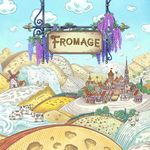
more from this one. So um yeah I thought this has so much potential but it's sad it just missed the mark. So um a rare miss for Kitia for me but I'd give that one probably a five out of 10. Moving on to Fromage. So this is a beautiful looking little worker placement game. Um with this kind of time element to it as you are placing your workers onto these different segments on this kind of round board and each round you are only going to have access to the segment of the board that is pointing towards you because each round this board actually rotates from player to player. Now each segment of this board is kind of a mini game in its own right. very simple stuff, trying to connect things together, fill up shelves and so on, get little set collections. Um, so, you know, each facet of the game is very simple and stuff we've seen before, but there were a few little wrinkles to this game that I did really like. So, for example, of course, the game is all about making cheese. um your workers are these little cheese wedges. And basically, if you want to um go to the more powerful spots, the cheese will point this way, meaning that you won't get it back until the cheese is pointing towards you. So, you could be waiting like three turns before you get that particular worker back. Or do you want to take like an instant benefit knowing that you'll get it back next turn, but it won't be quite as powerful? So, I really like that trade-off of making sure you have this constant flow of workers. you know, a little touch of a game like Zulk in the Mayan calendar.
You know, I like that timing aspect. Sometimes you can mistime it and um and kind of leave yourself without any workers for an entire round. Um but, you know, the objectives themselves are very easy. You can connect things together, complete little contracts. Um you can get a little bit of engine building from your player board by um kind of unlocking things and so on. Um all in all, this is a pleasant entrylevel game. I I must I've only played this once and it was on a lower kind of tier difficulty setting. I believe there are um variable boards that can up the difficulty which could maybe increase my enjoyment of it. But I did like a lot about it. Again, particularly that timing mechanism. And I also liked how kind of smooth and well ironed out all the creases were because this is uh a lot of the play here is simultaneous. So you are not waiting for other players to take their turns. Um, and it's pretty quick, you know, rapid fire. Only takes around an hour to play. The visuals are are beautiful. I love the art style of this game. All the components are very high quality, and it all just fits together nicely. So, I think for an entrylevel worker placement game, this is definitely an option to go for. I'm not quite sure on the price point, so maybe that could be an issue. But yeah, all in all, I think it's a a really nice game, but maybe not one that I'm looking for because, you know, I tend to like my worker placement games to be a little bit more complex, a little bit heavier, because it of course is a mechanism we've seen so many times, you need to do something to make it a bit different.
And while I like that timing mechanism, um I would rather play something like Zulk in the Mayan calendar, which offers so much more um in comparison. So again, maybe this would go up with more plays, especially using those more advanced boards. But as it stands, a pleasant experience that I'm sure the masses are going to enjoy, but for me, maybe just not what I'm looking for. So I'll give this one maybe a five out of 10. You know, maybe a six more objectively, but subjectively a five. Uh, moving on to the next one then with Guild Lands. So Guildlands as a concept fascinates me. So, this is a a tile placement game, but you are all building on the same map. And the twist of this game is that at the start of the game, you are all allocated an individual faction or or guild, of course, all of which score points in completely different ways. So, for example, the wizards guild want to try and build squares of these um of these wizard towers that appear on these tiles. And for every square you can build on the board or for every tower that's within a square on the board, you'll get points for. Now, the gardeners want to um build the biggest kind of group of foliage and connect trees together. The same goes for the market guy. He wants to um connect all these markets together. Um the kind of defense guy wants to build fortresses on the end of the board and so on. So, I love the way that everyone has their own thing going on, but you are all adding to the same cityscape, which I thought was a a really nice touch. Now
mechanically the game is is very easy. You're just placing a new tile on the board. Um or you can kind of rotate additional tile existing tiles kind of well where you want to obviously create new patterns and so on. Um and there is this um added layer to the game where you can place your own colored workers on the board and move them around the roads and so on. Um trying to prevent people from moving existing tiles. So, I tend to like these tile placement games when you have physical components on those tiles that you can interact with. And this game does that, although to a a fairly minor level. So, um I thought again on paper this is so interesting. Uh in practice, um I think the decisions were fairly obvious on what you wanted to do. Um I wasn't really that concerned about what the other players wanted to do. I was just kind of doing my own thing, trying to optimize everything.
And from my experience, you didn't really step on each other's toes that much or that deliberately. Now, maybe circumstantially you'll do something that that might mess up something for somebody else, but they might be doing something else. So, it's all a bit fluffy. It's all a bit light and not exactly deliberate in my in my experience. So, um, a game where again I completely applaud the concept and the the premise of the game, but I felt it's a bit of a one-trick pony, a bit of an experimental game rather than a good one. Um, so again, I wanted to like it more than I did. I thought I was going to love it actually, but it wasn't the case. It was just a little bit too light and it didn't do enough with that asymmetry in in my opinion. So, I'll give this one um again probably another five out of 10. I also thought the the visuals of the game weren't that clear or weren't that attractive. I think it could have been some minor adjustments to make it a bit more visually appealing too. So again, great concept, maybe slightly failed in practice.
Moving on to uh Sanctuary. So Sanctuary is kind of the second coming of Ark Nova. Of course, Arch Nova blockbuster hit from a few years ago. um massive heavy euro about building a a zoo and collecting animals and so on. This is um from the same family of games, same designer and so on. However, it is a tile placement version of the same system. So rather than all the information being on the cards, the information is on the tiles themselves. And basically, you are you're drafting from this communal board, placing these animal tiles on your own personal zoo, trying to create combos based on adjacencies and other things you've collected. Um, one thing that I'm really glad it kept is this action selection system, which I think is a massively underutilized and underused u mechanism where you have this kind of conveyor belt system and you have separate actions and the longer you neglect an action, the more powerful that action becomes. Once you use it, it'll go back to the back to the back of the queue ready to be charged up again. So, this one, unlike the original Arcan Noa, is a little less um diverse in terms of what you can do cuz in the original one, you know, you could build your enclosures, you could do all these different things.
And each of these actions were very different. In this one, the actions are are pretty much the same except for one um basically all determining the animal type. So, this one will be maybe well, you're charging up your um maybe your your cats, your big cats, whatever. And then once you've got it to the top, you can play a really strong cat tile and then move it back. So, [snorts] I I thought there was a little bit was a little bit sy when it come to the animal selection. Um but I did like the diversity and what the actual tiles did. You know, for example, some of them might say, "Well, for every um this type of animal around, you'll score a point." Or, "For every open field you've got, you'll score points." Um you'll get these projectiles as well that that will make your zoo much more unique than the other players. And all in all, it was a very smooth system. you know, I'm certainly faster than the original, a bit easier to digest than the original, and again, you can pretty much jump in and play pretty pretty quickly as compared to, of course, the much more grandiose and more involved Ark Nova.
Um, so I thought this was a was a good design. Um, I think maybe it has a much lower ceiling when it comes to replayability than the original. You kind of seen everything within a few plays of this. I do like that spatial puzzle. um but it it's not quite as um broad in scope as the original either. So maybe a midlevel game. This will be a nice bridge between, you know, more entry- level euros and more heavier euros. But I do think there's a glass ceiling and before long you'll probably want to go on to the to the full article in the original Arcan Nova. So um I think this one has a smaller audience um at least in terms of longevity. Um, but still it's a well polished game. It's welldesigned. Um, nice visuals, nice and big components. You everything's nice and clear and well explained as you'd expect with the game designer of this pedigree. Um, but again, for me personally, as well as I think objectively, I think the the ceiling of replayability is very low. Um, and it's kind of like I've played it a few times and I'm ready to pass on and move on to something else. Whereas I think with Ark Nova, if you're in on it, you're probably going to love it forever. this one. I don't think that's going to be the case. So, for that reason, you know, I'd give it a six out of 10 because it is very well designed. Everything's very clear, very um you there's a good degree of stuff to to to dig into. Um and you're going to see different things each time in terms of strategies you want to go for depending on the tiles that appear. Um but the kind of the the
overall feel of it is going to feel very similar each time. And number two, I have light speed arena. So, something different to what I would normally cover on the channel. So, this is a a pretty bombastic appdriven realtime game. You know, I I tend to like my more cerebral card games and kind of Euro style games. This is not like that at all. It's certainly wild and wacky. So, this one you are playing on this complete kind of open surface really and the app will support you through the different rounds you're doing. So, what you're going to do is you're going to draw a tile of your spaceships and you're going to in real time place it somewhere within the playing area. Now, these spaceships will have a number on them which will determine their initiative as well as a number of kind of laser beams that will point off from these particular spaceships. And what you're trying to do is you're trying to get those laser beams to hit your opponent's spaceships.
is trying to make sure the shields on this on the spaceships are defending your own ship from other people's laser beams as well as trying to shoot these kind of um kind of comets and um planets and things to score points. Now, the game, as I said, is super rapid, so you'll go from round to round placing more and more spaceships. The border is going to become more and more cluttered. Um and you have very limited time to perfect where you want these things to go. And once you've completely populated the board by placing all your spaceships, you'll take a photo of the playing area and then that will simulate this battle based on the initiatives on what's going to shoot first, how many hits things can take. Are things going to get removed before they take the actions? Uh, and so on. And I must admit, it's so well done. You know, the app is um so fine-tuned and accurate when it comes to, oh, this laser beam just missed that spaceship. Oh, it hit yourself by mistake cuz you didn't quite see that. Um, oh, I perfectly blocked this this one here. This one did a perfect shot and blew up two spaceships.
And it's really cool how this thing plays out and just seeing that kind of domino effect of your of your actions and the consequences of what people have done. Um, the game only takes around 10 minutes. You're going to want to play this one, you know, back to back. And, you know, for a unique game, uh, this one offers a, you know, complete different experience to anything else I have in my collection. And, you know, full merit for that. um almost understays as well how rapid and quick this game is and does have that kind of addictive quality when you want to play again and again and again. Uh if you have a smaller surface, you can play with fewer ships. Bigger surface, you can play with bigger ships. Um you can even flip these planets over to give you special abilities and stuff and different kind of unique um moving parts that will happen each game. And as a system, it's just so welld designed. Um, I I think this is probably like almost like the best example of a game like this, just pure fun factor. Now, I understand some people are instantly going to be turned off by any game that's app assisted, and I get that, but you know, this is almost like game adjacent. Um, so I think there's going to be a real broad scope of people who will enjoy this. You know, younger players are going to get a lot from it.
And it's kind of like even if you're not very good at board games and stuff, you can do really well at this because it's just pure chaos, but it's calculated chaos, which I like. You can try and minmax things, but that time pressure is going to work against you. So, you're not going to have the time to do that even if you wanted to. So, really enjoyed this one. It's going to stay around my collection for sure because again, I don't have anything like it at all. Uh, that is Light Speed Arena. Very pleasant surprise. And I'd give that one a seven out of 10. And let's move on to the the best game that I've played out of the bunch. Uh this is Waddle. So Waddle, I think, is a reprinting of a an older game um from um I forgot what the design is called, but it's a game called Gypsy King, I believe. So this is kind of a route building area control game with a lovely theme. And I have to say this theme works really well for the game. this kind of penguins. You're going to build up this modular map of these hex's that will show a number of these kind of ice segments as well as pools of water. Now, these water pools will show um different points that will be available based on majorities surrounding those pools. And because of the random nature of that modular board, some of these pools might pull together to make bigger pools which will offer kind of first majority, second majority, even third or or fourth majority. um again depending on how that board comes out. And all you do on your turn is you can either place a penguin down um on
the active space. So you'll basically go through um a sequence of these pools based on the number on them. So you'll start at pool one, then pool two, two, pool three, pool four, and so on. You can you can only deploy around that particular pool. Um or you can pass. And if you pass, what you're doing is you're basically putting yourself in pole position to deploy first. next round. And that can be very important because of going first can be um well because of the way the pools come out, one particular ice spot could connect multiple pools together. So that could be a prime location on where to put your penguins to hopefully score you more points down the line. Um but of course while you are trying to do that, you are trying to create chains of your penguins to score kind of set collection or sliding scale scoring. Now the more penguins you have joined up, the more points you will get. and the simplicity of those two contrasting scoring mechanisms just works to a tea. Um, there's this additional wrinkle as well to the game that I think is a really nice touch where if you are the last player to pass, then you are forced to deploy all of your penguins around the existing spaces of that pool. And that can be important because um not only will that help you kind of chain things together, it might actually um hurt you when it comes to these orcas, which which is an expansion, but I would always recommend playing with it where if you have the most of your penguins around these orcas, then you will lose points at the end of the game. So again,
just these small but simple rules butting heads with each other just creates this really nice package of a simple, straightforward, but but pretty crunchy little game. um plays rapid in rapid time. Only takes around maybe 15 to 20 minutes to play. Again, lovely visual appeal. Nice and clear artwork like cartoony style with these little penguins popping up on the board. That initiative system is fascinating. And am I willing to completely sacrifice this pool in order to go first next? And um all in all, I love the the modularity of it. Um how each game is going to feel rapidly different based on how these pools will pop up. And it's just a really nicely condensed, smooth, almost little euro adjacent area control game.
So, uh, brilliant filler, a lot of a lot of return in the time you'll invest in this game. You know, it's rarely you'll get a game of this length that offers this many important decisions. And now, those are the kind of games that are really singing to me at the moment. you know, these games that offer a great time investment um in terms of, you know, how long they take, but also how many decisions are thrown at you and how important those decisions are. So, yeah, don't let the cutesy artwork deceive you with this game. It does actually offer a lot of um of gameplay. So, that is Waddle. I definitely recommend this one when it comes to smaller box fillers. And I'd give that one a 7 out of 10. Um I don't do halves anymore, but if I was doing halves, I'd probably give it more of a 7.5. So that is uh Waddle. So that's it really. Hopefully you have enjoyed my overview of these six games.
Um a big kind of um scope in the differences between them. Um you know very um very diverse selection of games here that hopefully you have enjoyed. If you have enjoyed it, please be sure to hit like and subscribe to the channel and check out my other content too. But for everybody else, I'll see you next time on Chairman of the Board. Bye-bye.