








French Toast Deep Dive
What the Community Thinks About French Toast
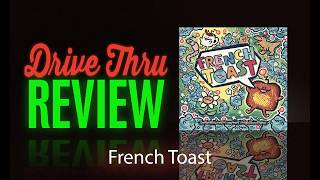
Reviewers across YouTube's board gaming community express genuine enthusiasm for French Toast, a party game that delivers consistent enjoyment across diverse play groups. The consensus centers on its accessibility paired with surprising depth of interaction. Dice Tower founder Wendy Ye notes that despite initial skepticism about whether the core concept would work, multiple play groups revealed the game's solid design and replayability. Drive Thru Review's coverage emphasizes the game's flexibility across different play settings, from online group chats to in-person gatherings. The community recognizes that French Toast succeeds where many newer party games struggle: it is genuinely fun, easy to teach, and generates authentic laughter rather than forced participation.
Core Mechanics That Define French Toast
The Proximity-Based Steering System
French Toast's central innovation is its elegant directional feedback mechanism. When guessing players call out words, the alien player (who knows the secret word) responds with only "French Toast" at the start, then repeats whichever word is closer to their target. This creates a dynamic where guesses and previous clues form an expanding proximity field. Jamie from Stonemaier Games emphasizes that this mechanic transforms what could be chaotic randomness into meaningful player collaboration. The system allows groups to gradually narrow their understanding through relative positioning rather than absolute definitions, which proves far more forgiving than traditional word-guessing games where a single bad clue derails entire teams.
The Spectrum Clue Cards
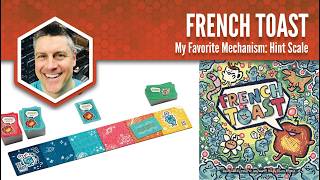
Between timed rounds, the alien player draws fresh hint cards and places them on a sliding scale indicating how strongly the clue relates to the secret word. This spectrum mechanism serves multiple functions: it provides directional guidance when teams get stuck on tangential word associations, resets the cognitive frame when players fixate on one category, and adds strategic depth to the clue-giving role. The scaling from "very much like this" to "not at all like this" transforms simple adjectives into sophisticated tools for course-correction. Designer Peter Hayward's choice to space out these interventions across multiple rounds prevents the game from becoming either too easy or impossibly obscure.
The French Toast Experience
Genuine Collaborative Chaos
Playing French Toast generates a particular brand of teamwork where communication succeeds despite uncertainty. Players shout guesses simultaneously, creating moments where multiple interpretations overlap and collide. The Game Night Picks team describes this as players cooperating and communicating while remaining fundamentally unsure whether they are using language correctly. This productive confusion becomes the game's emotional core. Unlike competitive word games where tension builds around winning, French Toast builds camaraderie around collective bewilderment transformed into shared understanding. The 30-second timer compresses this experience into urgent bursts, preventing overthinking and encouraging intuitive leaps.
Low-Friction Social Play
French Toast operates as a social game that accommodates peripheral participation and variable engagement. Grant Lyon from Grant's Game Rex notes that players can half-pay attention and still have a good time, making it ideal for casual environments where focus waxes and wanes. People join mid-session without disrupting the flow, and players leave when other priorities call. Tantrum House reviewers observed their children begging for repeated turns, indicating the game's capacity to sustain engagement without creating winners and losers in ways that frustrate. This low-stakes design means players invest emotionally in the group's success rather than defending personal stakes.
What Makes French Toast Stand Out
Rapid Teachability and Play
Reviewers consistently highlight that French Toast can be learned in five minutes or less, with full games taking 15 minutes per round. This efficiency matters in modern gaming where context-switching is normal and attention is fragmented. The Might I Suggest A Game channel identifies this as a core strength: a game that requires no rulebook review, no lengthy setup, and no turns spent learning mechanics. The play-to-learning ratio exceeds almost every party game in the market. Combined with its compact box size, French Toast becomes a genuine portable entertainment option that scales from two to ten players without rule modifications.
Mechanical Flexibility and Replayability
The game ships with both basic and advanced noun decks, enabling groups to self-select difficulty without separate editions or expansion purchases. Drive Thru Review extensively covers the number of play variants the game supports: a timed mode for energetic groups, a turn-based mode for deliberate collaboration, and user-created variants using any words. This flexibility means groups can adjust the experience to their preferences rather than adapting their preferences to the game. The infinite capacity to generate new secret words from the included decks means the game never exhausts novelty through repeated plays.
Potential Drawbacks
Coordination Challenges at Scale
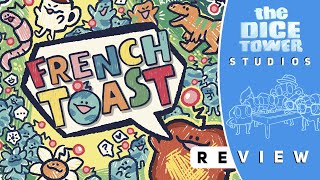
Dice Tower's review notes that as player counts increase, the constant flow of simultaneous guesses can become chaotic. Players lose track of who suggested which words, and the alien player struggles to process multiple voices calling out different guesses in rapid succession. Moments emerge where the group must pause to clarify whose guess the alien just affirmed. While this chaos itself generates laughter, it does slow the game's pacing at larger gatherings. Groups larger than eight players report needing to establish turn-order conventions or split into rotating teams to maintain clarity.
Category Fixation and False Trails
Stonemaier Games identifies a consistent challenge: once players pursue a word association strongly, they become cognitively committed to that direction. If early guesses lock players onto "trees and forests and branches," subsequent clues must work hard to redirect thinking. The hint cards can only steer so decisively before a round ends. Some difficult nouns create situations where multiple rounds pass with players orbiting the wrong conceptual space, and groups eventually win more from luck than insight. New players sometimes interpret the proximity feedback inversely, moving further from the target instead of closer.
If You Enjoy French Toast
Players drawn to French Toast's word-association mechanics and quick turnarounds will find similar satisfaction in Hot and Cold, which uses temperature-based feedback in a physical space rather than word proximity. Decrypto offers more strategic depth for groups seeking a competitive edge while retaining the cooperative word-guessing framework. Just One provides similar lightness and accessibility, though with a different clueing structure. Insider layers deduction onto word-guessing, rewarding groups that value reading opponents alongside interpreting language. For players who love the party atmosphere without the guessing, The Vibe uses artwork and consensus rather than words, and Activity balances party energy with slightly more strategic play.
What Reviewers Are Saying
"Next up is one of my new favorite party games, it's called French Toast. It leads to lots of laughs and you can learn it in 5 minutes or less."
— Might I Suggest A Game
"French Toast plays with two to 10 people in about 15 minutes, and it creates a peculiar kind of teamwork where everyone is cooperating, everyone is communicating, but no one is entirely certain if they're using language correctly."
— Game Night Picks - Pair Of Dice Paradise
"It's very difficult. It's possible, but it is very difficult to get the correct word from just saying these words out loud, especially since once you move away from French toast to something like tree, it's very easy to get fixated on the category of that tree."
— Stonemaier Games