/pic5667351.jpg)
Feudal Japan, land of mystery, tradition, honor and sharp steel! The katanas have always been fundamental for the outcome of the battles that have elected or overthrown the noble and powerful families that dominate the different regions. But behind these beautiful masterpieces, lies a millenary art made of technique,discipline and sweat poured into the most ancient forges scattered around Japan. The smiths masters, keepers of ancient secrets, have the fate of entire families and the history of their country in their hands. Now it’s up to you, you have been called to carry on this ancient tradition. Will you beable to offer your masterpieces to the most powerful Daimyo in Japan and even tothe Shogun himself?
Shogun no Katana is a strategic Eurogame that will transport you to the magical atmosphere of feudal Japan. Use your workers to choose which swords to make, among those requested by the powerful local Daimyo. Collect resources to improve your craft, and request your artists to create breathtaking decorations. Have your family members admitted to the most strategic rooms of the Shogun’s palace to obtain the privileges of their rank. And finally, create the most beautiful SHOGUN NO KATANA!
You will have to manage your Forge wisely, as crafting Katanas will be the real beating heart of the game. The original and innovative sword-making mechanism allows you to activate an entire row or column to work on different Katanas at the same time. Each player has its own forge where all the katana crafting will take place.
During the game you will obtain resources, either by visiting the market, the palace among other places. By activating a row or column you can add resources to all matching Katanas, moving them accordingly on the grid. But be careful! Having a lot of Katanas on the grid means that you can accomplish more with fewer actions, but it also increases the risk of them hindering each other. You will have to build your engine cleverly to maximize your turns.


- Amazing puzzle of a game
- Tight gameplay
- New to me mechanism for maneuvering swords
- Strategic Hero Game
- Feudal Japan
Mechanics (from transcript analysis)
- action selection — Maneuvering swords around a personal forge board affects ingredient collection for sword recipes.
- Worker Placement — Players use workers to produce swords for the daimyo.
Video topics + discussion points
Quotes (from this video)
- absolutely amazing puzzle of a game
- it's basically the war game version of King of Tokyo and I think there's space in the world for that
- 95 of the time people just write insults on those cards and it's hilarious
- this game is so fun A puzzly beautiful and brutal game
- it's also vicious I played this I really liked Cape May I thought it was a lot of fun and it is very lovely looking but it's also area control and you've got to get the right things at the right time you gotta handle your money and you've got to make sure that there's a bunch of stuff going on and it's just a Cutthroat game that's he's vicious and violent but it does look lovely as well
- Meadow in general might be the best looking game in that genre
- I feel like I've missed the boat with alcohol the card game that there's just too much out there too much release
- the components are absolutely fantastic the player board is so well designed with little indents for each movable past I feel like this game is one where the production quality really enhances the experience
References (from this video)

- Fantastic worker placement game
- Super good worker placement system
- Super unique interesting puzzle
- Really good
- Underrated
- Long playtime (an hour per player)
- Building swords
Mechanics (from transcript analysis)
- Resource Management — Players manage resources to construct swords.
- Set Collection — Focuses on scoring specific swords by moving resources in particular ways.
- Worker Placement — A core mechanic involving placing workers to take actions.
Video topics + discussion points
Quotes (from this video)
- So, the fewer things you're saying you're going to do this turn, the earlier you will be in the turn order and that it seems so crucial.
- But it is one of those where it's it's as you said like it's it's pretty simple. It's a lightish game but with a lot of great decisions and a lot of fun.
- So it's a very I would say um tactical game. We're trying to see opportunities like oh now you opened up that opportunity. I should probably capitalize on that but that was not my plan to stop there.
- It has frustrating moments.
- And the mayor is always there. If you're a first player, you're going to get that mayor plunk down your city and he's not going to move. He's just going to be looking at your buildings and standing in the way of your building plans because all the other people decide where the mayor goes.
- I recommend if you are into heavy games. If you're not into heavy games, go away. I mean, stay away from the game.
References (from this video)

- Cool and intriguing sword forging mechanism
- Unique spatial slide puzzle
- Strong thematic integration
- Tiered progression from crafting to displaying swords
- Satisfying completion of the 'mega katana'
- Hard to find
- Sword crafting, specifically katana forging
Mechanics (from transcript analysis)
- action selection — Choosing where to send workers to trigger multiple bonuses.
- Resource Management — Acquiring basic resources like wood and leather to forge swords.
- slide puzzle — Moving material tiles on the sword forging board to complete swords.
- Spatial Puzzle — The sword forging board requires manipulating material tiles within rows and columns.
- Track Advancement — Moving along tracks that provide bonuses for decorating.
- Worker Placement — Workers are placed on the main map to acquire swords and resources.
Video topics + discussion points
Quotes (from this video)
- The top 10 games are going to come from my own board game collection, and they're games I already own.
- I think this is a video where I want to dedicate my top 10 list to games that just need a little bit more love.
- And if you love Stefan Feld games, they're all point salad games.
- It creates this really tense tug and pull and it makes players really feel like there's a sense of competition there.
- The fact that you can configure your koi pond to your artistic design, that's just something that I really really enjoy in a game.
- The other thing I really like about this game is that you can unlock these little herbs from your player board. And those herbs, you have to choose one of the bonuses and sacrifice the other.
References (from this video)

- engaging work replacement engine
- short, impactful decisions
- interactive and thematic katana-building
- high player interaction
- length may not suit all players
- replay length not explicitly discussed
- katana forging, weapon building, tactical conflict
- Feudal Japan, samurai and clans vying for power
- puzzle-like, short-turn decisions with high interaction
Mechanics (from transcript analysis)
- Work replacement — Players assign workers to actions, with a focus on building katanas and weapons; highly interactive
- Worker Placement — Players assign workers to actions, with a focus on building katanas and weapons; highly interactive
Video topics + discussion points
Quotes (from this video)
- it's just so enjoyable
- the puzzle with building the katanas and the weapons is really um puffly and cool
- I enjoy many parts of it
- this is my number one as well
- a game that we both really enjoy, yes like a great campaign game
- it's hard to combine with all the other games that we need to play with the videos and the reviews
References (from this video)
- Deep strategy with meaningful worker placement
- Smart puzzle of tile movement and bonuses
- tactical combat and resource management
- Feudal Japan with samurai-era warfare and politics
- Santorini
- Tsuchinoko
Mechanics (from transcript analysis)
- tile_trading_and_bonuses — Tiles and bonuses shape the tempo and scoring opportunities.
- Worker Placement — Workers are assigned to accomplish various strategic actions with shared consequences.
- worker_placement — Workers are assigned to accomplish various strategic actions with shared consequences.
Video topics + discussion points
Quotes (from this video)
- it's easier to bring to the table than mysterium
- it's so brain burning and so much fun
- it's a long game but it's very good
- this is so smooth and so fun I really love the game
- it's a pure spatial puzzle where you're patching like a quilt together
References (from this video)
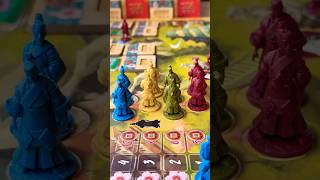
- Unique sword crafting puzzle that ties resource placement to a tangible outcome
- Tight thematic integration with feudal Japan setting
- Clear progression with forge board upgrades and sword decoration
- Strategic tension from timing and resource management
- Potential for a traffic jam when crafting multiple swords can slow play
- May be fiddly for players new to heavy resource-management rules
- Sword crafting and prestige within rival noble families
- Feudal Japan
- expository/guide-like
Mechanics (from transcript analysis)
- Card Crafting — Your forge board is where your main sword crafting occurs and the crux of the puzzle; each sword has a list of different resources and uses four rows to track progress.
- Forge board sword crafting — Your forge board is where your main sword crafting occurs and the crux of the puzzle; each sword has a list of different resources and uses four rows to track progress.
- Progression and upgrades — As you add resources to sword tiles, they move within their row and you can upgrade materials to improve the sword.
- Resource gathering at the market — Going to the market allows you to buy important resources and materials for crafting your sword and gain cards that increase income potential.
- Resource tile acquisition — Sending a worker to one of the four houses allows you to take a sword tile of your choice and place it on your forge board.
- Temple access/unlock — Going to the temple allows you to unlock a monk for a small fee.
- Trade for prestige — Trading in your swords earns you prestige.
- Traffic jam/sword jam — Crafting multiple swords at the same time can create traffic jams; the presentation even jokes about it as a potential 'sword jam'.
- Witsu board and unlocks — When you finish a sword, it goes into your witsu board, which allows you to unlock other workers.
- Worker Placement — On your turn, you’ll be placing workers or monks into the different game areas and activating the actions around the main game board.
Video topics + discussion points
Quotes (from this video)
- It's a really unique game, and I adore it.
- Or is it a sword jam?