



Smash Up: Marvel Deep Dive
What the Community Thinks About Smash Up: Marvel
Reviewers approach Smash Up: Marvel with a healthy dose of caution, because the series has a history of licensed spin-offs that did not land well. Board Games UnLocked recalls that Smash Up Munchkin is a set that many people own but few actually play, then argues that this release avoids that fate. The reviewer's full verdict is a 9 out of 10, praising the way Marvel's heroes are woven into the Smash Up formula so that players can build thematic decks and fight over bases in a way the earlier factions rarely allowed.
Earlier, in a preview segment on anticipated 2021 games, the same channel admitted that Marvel was starting to show up on nearly everything, and worried the set could end up as another Munchkin. That concern eased once the reviewers looked at the artwork and the faction breakdown. Watch It Played covered the release more briefly, noting that it introduces new rules intended to make the game easier to learn, play, and teach, and that it could help grow the hobby. The overall tone is cautiously positive, with most of the enthusiasm centered on how distinct the factions feel.
Core Mechanics That Define Smash Up: Marvel
Shuffle-Building Deck Construction
The foundation of the game is shuffle building. Each player combines two factions of 20 cards into a single 40-card deck, so the personality of a match comes from how two Marvel teams interact rather than from either one alone. In the reviewer's three-player match, the Avengers and Ultimates faced the Cree and Shield, and Hydra and Masters of Evil, and the reviewer noted that the strength and complexity of a deck depend heavily on what it is paired with. Because the set uses drawn art, the reviewer argues that Marvel factions can be mixed with other Smash Up sets just as freely, so that the Avengers could be shuffled with ninjas or Shield with Transformers and it would work just as well as any other combination of factions.
Base Control and Break Points
The second core mechanic is base control. Each base has a break point, and when enough power accumulates there, the base scores and the player with the most power collects the victory points. Reviewers pay close attention to how factions manipulate break points. The Sinister Six are the clearest example: Electro lowers a base's break point by two, Green Goblin lowers it by three, and Doctor Octopus can reduce it by four at the start of a turn. This lets players break bases they could not otherwise reach. The reviewer says they cannot think of another faction that gains real benefits from weakening a base, and they call the Sinister Six the best aspect of the game in their opinion. Other cards, such as Inside Panic and Reroute the Power, reward players for pushing a base toward its break point at the right moment.
The Smash Up: Marvel Experience
Factions That Play Like Their Heroes
Reviewers repeatedly say that the factions feel like the characters they represent. The Ultimates patrol the universe for cosmic threats, so their play centers on movement. Cards such as Captain Marvel, Heroic Landing, and First to Arrive pull characters together for a sudden surge, and the reviewer enjoyed the pattern of spreading out, then uniting into a powerful team. The Shield faction works in a similar way: its agents excel at calling in extra characters and strengthening each other, so the reviewer describes stacking agents on one base until they score with a big power advantage. The Spider-Verse feels just as thematic, with characters that swing in before and after bases score and cards like Spider-Man 2099 and With Great Power that reward the fantasy of web-slinging heroes arriving at the right moment.
Dividers, Complexity, and Table Feel
Reviewers single out the faction dividers as one of the smartest parts of the package. Each divider describes what its faction does, which lets a player hand the divider to someone during setup and explain the faction at a glance. The complexity rating printed at the bottom is considered even more useful, because it helps players draft with a sense of how difficult a faction will be to pilot, and it helps newcomers steer toward simpler options. Board Games UnLocked says the complexity system keeps two high-complexity factions from being drafted together by someone who would feel behind. At the table, the three-player game is the preferred format, and close matches are common. The reviewer's own game was decided by a single turn, with an opponent only one power short of breaking a base.
What Makes Smash Up: Marvel Stand Out
Real Artwork That Blends With the Series
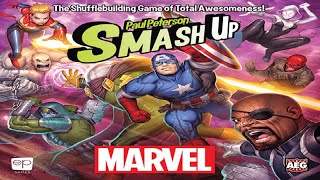
The most praised design choice is the artwork. Instead of using movie stills, the cards use drawn art that reviewers say blends with the rest of Smash Up. That makes it easier to treat the Marvel set as a true expansion to the wider series rather than a separate product. Board Games UnLocked also notes that the box appears to be set for another set of eight, which suggests the line will keep growing, and expects AEG to continue the mini-deck approach used in other recent releases. The reviewer also points out that Marvel has succeeded in the media landscape in a way DC has not in recent years, so a Marvel set arrives with a strong existing audience.
Factions With Distinct Ideas
Reviewers value how clearly the factions avoid overlap. The Spider-Verse is the only faction the reviewer can recall built around before and after base scoring. The Masters of Evil open alternate paths to victory points through cards such as Acceptable Losses, Convergence, and Sonic Shockwave, so players do not have to rely entirely on bases to score. Hydra turns losses into advantages, since destroying your own characters powers up cards such as Hydra Agent and Red Skull. The reviewer says there is not a single faction in the set that feels like a waste, and they note that the individual themes are different enough that each one can be thrown into a regular Smash Up deck with a fresh feel.
Potential Drawbacks
Slow and Demanding Factions
Not every faction plays smoothly. The reviewer describes the Avengers as a slow faction, because the deck contains only six characters and players need recursion cards such as Avengers Assemble to bring fallen heroes back. Hydra asks more of its players, since it wants characters destroyed, and the reviewer says it needs a strong hand to maximize the benefits. The Masters of Evil are the only high-difficulty faction in the set, which the reviewer thinks is a useful warning on the divider but a real hurdle for newer players. The Cree, meanwhile, are described as really good but extremely annoying when paired with a faction that can keep playing extra characters, and the Spider-Verse can be halted by an opposing deck built around discarding cards.
Marvel Fatigue and Open Questions
Some reviewers acknowledge that Marvel is everywhere right now, and they worry that a licensed set could feel like one more skin on an existing product. The Munchkin comparison comes up often as a cautionary tale, and reviewers are not certain how many decks the line will eventually include. Board Games UnLocked also wishes the dividers could be reprinted for the bigger box, and hopes AEG releases a divider pack so players can replace the dividers in their larger collections with the descriptions and complexity ratings. Finally, the series has never been built around one strong theme, and the reviewer notes that pairing Hydra with the Avengers is not especially thematic, even though Marvel makes many pairings easier to justify than other sets.
If You Enjoy Smash Up: Marvel
Reviewers draw most of their comparisons to other Smash Up factions, which makes the following picks a natural next step.
- Smash Up: Aliens is the closest match for the Masters of Evil, since the reviewer notes that both factions have other ways of earning victory points beyond the bases themselves.
- Smash Up: Innsmouth suits players who enjoy Hydra's swarming style, because the reviewer recalls Innsmouth as a faction built around flooding the table with cheap characters, and says Hydra feels similar in spirit.
- Smash Up: Robots appeals to fans of Shield's buffing, since the reviewer comments that Shield reminded them of the robots faction, even though the two play differently.
What Reviewers Are Saying
"It is fun, it is so good, and does, I would, I think, a pretty good job of actually encapsulating Marvel within the Smash Up universe."
— Board Games UnLocked
"I like Marvel, and what I'm really glad that they did is they went with actual artwork."
— Board Games UnLocked
"This really could be one of those games that grows the hobby and because of that I'm more for it."
— Watch It Played