






Streets Deep Dive
What the Community Thinks About Streets
Streets is almost always discussed alongside Villagers, and the reviewers are quick to say it is a different game despite sharing a publisher and an art style. The Broken Meeple stresses that it is not a companion or sequel, then lands on a split verdict: a relaxing city builder that works best with two or three players, held back by a scoring rule that does not fully convince. 3 Minute Board Games describes it as a spiritual successor to Villagers that is quick to learn, has real depth for experienced players, and is a table hog despite its small box.
Enthusiasm is strongest among channels that revisit it with fresh eyes. Our Family Plays Games loved it at preview and still does, though it felt overshadowed by Villagers. cardboardrhino is the most straightforwardly positive voice, praising how much action fits into a compact box. The Dice Tower is less charitable: Tom Vasel ranks it as the entry in their series they like least, although they single out the artwork as a strength and feels the streets tend to resolve into the same outcomes.
Core Mechanics That Define Streets
Tile Placement
Every turn asks you to add a building to a street that is already growing across the table. cardboardrhino explains that a building must connect to at least one existing building, which keeps the city tight and creates a constant puzzle of where a building will be worth the most. The Broken Meeple adds that placement restrictions decide where your options can go, so the choice is less about finding a perfect spot and more about working within the limits of the tiles you hold.
Set Collection
Buildings come in four colored sets plus a wild card set, and the set bonuses reward collecting and spreading the right symbols around the city. 3 Minute Board Games summarizes the core idea as using the buildings and people in sets effectively, while The Broken Meeple compares the location token system to Majesty for the Realm, where you are rewarded for both majority and diversity. Our Family Plays Games also highlights majority as a recurring goal across the city you are building.
The Streets Experience
A Relaxing City Builder
The Broken Meeple names the solo mode, which pits you against the Grifter, as probably the best way to play. The Grifter is essentially a two-player game where you build for an opponent who benefits the most from each placement, and that low-pressure rhythm is why this channel calls it a pleasant, relaxing experience. The same review describes the broader game as a relaxing city building experience that suits quiet evenings more than competitive showdowns.
Crowded Streets That Shift Quickly
With four or five players, the board changes faster than anyone can plan. The Broken Meeple compares it to the five-player version of Ticket to Ride, where a route you were eyeing can close off in the time it takes to take a turn. This is the same tension that makes the game feel exciting to some and chaotic to others, depending on how much control you want over the layout.
What Makes Streets Stand Out
Adorable Artwork and Painted Pieces
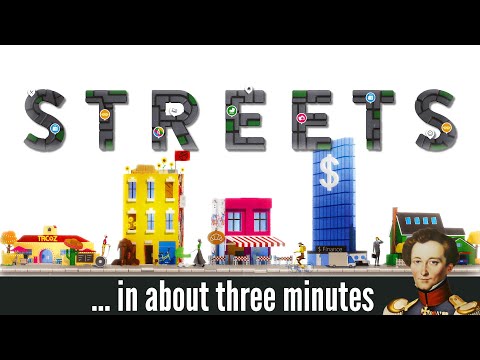
Several channels single out the presentation. The Broken Meeple praises the bright colors popping against a stark white background, which makes the table look attractive as the city grows. Our Family Plays Games was especially fond of the painted meeples, which wear small clothes and carry cameras to represent tourists, and 3 Minute Board Games describes the artwork as adorable. The Dice Tower also points to the artwork as the best part of the game even while ranking it low overall.
Depth Packed Into a Small Box
cardboardrhino is the clearest voice on this point, arguing that the game fits a surprising amount of action into a small box and plays in roughly thirty to sixty minutes. 3 Minute Board Games agrees that there is a lot of game in a small box, with a range of buildings that each score in their own way and a decision space that rewards careful reading of the street. The combination makes it a convenient game to bring along, even if the table footprint ends up larger than the box suggests.
Potential Drawbacks
Fear of Missing Out Scoring
The most consistent criticism concerns the rule where meeples leave a scored street and crowd onto another building of the same color. The Broken Meeple describes the mechanic as very clunky and very fiddly, and says it can swing the result sharply, handing one player several extra dollars because of where the meeples happen to land. The Broken Meeple's main review also finds the thematic link weak for some buildings, such as a tourist shop or a spa, and calls the rule not entirely mechanically sound. Scoring also interrupts the flow, since the game pauses each time a street closes to tally every building in it.
Luck of the Draw
Players hold only three tiles and draw from a face-down stack, which means a perfect building for a perfect moment often comes from chance. The Broken Meeple says that you may be left waiting for a color that never appears, and suggests that a face-up option would give players more real choice. 3 Minute Board Games makes a similar point, noting that you only draw a tile at the end of your turn and that Villagers gave players far more control over what they took into their hand.
If You Enjoy Streets
- Villagers: The obvious companion, sharing the art style and the same publisher. 3 Minute Board Games and Our Family Plays Games both treat it as the strongest point of comparison, with the drafting and hand control that Streets gives up.
- Majesty for the Realm: The Broken Meeple draws the direct parallel for the location bonus that rewards both majority and diversity, so fans of Streets' set bonuses will feel at home.
- Suburbia: 3 Minute Board Games recommends this as the next step for players who want a more complex tile placement city builder.
- Cascadia: Our Family Plays Games highlights its drafting, tile placement, and pattern building, which will appeal to players who enjoyed the gentle puzzle of laying tiles in Streets.
- Bunny Kingdom: The Broken Meeple compares its scoring pauses to those in Streets, so it suits players who accept that rhythm for the sake of a bigger, more ambitious board.
What Reviewers Are Saying
"the best thing about this game is the combination of adorable artwork portability and a great decision space there's a lot of game in a small box"
— 3 Minute Board Games
"overall what i love the most about this game is the fact that so much action can be packed in such a small box and in only 30 to 60 minutes of gameplay"
— cardboardrhino
"all in all i like the game i like the game those two floors kind of drop it a little bit for me but this is one that i would bring out every now and again if i've got two or three players"
— The Broken Meeple