

Task Force: Carrier Battles in the Pacific Deep Dive
What the Community Thinks About Task Force: Carrier Battles in the Pacific
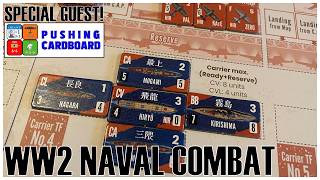
Reviewers see Task Force: Carrier Battles in the Pacific, the two-player World War II naval wargame published by VUCA Simulations, as a game that captures the feeling of carrier combat without the heavy learning curve its box suggests. Zilla Blitz described a session played with Grant from Pushing Cardboard at SD Historicon as a blast, and said the game met high expectations for its gameplay. The consensus is that the game is at its best head to head. Reviewers who tried the solitaire modes came away less impressed, and they regard solo play as a way to learn the system rather than the main event.
Core Mechanics That Define Task Force: Carrier Battles in the Pacific
Hidden Deployment
VUCA Simulations builds the game around concealed task forces. Each side groups its ships into task forces, and each task force carries a counter, but players also field a number of dummy counters. As Zilla Blitz explained, an opponent facing a counter cannot tell whether it hides a carrier fleet, a capital ship group, or nothing at all, so every search becomes a decision under uncertainty. Reviewers said the effect is strongest when players use a physical screen between their boards. Zilla Blitz said that separation "really added some spice," because it prevented each player from reading the other's display. In the session Zilla Blitz described, both players used a pair of destroyers to pose as a carrier group. One deception fooled the opponent completely, while the other did not, which shows how much the bluff depends on how each side reads the searches.
Search, Launch, and Carrier Readiness
Searches are the core of the cat-and-mouse loop. A player launches search aircraft at a counter, and the searched player draws a chit from a cup. The result is either detected, not found, or detected but misidentified, so a successful search still may not reveal whether a target is a dummy, a carrier fleet, or a capital ship fleet. Zilla Blitz compared this to the secret-table approach in Clash of Carriers, where the defender rolls on a hidden table and the attacker sees only a graded result. Once a carrier is found, the strike phase punishes any aircraft left on deck. Planes that are armed and fueled on a damaged carrier can detonate, and in the Midway session a carrier that took a hit was nearly destroyed multiple times. Reviewers also noted that fighters held in combat air patrol must be recycled below decks before they can launch again, so a player who keeps planes in reserve may be caught unable to respond.
The Task Force: Carrier Battles in the Pacific Experience
Cat-and-Mouse Tension
Zilla Blitz and their opponent were both visibly tense every time a search check went against them, and each decision about how many fighters to keep on combat air patrol was made before the search results were known. Zilla Blitz described the same dynamic when playing the Midway scenario with Grant, calling the game full of tension because each player is trying to work out where the other's carriers are. Reviewers present this as the defining feature of the game: a player who has not found the enemy fleet can still lose it, and a player who has found it may still be unable to strike in time.
Recreating the History of Carrier Battles
Reviewers repeatedly said the game feels like a simulation rather than an abstract contest. In the Midway scenario, the first day's sequence of strikes, sinkings, and crippled carriers closely followed the historical battle, and the reviewers said so while playing. Zilla Blitz said the design "did a really good job of modeling the history of how it went," and that it felt like the players were "simulating something." The game was not a perfect copy of events, since the outcome depended on dice and on how each side searched, but the broad shape of the battle emerged from play.
What Makes Task Force: Carrier Battles in the Pacific Stand Out
Historically Grounded Combat Modeling
Reviewers singled out how combat is resolved in stages. Combat air patrol is contested first, then anti-aircraft fire, and then the strike itself. Strong anti-aircraft fire does not remove attacking planes outright, but it adds a dice modifier that makes the strike less effective, and reviewers said the scattering of incoming aircraft felt authentic. Ship damage is also threshold based. Zilla Blitz described a ship that takes seven hit points of damage getting only a light damage marker, while exceeding that total flips the ship to its damaged side, and Zilla Blitz said the system "worked great." Reviewers noted that the same general approach appears in Clash of Carriers, which made the modeling feel familiar to players who knew that title.
Accessible Rules and a Streamlined Sequence of Play
Despite its size, reviewers said the game is easier to play than its box implies. Zilla Blitz rated its complexity around five out of ten, and described it as roughly half the complexity of Mark Herman's Pacific War. The scenario structure is a major reason. The early scenarios introduce movement and air attacks gradually, so players reach the full carrier scenarios with the basics already in place. Zilla Blitz said the rules were "way more lucid and clear and easy to parse" than expected, and that the chart-driven sequence of play is easy to chunk through. Playing the first day of the Midway scenario took about two hours for players who were still learning, and the players estimated that a later replay would take two to three hours.
Potential Drawbacks
A Weak Solitaire Experience
Zilla Blitz questioned the solitaire rating of seven out of ten printed on the box, arguing that the rating does not hold once hidden movement is involved. The solo scenarios that do exist are mostly learning scenarios with limited mechanics, such as the Pearl Harbor scenario, where planes practice dive and torpedo attacks against stationary targets. Zilla Blitz said that trying to play full carrier scenarios alone required improvising a system for revealing and rolling for enemy contacts. In Zilla Blitz's ranking of favorite wargames, the solo modes are described as being for learning the game, with the two-player game as where its heart lies. Reviewers therefore recommend the game mainly for two players.
A Rulebook That Reads Harder Than the Game
Several reviewers said the rulebook made the game seem more complicated than it is. Zilla Blitz admitted to finding the rules complex while reading them, but found the play much simpler, suggesting that the way information was laid out made the rules hard to follow on paper, and that the explanations were more confusing than the charts themselves. The game's three main resolution tables, covering intercepting combat air patrol, anti-aircraft fire, and strikes, contain only a few modifiers each, so once the charts are in front of players the logic becomes clear. Reviewers recommend that new players read the rules with the charts in hand, or start with the learning scenarios.
If You Enjoy Task Force: Carrier Battles in the Pacific
- Avalon Hill's Midway: Reviewers describe this classic as the same kind of hidden carrier duel, with a double-blind system and a sharp contest over who strikes first. Players who value the search-and-strike tension of Task Force will recognize its core appeal, though Task Force adds more nuance in search, anti-aircraft, and damage.
- Clash of Carriers: Reviewers compared it directly to Task Force. Both use hidden task forces, dummy formations, and anti-aircraft and strike sequences, so it suits players who want the same cat-and-mouse structure with a different search method.
- Chase of the Bismarck: Zilla Blitz praised this title for its double-blind play, where each side cannot see the other's board. Like Task Force, it depends on trust and on both players understanding the rules well.
- Mark Herman's Pacific War: Reviewers describe this as a much heavier Pacific campaign game. Players who find Task Force approachable and want more depth in the same theater may find it a natural next step, though they should expect a steeper learning curve.
What Reviewers Are Saying
"I think it, I think what made it so fun is it, it, it gave that thing that you always want from a World War II naval game, which is the cat and mouse of trying to find the other guy. Like, that's, like, if you don't have that then you don't really have a game."
— Zilla Blitz
"The two-player game, I think, is really where the heart of the game is because you get into all that hidden aspect of not knowing where your enemy is, trying to be the first one to find and launch a carrier strike."
— Zilla Blitz
"There's all this tension because you have no, you're trying to figure out where your opponent is, so as we were playing it, it made this realization, like we're recreating this battle historically with all of the tension and the drama that surrounds it."
— Zilla Blitz