





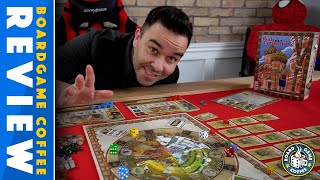

The Red Cathedral Deep Dive
What the Community Thinks About The Red Cathedral
Reviewers generally describe The Red Cathedral as a polished, mechanically sound Euro game that rewards planning more than luck. The physical presentation draws frequent praise. Before You Play highlighted how much game fits into a small box, and the seasonal rondel board and cathedral section cards were described as beautiful to look at. Beneath that surface, the dice-driven resource engine is the real draw, and the consensus is that the game asks more of the table's attention than its printed play time suggests.
Playing time is the most consistent caveat. Board Gaymes James noted that the box lists 80 minutes but that a first game ran closer to three hours, and still concluded that the game is worth picking up. In that review, White Castle was described as the stronger design when the two are compared directly. Meeple University echoed the length concern, describing a puzzle that can produce long pauses while players recalculate their options.
Player count is another dividing line. Before You Play felt the game is at its best with four players, where competition for the cathedral sections and the constant rotation of the dice keep everyone involved. Two-player games were described as still enjoyable but more prone to a runaway leader. Mark Maya of Board Game Coffee reviewed the Contractors expansion with enthusiasm for its new guild cards and contractor map, while noting that the expansion brings frustrations of its own. Meeple University summarized its feelings as a love-hate relationship, appreciating the timing puzzle while finding it occasionally frustrating when a planned turn is undone by another player.
A digital edition is also in development. Totally Tabled played a three-player match against medium AI opponents and finished with a score of 88 against 67 and 65. Paul Groen played the build in progress and noted that the developers were still tuning it, so reviewers treat the digital version as a work in progress.
Core Mechanics That Define The Red Cathedral
Rondel Dice Movement
The central board is a circular rondel, and most of the action is built around moving dice around it. On a turn, a player picks one die and moves it clockwise by its pip value. The player then collects the resources shown in the segment where the die lands, multiplied by the number of dice already sitting there. Meeple University explained that the player can take any die and move it as many spaces as it has pips, and that the dice in that segment are rolled again afterward so the board is different for the next player. Die color adds another layer. A workshop tile claimed earlier can be activated whenever a die of its matching color moves, and the white die can be upgraded to pay for extra movement. Because a die that would land in a full segment cannot be chosen, reviewers described planning a turn around specific dice as a constant balancing act.
Area Majority Tower Scoring
Final scoring is built around the cathedral towers. Each tower carries a point value, and the players who contribute the most banners and decorations to it compete for that value. Drunkett's Games explained the rule that the player who contributed the most takes the full value of the tower, while second place receives half, rounded down. Board Game Coffee described the same pattern as area control, where the goal is to have the most pieces on the bigger towers. Recognition is also tied to construction, since building a section above another player's unfinished section costs the lower player recognition points. That interaction keeps the majority contest active throughout the game rather than only at the end.
The Red Cathedral Experience
Satisfying Engine
Much of the pleasure comes from assembling a working machine. Before You Play highlighted how the workshop tiles let a single action deliver several rewards at once, so a well-timed move can collect resources, activate a tile, and use a guild card in one turn. The reviewers treated that efficiency as the point of the game. Collecting one resource per action and delivering it piece by piece is slow, while chaining rewards turns the board into an engine that accelerates. Totally Tabled's digital playthrough showed the same rhythm, with the reviewer working through combinations of tiles and guild actions to keep materials flowing toward the cathedral.
Interactive and Dynamic
Because the dice are shared, one player's move reshapes what the next player can reach. Meeple University described the frustration and fun of this directly: a plan built around a specific die can vanish when someone else moves it. Before You Play noted that at higher player counts, players count on other people to change the board so they can move the die they need without revealing their intent. Spending prestige to reroll dice is always an option, but reviewers observed that it is rarely attractive, because prestige is hard to earn and the exact number needed is only a one-in-six chance. That tension keeps the board feeling alive and occasionally unfair in the moment.
What Makes The Red Cathedral Stand Out
Compact Packaging and Strong Art
Before You Play praised how much game fits into a small box, noting that shelf space is a hot commodity and that a publisher condensing a quality game into a compact package deserves credit. The reviewers also repeatedly singled out the artwork, from the seasonal board to the cathedral section cards, as a major part of the appeal. Board Game Sanctuary's overview highlighted the cathedral sections and the guild cards as distinctive visual elements.
A Different Cathedral Every Game
Variability is a repeated point of praise. Board Gaymes James said the cathedral itself is different every time the game is played. Before You Play explained that the cathedral plan, the workshop tiles, and the guild cards are randomized, and that the double-sided player boards offer an advanced side that plays differently. A solo mode is also included. Before You Play was careful to separate variability from replayability: the core loop of collecting resources and delivering them to the cathedral stays similar from game to game, so the setup changes matter most to players who want variety between sessions.
Potential Drawbacks
Length and Downtime
Reviewers consistently warn that the game can run well beyond its printed time. Board Gaymes James reported a first game that took about three hours. Meeple University warned that players who do not plan ahead can face a lot of downtime while everyone recalculates what is optimal, drawing a comparison to Five Tribes. The Contractors expansion adds further decisions, and Board Game Coffee described it as good but accompanied by frustrations of its own. The same reviewer still recommended the expansion to anyone who already owns and enjoys the base game.
Two-Player Tension
Before You Play found that the two-player game loses some of the tension that makes the multiplayer experience work. With fewer players, the dice change less between turns, so it becomes easier to see who is ahead. Once a player completes a cathedral section, the outcome of that section is effectively set. The reviewers also noted that in a two-player game the runner-up on a tower receives a third of its points rather than half, which reduces the incentive to contest towers for second place. The result is a game that can feel decided before the final turns.
If You Enjoy The Red Cathedral
Players who enjoy The Red Cathedral's shared dice and rondel will find a natural companion in Five Tribes. Meeple University used that game as the reference point when describing the downtime that comes from recalculating after other players move the dice, and it also mentioned Yamatai, the title that followed Five Tribes and shares its tendency toward one perfect action that everyone converges on.
Players who value the tower scoring and the sense of racing to finish a structure may find White Castle appealing, since Board Gaymes James compared the two games directly. Those who want a balance of simple actions and heavier end-game scoring might look to Kanban, which Meeple University used as a complexity reference. Maracaibo was also mentioned by Meeple University as an example of how small board changes between scenarios can reshape the whole experience, which is a quality that also appeals to players who like the variable cathedral setup. Players interested in expansion-driven variety can consider the Viticulture expansion, since Board Game Coffee linked the contractor map in Contractors to the worker-placement map that expansion adds to Viticulture.
What Reviewers Are Saying
"I still really like this game for some reason even though I don't normally like the idea of having to do taxes every time I play a game."
— Board Gaymes James
"It's one of the biggest things that I appreciate when when a publisher can can condense a quality game into a small box, just because shelf space is such a like a it's a hot commodity. In addition to the actual components the artwork is beautiful."
— Before You Play
"I plan my turn. Okay, I want to do this, this is a dice, one two three, I'm gonna land there and then somebody do that and then roll all the dice and I can't do that anymore."
— Meeple University