







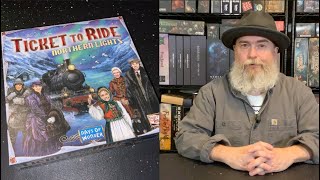
Ticket to Ride: Northern Lights Deep Dive
What the Community Thinks About Ticket to Ride: Northern Lights
Reviewers see Northern Lights as a welcome new way to play one of the most familiar games in the hobby. The shared view is that it is easy to teach, plays quickly, and adds a few new rules to the classic Ticket to Ride formula. The praise centers on the bonus card system, the Nordic map, and the sense that the game feels like Ticket to Ride with a little more to think about. The criticism is narrower. Reviewers wonder whether the set is as new as its packaging suggests, and Kevin Delp wishes the bonus card pool were deeper.
Core Mechanics That Define Northern Lights
Ferries and Locomotive Symbols
Several reviewers single out the ferry routes as the most distinctive change. Some ferry spaces carry locomotive symbols, and a player must discard a locomotive card, or a pair of matching cards, for each symbol before claiming the route. The rest of the spaces are then filled with cards of a single color, which do not need to match the cards spent on the symbols. The Discriminating Gamer describes these routes as a fun twist that rewards planning, and notes that some ferries also grant cards when completed.
Locomotives on Gray Spaces
The left side of the map is packed with gray spaces that carry locomotive symbols, and many of them reward the player with extra cards for finishing the route. Kevin Delp points out that locomotive cards work only where the map shows them. They are not wild cards in the way players may expect from other Ticket to Ride releases. Kevin Delp also highlights a rule that lets a matching pair of cards act as a locomotive, which gives players more flexibility when they are short on the right card.
End-Game Bonus Cards
The bonus cards are the feature reviewers discuss most. Each game uses a random selection from a larger pool, and the cards are scored after the final turn alongside completed routes. The bonuses reward whoever leads in a particular area. Examples include the most trains left in supply, the most locomotives in hand, the most routes reaching specific cities, the most routes into the Arctic Circle, and the most completed tickets. Because the selection changes from game to game, the strategy changes too. Matthew of Watch It Played notes that a longest route bonus may decide one game while a fewest trains bonus decides the next. Kevin Delp says the cards give players another goal beyond their tickets, and that extra goal proved satisfying in Kevin Delp's own game.
Map and Components
The map covers Denmark, Sweden, Norway, and Finland. It folds out into sections illustrated with landmarks and regional peoples, and the vertical ticket cards suit the tall shape of the countries. Reviewers praise the train cards and the bright player colors, and The Discriminating Gamer says the board looks brighter than expected. Kevin Delp warns that many American players will struggle with the city names, and Kevin Delp expects some laughter at the attempts. The plastic insert holds the components neatly.
The Play Experience
Reviewers consistently describe Northern Lights as quick and approachable. The Discriminating Gamer says the game is easy to teach and easy to learn, and that it delivers a lot of fun for the time it takes. Kevin Delp reports that a full table finished in roughly forty to forty-five minutes, which fits the game's listed playing time. The core rhythm of Ticket to Ride stays intact. Players still draw cards, claim routes, and try to line up their destination tickets with cities that sit close together. Kevin Delp says that a left-side route network paid off because those routes earned extra cards.
What Makes Ticket to Ride: Northern Lights Stand Out
Bonus Cards That Change Every Game
Reviewers return to the end-game bonus cards more than any other feature. The game includes 11 bonus cards, and each game deals four of them at random. Because these cards score at the end of the game and usually reward the player with the most of something, such as trains left in supply or routes into the Arctic Circle, the four drawn cards shape how each table plays. Kevin Delp calls the bonus cards the biggest addition to the set, and that variety is what gives them their appeal.
Easy to Teach, Quick to Play
The other praise that comes up again and again is how approachable the game is. The Discriminating Gamer says it plays easy, is super easy to teach, and is super easy to learn, while Kevin Delp reports that a full table finished in roughly forty to forty-five minutes. The rules layer onto the familiar Ticket to Ride structure without asking players to relearn it, so newcomers can join a game quickly while experienced players focus on the new bonus cards and ferries.
How It Compares to Nordic Countries
Comparisons are where reviewers disagree most. Tom Vasel of The Dice Tower calls Northern Lights the remake of the earlier Nordic Countries map pack and believes the two are almost the same thing. Kevin Delp sees clearer differences, pointing to a new map, more players, and a bonus card system that the earlier pack lacked. Kevin Delp notes that Nordic Countries was limited to a smaller player range, which is another key change. Lance of UndeadVikingVideos frames the release as a long-awaited arrival, explaining that the Nordic map was traditionally sold only in the Nordic countries before this English release. Matthew loves the Nordic version and hopes Northern Lights will receive a wide release beyond Scandinavia.
Strengths
- Accessible rules: Reviewers consistently describe the game as easy to teach and quick to play.
- Meaningful bonus cards: The end-game bonuses change the goals from one game to the next and reward different kinds of planning.
- Distinct ferry and locomotive rules: The ferry costs and gray-space locomotives add a new layer to route planning without overwhelming the core game.
- Strong presentation: The colors, the vertical ticket cards, and the illustrated map earn praise from several reviewers.
Potential Drawbacks
- Limited novelty for some fans: Tom Vasel and others see it as close to Nordic Countries, which makes it a harder sell for players who already own that pack.
- Bonus card pool: Kevin Delp wishes there were more bonus cards, since the pool is what makes each game feel different.
- Standalone status: Kevin Delp expected a map pack rather than a standalone game and wishes the other side of the board had shown another country.
- Geography and names: The city names can be hard to pronounce, and players less familiar with Scandinavian geography may need a few games to settle in.
If You Enjoy Ticket to Ride
Northern Lights suits players who want a fresh Ticket to Ride map without a lengthy learning curve. Families and newcomers are likely to find the rules approachable, and experienced players who enjoy expansion-style twists will appreciate the bonus cards and ferry mechanics. Collectors who already own the Nordic map pack should weigh whether the bonus system and standalone format justify the purchase. Reviewers agree that the game holds its own among the other Ticket to Ride maps and that it earns its place in the line.
What Reviewers Are Saying
"The biggest addition to Northern Lights is the bonus cards."
Kevin Delp, Tantrum House
"It plays easy. It's super easy to teach. Super easy to learn. And it's just a whole lot of fun."
The Discriminating Gamer
"but I have played Ticket to Ride Nordic countries, which I believe is almost the same thing."
Tom Vasel, The Dice Tower