





Ticket to Ride: San Francisco Deep Dive
What the Community Thinks About Ticket to Ride: San Francisco
Ticket to Ride: San Francisco takes the route-claiming loop of the series and compresses it into a small-box city game that runs about 10 to 15 minutes for two to four players. Reviewers describe a familiar engine with one new layer on top: souvenir tokens that reward players for connecting landmarks across Fog City.
Reviewers generally treat this edition as a fast, thematic entry in the Ticket to Ride family. The San Francisco map draws consistent praise, with recognizable landmarks, cable car artwork, and a 1960s setting all earning approving comments from players who know the city. Several reviewers also note that the experience is quick and the core decisions are familiar, which makes it an easy pick for people who already enjoy the base series.
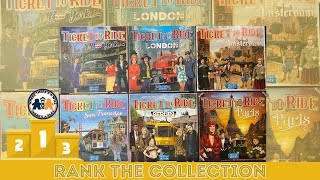
Opinion is more divided on how much the souvenir layer adds. One reviewer ranked it near the middle of the six city editions, feeling the tokens did not add enough to set the game apart, though that same reviewer preferred its souvenirs to the trade contracts in Amsterdam for a two-player game. That reviewer also suggested the edition would work better at three or four players, where more people compete for routes and tokens.
Core Mechanics That Define Ticket to Ride: San Francisco
Set Collection Through Souvenirs
Each time a player claims a route, they may take one souvenir token from a stack at either end of that route, provided they do not already own that type. Players finish the game by scoring their unique souvenirs: zero or one earns nothing, two earns 1 point, three earns 2, and the total climbs to 12 points for a complete set of all seven. Because every new unique type adds to the score, each souvenir matters on its own rather than through a majority contest, which pushes players to route through landmarks and not only toward their destination tickets.
Route Building With Ferry Wilds
Players pay coloured transportation cards to claim routes of one to five cable cars. A single-car route scores 1 point, a three-car route scores 4 points, and the five-car ferry route pays 10 points. Multicolour ferry cards act as wild cards, and certain routes at the top of the map display a ferry icon that requires one ferry in addition to the normal cost. Once a player claims a route, it is blocked for everyone else, and in a two-player game the parallel twin of a double route disappears as soon as one of them is taken. Each turn allows only one route claim, which keeps every decision focused on a single connection.
The Experience
A Playful Sense of Tourism
The theme of tourists hopping between landmarks shapes how the game feels at the table. Players trace cable car routes between sites such as Lombard Street and the Golden Gate Bridge, and reviewers note that the artwork makes the board feel like San Francisco even to people who have never ridden a cable car. The sightseeing framing gives the race for routes a light, playful tone.
Quick, Tight Sessions
Because the routes are mostly two or three spaces long, the board stays compact and the game moves fast. Setup is simple: each player receives two cards, the souvenir stacks are placed on the map, and destination tickets are dealt before play begins. Since the map is small, players rarely plan far ahead, so tension comes from short-term races for specific connections rather than from long chains of planning.
What Makes It Stand Out
A Faithful San Francisco Map
Reviewers repeatedly point to the map as the reason this edition differs from the other city games. The board includes many landmarks that people who know the city will recognize, and the 1960s setting, where cable cars form the city's transit network, gives the design a clear identity. Players who know San Francisco tend to enjoy spotting familiar sites while they build connections between them.
Souvenirs That Reward Exploration
The souvenir tokens encourage players to claim routes that pass landmarks, not only the ones their destination tickets require. Reviewers describe a useful tension here: a player may want a particular souvenir for its endgame points while still needing a specific connection to finish a ticket. Because the scoring rises with each unique token, a player who wins several races can pull well ahead, which keeps the final tally from being a simple count of routes.
Potential Drawbacks
A Light Souvenir Layer
Some reviewers feel the souvenir tokens do not add enough to separate this edition from the rest of the city line. Because the core loop matches the base game, players who already own several city editions may find the new mechanic a modest change rather than a reason to add another box. The effect is clearest when the souvenirs are part of an active race, so a quiet table may not feel much of the extra depth.
Weaker Pull at Two Players
The two-player experience draws the sharpest criticism. One reviewer found the souvenir layer less satisfying with only two people, feeling that the game simply does not work as well at that count. Scoring is also less varied in a two-player game, since one player is more likely to hold the majority in any scoring contest. Players who prefer a more competitive table may find that the edition shines more with three or four.
If You Enjoy
- Ticket to Ride: the original route-claiming game with destination tickets, which teaches the same core loop on a larger map.
- Ticket to Ride: New York: a compact Manhattan map where tourist attractions score at the end, echoing the souvenir scoring found here.
- Ticket to Ride: London: district bonuses reward connecting numbered areas, offering a different kind of bonus on a similar scale.
- Ticket to Ride: Europe: a larger continent map that adds tunnels and ferries for more route-planning depth.
- Railways of the World: a more involved railway game with a bigger map and deeper economic choices for players who want more to manage.
What Reviewers Are Saying
"Remember that ferry cards are wild, so you could pay one ferry and one yellow card to claim this route, or even two ferries. Somebody should also tell the Port Authority that there's a ferry floating down the middle of Columbus Avenue."
— Nights Around a Table
"Ticket to Ride San Francisco is set to be the next in the small box Ticket to Ride games line where it's the 1960s a mythical time where people could still afford to live in San Francisco and you'll be developing a network of cable cars to help get people from A to B. There's a system of souvenir locations from Lombard Street to Golden Gate Bridge and the more of these souvenirs you collect the more points you get at the end of the game."
— Watch It Played
"The more you have it's kind of like that exponential scoring so it kind of encourages you not to only like score the routes that you need on your secret objectives but also at the same time try to race to get to these souvenirs so you can score at the end of the game."
— Before You Play