




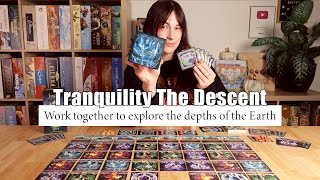

Tranquility: The Descent Deep Dive
What the Community Thinks About Tranquility: The Descent
Tranquility: The Descent is a silent cooperative puzzle that reviewers describe as both profoundly calming and intensely challenging. The community view is overwhelmingly positive: the game is described as amazing, excellent, and well worth backing. Reviewers emphasize that despite its restrictions on communication, the game creates genuine cooperation and coordination. The artwork consistently draws praise, with multiple reviewers noting how visually beautiful the game is. The experience feels zen and meditative, yet demands constant strategic deduction about what other players hold in their hands. Even skeptics who normally avoid hidden communication games found themselves enjoying it. The consensus is that this is the strongest entry in the Tranquility series to date.
Core Mechanics That Define Tranquility: The Descent
Limited Communication: The Silent Deduction Challenge
The heart of Tranquility: The Descent is its commitment to silent play. Players cannot discuss what they plan to do or what they hold. Instead, they must deduce information from each other's card positions. Because all numbered cards in your hand are arranged from lowest to highest in ascending order, when another player draws a card from the middle of their hand and it reveals a 7, you instantly know everything to the left must be higher and everything to the right must be lower. This silent deduction forces a unique kind of cooperation where your physical play becomes your communication. Reviewers describe it as creating a zen-like puzzle experience where you sit in pure tranquility while trying to read your teammates. The game includes canary tokens for multiplayer games, which allow limited breaks in silence (you can knock on the table to say a move is important, or peek at another player's card), but these are precious and finite, forcing you to save them for critical moments.
Hand Management and Strategic Card Play
Your hand of five cards defines everything you can accomplish. You must hold them in sorted order, giving away information with every draw and every play. The strategic tension comes from deciding not just which card to play, but which card to draw. In a two-player game, you have choices about where to get your next card. In multiplayer, that choice narrows. Each turn, you play one card and draw one card, maintaining your five-card hand. The elegance lies in how this simple action generates endless deduction puzzles. If you take a card from your left side, everyone learns something. If you pull from the middle, the implications shift. Reviewers highlight how leaving open spaces on the board for teammates becomes an art form in itself, part of the unspoken coordination that makes the game feel like you and your teammates are thinking as one.
The Tranquility: The Descent Experience
Silent Deduction and Tension
Reviewers describe an experience of sitting across the table from teammates, saying nothing, yet communicating constantly through card positions and board placement. The deduction unfolds turn after turn as you learn more about hidden hands through the cards people play and the cards they draw. One reviewer notes that after a full game of silent play, you and your teammates have shared an entire conversation without speaking a word. The tension builds as rows complete and you move deeper into the cavern. There is a moment of desperation when certain cards seem unavailable and the deck grows thin, yet this never breaks the calm, meditative atmosphere. Even when the game becomes tense, reviewers consistently describe it as tranquil.
A Calm Yet Cognitively Demanding Puzzle
The game creates an unusual emotional space: it is relaxing in feel, yet it demands constant mental engagement. You are solving a puzzle collaboratively while your mind tracks what dozens of cards might be in hidden hands. The experience is described as peaceful rather than stressful, even when outcomes are uncertain. The game's pacing enforces this calm. There is no timer, no rushing. You take your turn when you are ready, and your teammates wait in supportive silence. This creates what one reviewer calls the game's greatest strength: pure tranquility. Unlike many cooperative games where chaos or time pressure creates anxiety, Tranquility: The Descent lets you think, deduce, and play in a contemplative state.
What Makes Tranquility: The Descent Stand Out
Stunning Visual Presentation and Theme Cohesion
Multiple reviewers single out the artwork as a standout feature. The cards depict glittering caverns and underground glades with a beauty that makes every play feel meaningful. The visual presentation serves the theme perfectly: you are descending into depths, and the art makes you feel that descent. One reviewer notes that the square box and consistent branding across the Tranquility series creates joy in storing them together on a shelf. The components feel premium, the colors evoke the elements you are discovering, and every card draw feels like an aesthetic experience. This level of care in presentation elevates the entire experience beyond a pure puzzle into something that feels like an artistic collaboration.
Solo and Multiplayer Modes Work Brilliantly and Differently
The game ships with two distinct modes that feel like entirely different games. Multiplayer is about deduction and reading teammates. Solo, by contrast, becomes a pure spatial and numerical puzzle. In solo mode, you hold only four cards instead of five, and you can see all your own cards and arrange them however you like. The deck is split into four piles, and you choose which to draw from, giving you information about what is available. Without opponents to deduce, the challenge shifts to optimizing placements within the cavern, managing your hand's card colors strategically, and dealing with the puzzle constraints of the descent and minecart cards. Reviewers praise both modes. Some prefer the social, silent cooperation of multiplayer. Others love how the solo game becomes a pure puzzle without the communication layer. This flexibility means the game works powerfully in either context.
Potential Drawbacks
High Cognitive and Deduction Load
The game demands significant mental effort. You must track the contents of multiple hands, remember which cards people played, calculate what they might have drawn, and update your model constantly. For some players, especially those less practiced at deduction, this can feel overwhelming. One reviewer who typically avoids hidden communication games initially doubted the experience but came to enjoy it, suggesting that players who dislike reading hidden information or who find deduction stressful might struggle. The game is not rules-heavy, but it is mentally taxing in the best way. This is not a game for pure relaxation in the sense of low engagement; it is relaxing in atmosphere but challenging in thought.
Risk of Stalling and Complex Module Interactions
Reviewers note that certain card sequences can trap you into unplayable positions, requiring careful planning to avoid wasting cards. The three optional modules (objectives, minecarts, and rabbits with foxes) add layers of interaction and complexity. The rabbit and fox module in particular introduces cascading effects: rabbits multiply when you complete rows, and you must use foxes to clear them before you can play more odd-numbered cards. While this creates engaging puzzle depth, the rulebook can be ambiguous on certain interactions. One reviewer notes that even relatively simple rule clarifications require checking FAQs. The base game is elegant, but adding multiple modules simultaneously requires reading rules carefully and potentially dealing with unintuitive interactions.
If You Enjoy Tranquility: The Descent
If you love this game, seek out the original Tranquility and Tranquility: The Ascent. Multiple reviewers who have played the series note that The Descent stands as the strongest entry, yet the original Tranquility remains a beloved classic with its own charm. The Ascent offers a different aesthetic and direction (ascending instead of descending) with its own set of mechanics and beauty. All three share the silent cooperative spirit that makes the Tranquility series unique. If you enjoy the meditative, deduction-heavy cooperation of The Descent, you will find that same zen satisfaction in its siblings.
What Reviewers Are Saying
"This game is amazing. Like go and back this one if it's still available. The cooperation in this is just excellent as you're trying to build downwards with these cards and you're like leaving spots for each other. It's really cool."
— One Stop Co-op Shop
"This game is so zen. You just sit here and puzzle it out in pure silence, in pure tranquility. Hence the name of the game."
— Rahdo Runs Through
"The artwork's gorgeous. The game is interesting. The people that I have spoken to that have played the other ones in the series have said this is the best one. And I preferred this one to the first one, but it's been years since I've played the first one, so I can't quite remember it that well, but I know that I did actually enjoy this one."
— Gaming Rules!