





Tumble Town Deep Dive
What the Community Thinks About Tumble Town
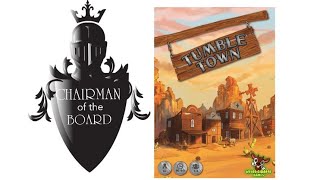
Tumble Town is a dice-driven town building game designed by Kevin Russ and published by Weird Giraffe Games after a Kickstarter campaign. Reviewers on the Chairman of the Board channel describe it as a hidden gem that arrived with little buzz and deserved far more attention. The host of a dedicated review called it a huge surprise and an absolute delight to play, and later lists from the same channel placed it among its hidden gems and pleasant surprises.
The gameplay draws the warmest praise, while the artwork and component presentation draw the most consistent criticism. Reviewers agree that the rules are digestible and that the decisions are meaningful, but they differ on how to frame the audience. Some present it as a family game that still holds up for experienced players, while others treat it as a light dice puzzle for groups who want a quick, satisfying session. Kevin Russ also designed Calico, and reviewers point out that Tumble Town has not received the same attention, even though both games share a pattern-driven design sensibility.
Core Mechanics That Define Tumble Town
Drafting Buildings and Dice From a Shared Card Row
Each turn, a player takes a card from one of three rows. Every card is a building plan, and taking it also gives the player dice to use as resources. The dice are colored by material: brown dice represent wood and gray dice represent stone, while black dice and golden dice round out the pool, with golden dice described as a wild or more lucrative resource. The host of the hidden gems video on the Chairman of the Board channel summarized the flow as drafting a card, rolling the dice, and then building the buildings already collected.
Building plans carry requirements that go beyond simply matching dice colors. A plan may demand that all dice share a color, that every die shows a different pip value, that dice form pairs, or that the total of the pips clears a threshold. Reviewers note that drafting is a planning exercise because players must consider which requirements their dice pool can satisfy before committing to a card. Finished buildings are placed on a player board that represents the town's main street, where specific squares reward particular dice placements or stacks with extra points at game end. Only six dice can be carried from one round to the next, so players are encouraged to build something every round rather than let resources go to waste.
Dice Manipulation Through Building Abilities
Completed buildings provide abilities that change dice during later turns. Reviewers describe these powers as the engine of the game, letting a player re-roll dice, flip a die to its other face, convert one die into a different color, or add new dice to the pool. As the town grows, players gain more control over the dice they have rolled, which makes the expensive buildings that use golden dice easier to finish. The Chairman of the Board channel describes the result as a small engine that builds as the game goes on, and the dedicated review praises how the design lets players tailor the dice to their needs.
The Tumble Town Experience
Breezy but Satisfying
Reviewers consistently describe Tumble Town as breezy and quick, with turns that tick along without much downtime. The dedicated review calls it very simple but engaging, with a playtime of about half an hour. The pace comes from the simple structure, because each round reduces to drafting a card and then building with the dice available. Despite that simplicity, the moment a player completes a demanding building with a precise set of dice is described as deeply satisfying. The game also tends to end just as an engine starts to hum, which the host of that review says leaves players wanting another round.
Tactile Tension at the Card Row
The table feel is another recurring theme. Because players physically build their town with the dice they have rolled, the game has a strong tactile quality, and reviewers praise its table presence for that reason. The tension comes from the shared card row. A building that fits a player's dice perfectly can disappear the moment an opponent takes it, and the Chairman of the Board channel describes that turn order frustration as palpable. The dedicated review frames this as a good thing, since it forces players to balance their own plans against what the table is likely to take next.
What Makes Tumble Town Stand Out
Accessible Rules With Real Decisions
The most prominent praise concerns how little rules overhead the game carries while still asking for meaningful choices. Reviewers describe the rules as extremely digestible, with setup and teardown requiring little effort because the card tableau is built by removing cards based on player count. Each turn still asks players to weigh cheap buildings for bonuses against expensive buildings that use golden dice for larger end-game scoring. That mix makes the game attractive to families and to more seasoned players alike, and the host of the dedicated review recommends it to fans of family weight games.
A Physical Town Built From Dice
Reviewers also highlight the component quality and the physical experience of building with dice. The dice are described as good quality, and the game includes a dice tower that the dedicated review considers a welcome surplus component. Stacking dice into towers to represent a building gives the game a distinct visual identity on the table. The host of the hidden gems video describes that tactile building as a large part of the game's appeal, and the dedicated review calls it really cool.
Potential Drawbacks
Prototype-Looking Artwork and Player Boards
The most consistent criticism concerns visual presentation. Reviewers describe the building cards and player boards as basic, plain, or amateurish, and the art is said to look like a prototype. The dedicated review argues that the artwork could have been more vibrant and cartoony to increase appeal, though it notes that the cards are clear enough that players can see the dice requirements at a glance. The pleasant surprises video felt the production let the game down, even though the gameplay itself was strong enough to overcome the presentation. Reviewers generally agree that a reskin or revised art direction could help the game reach a wider audience.
Limited Retail Availability and Discoverability
The second concern is distribution. Because Tumble Town was a Kickstarter title that did not receive much buzz, reviewers worry that it may stay under the radar. The Chairman of the Board channel questioned whether retailers will carry the game in meaningful numbers, and suggested that many players may only encounter it through backers or the secondary market. Reviewers express hope that word of mouth or a future reprint with new artwork will help it find an audience, but they acknowledge that the game's visibility is currently limited.
If You Enjoy Tumble Town
Reviewers point players who enjoy the dice drafting and pattern-building aspects of Tumble Town toward Sagrada. The Chairman of the Board channel says Sagrada appeals in a similar way because it asks players to fit dice into restrictions while still trying to score as many points as possible. Tumble Town differs in that its restrictions apply to the buildings players construct, and its dice manipulation abilities give players more room to adapt when their dice do not cooperate.
Players who appreciate the design approach of Kevin Russ should also explore Calico, the designer's better-known title. The Chairman of the Board channel describes Calico as a tight tile placement game with a small margin for error, where players must be selective about which scoring criteria they pursue. That same sense of selective, constrained planning runs through Tumble Town, so fans of Calico may find that the dice-based version offers a similar pleasure with a different kind of tactile play.
What Reviewers Are Saying
"i mean if this is what you're looking for then i cannot complain at all. but in the same vein you know the aesthetic might hold it back a bit."
— Chairman of the Board
"i think a big part of that is maybe the visual aspect isn't quite as strong with this one. i think the artwork is questionable but the game mechanisms themselves are extremely accessible fun and very family friendly."
— Chairman of the Board
"but when i actually played it i couldn't see any fat on this game whatsoever. the production let it down a little bit i think in terms of the artwork and graphic design."
— Chairman of the Board