/pic7360578.jpg)
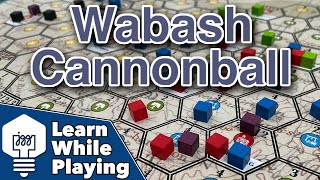
Wabash Cannonball, which has also been released as Chicago Express, was the first title in Winsome Games' Historic Railroads System.
In the game, the B&O, C&O, Pennsylvania and New York Central railroads drive from the East Coast across the growing eastern U.S. to Chicago. Smaller, more aggressive railroads like the Wabash spring up to further expand America's extensive railroads. The sharpest railroad executives vie for the maximum return on their investment in this luck-free business game lasting about one hour.
The game plays out over a maximum of eight rounds. In each round, players take turns choosing one of three available actions:
Auctioning a share of one of the railroad companies.
Expanding the rail system of one of the railroad companies.
Developing one of the board's hexes.
Each of these actions is available only a limited number of times. As soon as two actions can no longer be chosen, a dividend phase is executed in which all players gain income from the railroad companies of which they have shares. After this dividend phase, the number of actions is reset, and a new round begins.
The game ends after eight rounds or if one of the following conditions is met:
Three or more companies have no more locomotives.
Three or more companies have no more shares.
The general supply contains at most three houses.
At this point, the player with the most money wins.
Note: Some editions of this game have carried a player count of 2-6, while the 2023 Rio Grande Games edition is labeled for 3-6 players. No rules have been changed.

Wabash Cannonball - Learn While Playing

Mechanics (from transcript analysis)
Video topics + discussion points
Quotes (from this video)
- BGGCon is still essentially one of my favorite weeks of the year it's just an absolute blast
- it's just basically dreamland, hanging out with friends for ludicrous hours
- I played 44 is new to me games at the convention
- shifting shelf got surprisingly large, it's essentially a two-month shifting shelf
- I'm planning on doing a radar Vlog in a couple of weeks to cut the three months in half essentially
References (from this video)

Mechanics (from transcript analysis)
Video topics + discussion points
Quotes (from this video)
References (from this video)
- stock auctions, investments, and dividends in railroad companies
- Railroad expansion map across early American cities
- instructional demonstration
Mechanics (from transcript analysis)
- Auction / Bidding — Players bid for shares; the starting bid equals the company's current income; the stock is bought if all others pass.
- Auction / capitalization — Players bid for shares; the starting bid equals the company's current income; the stock is bought if all others pass.
- Development — Develop a location by placing a development cube on a non-starting, timber, or mine spots: timber gives immediate $2, mines add to income, cities increase the income track retroactively, industrial cities affect all companies.
- Dividend (General) — At end of a turn when two of the three action cubes are at end positions, a general dividend is paid to all players proportional to shares; calculation uses income divided by shares, rounding up for per-share value; Detroit and industrial cities affect dividends.
- End Game Bonuses — Game ends immediately after a general dividend if any of four conditions occur: (a) three of five railroads have no track; (b) three of five railroads have no stocks left; (c) three development cubes remain in supply; (d) Detroit fully developed.
- endgame triggers — Game ends immediately after a general dividend if any of four conditions occur: (a) three of five railroads have no track; (b) three of five railroads have no stocks left; (c) three development cubes remain in supply; (d) Detroit fully developed.
- expansion — On a player's turn, select an expansion action and place up to three cubes adjacent to existing cubes; costs depend on location; increases the income track for the corresponding company.
- Income — Cities and mines have base income values; adding cubes increases income; some spaces (forest, farmland) have special rules about how many cubes can be placed; income increases with development and with production.
- Income tracks and urban/rural spaces — Cities and mines have base income values; adding cubes increases income; some spaces (forest, farmland) have special rules about how many cubes can be placed; income increases with development and with production.
- Wabash special dividend — If a company builds into Chicago, that company pays a special dividend to itself; the remaining amount pays through into an auction for Wabash shares with special rules; Wabash income starts at 1 and Chicago provides a large dividend.
Video topics + discussion points
Quotes (from this video)
- I hope you enjoyed learning how to play
- I'm pretty happy that we have a stock in the best company in the game right now
- there is no final scoring so that means the stocks that we have in our portfolios mean nothing when the game is over
References (from this video)
- Original Winsome Games printing
- Collector's item
- Very expensive on secondary market (triple digits)
- Railway operation
- Chicago Express
Mechanics (from transcript analysis)
Video topics + discussion points
Quotes (from this video)
- most of what i look for in a train game is about emergent alliances
- the more people you get in there the more entangled it gets and that's what's really exciting for me about train games
- definitions are useful when they highlight affinities and they cease to be useful when they're used to exclude
- i will call it a train game because it will piss off how to train gamers
- this is the game that invented everything i rip off in my games
- it feels very much like a train game that would have been designed like in 2010
- the rules are really very simple they're just they just take a long time to play
- soft spot for games that are designed just for me as a solo player
- i really enjoy automated opponents and seeing what they're capable of