

































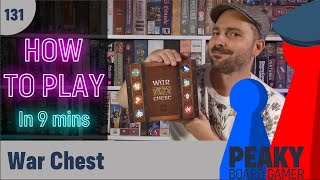
War Chest Deep Dive
What the Community Thinks About War Chest
War Chest stands as one of the most respected abstract strategy games in modern board gaming, drawing consistent praise from reviewers who recognize its elegant design and accessible depth. Players consistently describe it as a masterpiece that successfully bridges the gap between simplicity and strategic complexity. The game has earned a devoted following among both casual and competitive players, who appreciate its quick playtime and endless tactical variety. Reviewers note that the game consistently performs well across different player counts and experience levels, making it remarkable how little the core experience changes while maintaining engagement.
Core Mechanics That Define War Chest
Bag Building and Unit Activation
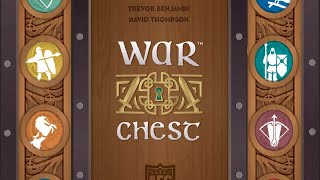
War Chest's fundamental system revolves around drawing tokens from a personal bag and deploying them strategically across the board. Players begin with two coins from each of their four randomly assigned unit types, plus a royal coin that enables special actions. On each turn, players draw three coins and alternate playing them one at a time. Each drawn token can either be placed on the board to deploy or strengthen a unit, or discarded face-down to perform an action like recruiting new units, claiming initiative, or passing. This creates constant tension between immediate board presence and long-term bag development. The genius of this system lies in how it naturally creates dramatic swings: bolstering a unit makes it stronger but removes tokens from future draws, while recruiting units dilutes the bag composition but builds tactical options.
Asymmetric Unit Powers and Tactical Depth
Each game's four unit types come with completely unique abilities that transform how players approach tactical situations. Archers attack from two spaces away and ignore obstacles but cannot engage in melee combat. Lancers move then attack in straight lines, creating powerful positional attacks but limiting maneuverability once deployed. Knights cannot be targeted by unbolstered units, providing defensive anchoring. Mercenaries grant bonus movement actions when recruited, offering early-game tempo advantages. The Pikeman retaliates when attacked, making melee engagement risky for opponents. These asymmetric powers mean that army composition directly dictates viable strategies, forcing players to adapt their approach based on what units they drew during setup. The draft option available to experienced players adds another layer, allowing skilled teams to counter-draft and create balanced matchups.
The War Chest Experience
Deceptive Simplicity and Escalating Tension
War Chest presents itself as straightforward upon first teaching, with rules explainable in under 15 minutes. Reviewers emphasize how quickly players grasp the core actions and begin playing competently. Yet within those first few turns, the game reveals its deceptive depth. Tension escalates naturally as players begin recognizing which units their opponents drew based on visible placements and discard patterns. Players must constantly calculate whether to place units for board control, bolster for resilience, or recruit to shore up bag balance. One reviewer described it as a game where one mistake can cost you everything, noting how late-game scenarios often come down to single crucial decisions. The memory element becomes increasingly important as the game progresses, with players tracking which opponent coins have been drawn and which likely remain in bags.
A Game of Controlled Warfare and Careful Positioning
Reviewers consistently highlight the game's kinetic energy and tactical battlefield feel. Rather than rushing toward victory, strong players develop defensive structures and test their opponents' responses before committing major units. One reviewer noted playing a game that became a war of attrition where both players had solid lines on the board, with everything getting counteracted. This tightly competitive dynamic creates games that often come down to controlling six specific locations on the board. The game rewards players who read opponent intentions, anticipate unit compositions, and position pieces with purpose. Even when combat occurs, it typically feels earned rather than random, with successful attacks usually resulting from careful preparation and positioning rather than luck.
What Makes War Chest Stand Out
Elegance Married to Modern Asymmetric Design
War Chest achieves something uncommon in abstract games: it maintains traditional abstract purity while incorporating the asymmetric unit abilities that appeal to modern board gamers. Reviewers note that unlike pure abstracts that can feel cold or overly mathematical, War Chest has thematic hooks that make units memorable and distinctive. The Crossbowman feels different from the Knight, not just mechanically but in how players mentally approach using them. This modern asymmetry prevents dominant strategies from emerging, as different unit combinations reward different tactical approaches. The result is something between classical abstracts and contemporary thematic games that satisfies fans of both.
Accessibility Without Sacrificing Depth
A remarkable aspect of War Chest is how thoroughly it accommodates different experience levels. Newer players can jump in after a single explanation and play competently, while experienced teams discover new unit synergies and counter-strategies in every session. Reviewers mention playing 50+ games and still finding new discoveries about unit interactions. The game scales gracefully from casual gaming to serious competition, with the draft option providing a tuning mechanism for balanced play among experienced players. One reviewer noted that even players who typically dislike confrontational games find War Chest appealing due to the elegance of its mechanical systems and the immediacy of its decisions.
Potential Drawbacks
Early-Game Unit Balancing and Luck Dependency
While reviewers overwhelmingly praise War Chest, some note that certain unit combinations emerge stronger than others depending on initial random draws. One reviewer acknowledged that mercenaries often dominate the early game regardless of other factors, giving players who drew them an inherent tempo advantage. Additionally, players can occasionally find themselves in positions where available units don't synergize well together, limiting tactical flexibility. However, reviewers emphasize that this imbalance typically resolves as the game progresses and additional units are recruited, and that the drafting setup option mitigates these concerns for regular players who want guaranteed balance.
Board Design and Token Draw Variance
One reviewer expressed that the board itself, while functional, lacks the visual elegance of the rest of the game's presentation. The printed board can warp during transport, creating an awkward playing surface despite otherwise exceptional component quality. More significantly, occasional bad token draws during critical moments can leave a player with no viable moves, forcing them to pass turns or make suboptimal plays while waiting for their bag to cycle. While this is mitigated somewhat through player choice in how they build their bags, the element remains present and occasionally creates frustrating moments.
If You Enjoy War Chest
Players who love War Chest often gravitate toward other asymmetric abstracts and tight tactical games. The Undaunted series shares War Chest's designers and similar bag-building mechanics but applies them to skirmish warfare with a historical setting. Experienced abstract players appreciate games like those from Hollandspiele that reward deep reading of positions. For those drawn to the unit-based tactics, games like Watergate or Patchwork offer similarly tight two-player experiences with elegant rulesets. The game's quick playtime and deep strategy appeal to players seeking alternatives to longer euros, while its accessibility makes it an excellent gateway for teaching strategic thinking to newer gamers.
What Reviewers Are Saying
"This is one of the best games I've ever played to be honest. It always keeps climbing and it is a masterpiece in my opinion."
— Chairman of the Board
"It feels deliberate, smart, elegant and refined. It's incredibly accessible and very good to start understanding the strategic implications of how you build your bag, how you posture your units, how to wring the most out of the units you do have at your disposal."
— The Cardboard Herald
"It's a light deck bag build type of game with a war element. Most games are very tight and you need to be very careful about what you choose at the right time because you can often help your opponent more than you help yourself."
— Meeple University