












Whale Riders Deep Dive
What the Community Thinks About Whale Riders
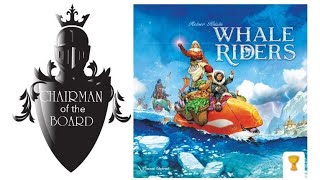
Reviewers consistently describe Whale Riders as a short, competitive trading game that packs more tension into its light surface than the rules suggest. It is a Reiner Knizia design published by Grail Games, with art by Vincent Dutrait. Before You Play previewed a prototype copy and framed the game as a race along the Ice Coast, where every trip out and back forces players to weigh when to buy, when to fulfill contracts, and when to push ahead. Meeple University walked through the full rules in a detailed tutorial, and All You Can Board, ranking the game among its most anticipated titles of 2021, described it as a game where you are never able to do everything in a turn, so you have to decide what matters most. Opinions diverge mainly on how much depth the game offers. Before You Play called it a very light strategy game, while Dice Tower placed it at number 100 in a countdown and still praised its clean, timing-driven design. Good Time Society also highlighted the game's efficiency and the way the two-action turn pushes the game toward its end. Another reviewer, who had been hunting for a copy for some time, focused less on the rules and more on the appeal of a route-based game with a strong sense of tension, and compared it to Parks.
Core Mechanics That Define Whale Riders
Resource Management
Resource Management drives nearly every decision in Whale Riders. Players spend coins at the ports to buy tiles showing meat, pottery, kelp, shells, shelter, and crystals, and a crystal can be spent as any other resource. Before You Play noted that coins are always in short supply, since players need gold on hand to keep buying tiles as the trip grows longer. Meeple University described the loop as trading money for resources and then trading those resources back in to complete contracts for money and pearls. Because the tiles slide down the port as purchases happen, the cost of a resource shifts with the board state and with what opponents are positioned to buy next.
Contracts
Each player begins with three face-down contracts, and the hand is refilled to three at the end of every turn. Meeple University explained that each contract is fulfilled separately, so surplus resources from one contract cannot count toward the next. Some contracts require specific resources, some accept any resources, and others require a number of tiles regardless of what they show. Before You Play emphasized the timing dilemma: fulfilling several contracts in a single action is more efficient, but a player may need the money immediately. Contracts pay out money on the spot and also count toward the final pearl total, so they serve as both an economic engine and a source of end-game points.
The Whale Riders Experience
Tense Decisions
Before You Play described the game as very light but still full of tense decisions. The pressure comes from the race to the far end of the coast and back. A player who moves out in front can make opponents nervous, because those opponents fear the leader will reach the pearl tiles first and buy them cheaply on the return trip. A player who lags behind has to decide whether to chase the leader or accept a weaker position. The same review noted that a player who is alone at a port can take items without any competition, which offers a brief moment of relief before the next contest for the same tiles.
Breezy Pacing
Reviewers repeatedly describe the game as quick to play. All You Can Board said it plays pretty quick, with each turn limited to two actions chosen from a short menu of options. Dice Tower called the design simple and uncluttered, and framed the buying and timing as a fresh take on a market game. Because the entire session is a single round trip along the coast, the game moves steadily and keeps the group engaged without long stretches of waiting.
What Makes Whale Riders Stand Out
A One-Way Route That Rewards Timing
Dice Tower singled out the cadence of the trip as the heart of the design. Players choose when to keep moving and when to spend a turn gathering instead, and the reviewer described the rhythm as turning around, coming back, and beating players to something. The track works like a ratchet: a player can advance as far as they like but can never move backward. That constraint, which another reviewer compared favorably to Parks, forces a real decision about whether a distant port is worth passing up the goods along the way.
Storms That Change the Market
Storm tiles give the game a distinctive sense of season and decline. Meeple University explained that storms cannot be bought or removed, and instead migrate toward the lower-value spaces as the game progresses. Before You Play demonstrated how the storms slide through the market and leave later purchases more expensive. The publisher's theme of a coast closing up before winter arrives is reflected in how the mechanic plays out, and reviewers treat the storms as a built-in clock that shapes the final stretch of the game.
Potential Drawbacks
Storms Can Lock Out Ports
Meeple University warned that the storm mechanic can have a harsh late-game effect. Resources become more expensive to purchase as storms accumulate, and some ports may become completely blocked by the end of the game. A player who has built a plan around a particular port can find that plan disrupted when the market drifts out of reach, so the late game asks players to adapt quickly to conditions they cannot control.
A Prototype Still in Flux
Both Before You Play and Meeple University reviewed a prototype copy and noted that artwork and components could change before release. Meeple University also mentioned that the Kickstarter edition would include unlockable variants, such as individual player goals and special action tiles, that were not covered in its rules video. Those additions could alter the experience, so the version reviewers saw may not match the final game. Secondhand copies were also difficult to find, with one reviewer seeing listings around $150 to $200 that were hard to justify for a game with limited availability.
If You Enjoy Whale Riders
Players who enjoy the one-way route of Whale Riders will find a similar satisfaction in Parks, which one reviewer named directly as a close comparison for the pathway mechanic. Players who appreciate planning across several turns while managing a constrained set of actions may also enjoy Wingspan, since both games reward steady engine-building and careful sequencing. Both recommendations reflect how reviewers described Whale Riders: a light, interactive game where timing and restraint matter more than raw complexity.
What Reviewers Are Saying
"there's decision-making in terms of oh do I take this cheaper tile but it's going to make a very good three item tiles so much cheaper for the person who's gonna go after me or when do I fulfill my contract cards so I need money now but if I can fulfill several in one turn then I can become more efficient."
— Before You Play
"Storm tiles cannot be purchased or removed from the board they will simply migrate towards the low-scoring spaces as the game goes on eventually making resources more expensive to purchase some ports may even become completely blocked with storms by the end of the game."
— Meeple University
"It's a simple game. It's a straightforward concept, but it livens up a buying from a market with that timing element, turning around, coming back, beating players to something, or maybe hanging back and going, 'Yeah, you guys go ahead. This is all mine now. Now I get to do what I want.'"
— The Dice Tower