








XenoShyft: Onslaught Deep Dive
What the Community Thinks About XenoShyft: Onslaught
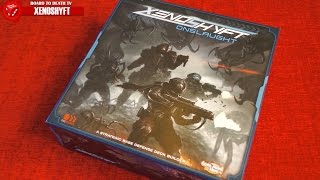
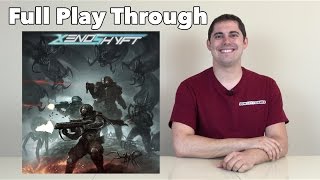
Reviewers agree that XenoShyft: Onslaught, published by CMON, is a demanding cooperative game that rewards planning more than luck. Getting Games presents it through a full two-player playthrough built around survival, where each player builds a personal deck while also shaping what the other player can draw on. Board to Death TV reaches a similar view of the core loop and adds a practical recommendation, saying the game works best with three players because downtime stays low when players buy together and act during each other's combat. Watch It Played follows a group through the waves across several episodes, and its hosts describe their base taking early damage, then fighting back in later rounds as the group learns the rules. The Rolling Dice & Taking Names interview with the publisher frames the game as a deliberate departure from miniature-heavy releases, with the artwork and board presentation carrying much of the appeal.
Opinions diverge mainly on difficulty and replay value. Getting Games's host plans to play several more times before deciding whether the game is too hard or too easy, while Board to Death TV worries that the pattern becomes predictable once players learn the wave structure and the alien deck.
Core Mechanics That Define XenoShyft: Onslaught
Deck Building
Deck building is the engine of XenoShyft: Onslaught, and reviewers describe the cards as a living army rather than a fixed hand. Every player starts with a small set of weak Militia troops, and purchases go directly into hand so they can be deployed or used the same round. Board to Death TV explains the cycle clearly: when a deck runs out, the player shuffles the discard pile and keeps drawing, so what is bought in one round shapes what appears in later ones. Getting Games walks through the burn mechanic, where discarding a weak card reduces the cost of a stronger troop, which turns a starter unit into a stepping stone instead of dead weight. The same video shows the wave two rule that lets players trade three low-value currency cards from the discard pile for one higher-value card, so earlier purchases are recycled rather than diluting the hand. CMON's version of the genre also depends on its troop roster, because the early Militia units are fragile and the stronger Paratroopers and armored suits only become available as the waves advance.
Cooperative Play
The cooperative structure is the second pillar, and reviewers describe it as a shared survival problem rather than a contest between players. Everyone defends one base, shares one loss condition, and faces one set of alien lanes, so each deployment decision affects the whole table. Watch It Played repeatedly leans on the rule that players can deploy troops and items into each other's lanes during the deployment phase, which lets a player with a strong unit but an empty lane fill it from a neighbor's hand. Each division also grants a personal ability, such as the Medbay discounting medical items or Weapons Research discounting weapons, so the table has to coordinate asymmetric powers rather than duplicate them. Rolling Dice & Taking Names summarizes the result as basic deck building with a tower defense layer, where the strategy comes from deciding which lane needs what and when.
The XenoShyft: Onslaught Experience
Escalating Dread
The dominant feeling is one of tightening pressure. Rolling Dice & Taking Names describes a wave structure in which the first wave feels almost harmless, the second wave brings a sudden jump in difficulty, and the third wave can collapse entirely if the group has not invested wisely in earlier rounds. Board to Death TV credits the game for signaling the coming change in advance, so the escalation feels earned rather than arbitrary. Watch It Played's hosts describe the same curve from inside the game, where one bad reveal can strip a lane and push the base into dangerous territory within a single round.
Cinematic Swagger
Several reviewers reach for film comparisons to describe the payoff. Rolling Dice & Taking Names contrasts Alien, which is built on horror, with Aliens, which is built on squad action, and says XenoShyft leans toward the second. Buying one large unit such as the Ajax battle suit creates a moment where the table cheers as it clears enemy after enemy. Getting Games shows similar payoffs when a paratrooper and a chainsaw are combined in one lane, and those swings are what keep the group engaged even when the base is taking damage.
What Makes XenoShyft: Onslaught Stand Out
Hidden Alien Reveals
Rolling Dice & Taking Names highlights that only the alien card currently under attack is visible, while the rest of the encounter sits face down even though it has already been dealt. This keeps the flip of each card a shared moment, and it makes a simple mechanic feel like a turning point at the table. Board to Death TV also points out how approachable the game is for newcomers, which means the reveal works for first-time players and veterans alike.
Art and Theme
Reviewers consistently praise the theme and presentation. Rolling Dice & Taking Names explains that one artist produced all of the aliens and another produced all of the Nor Tech troops, and that the two coordinated their styles so the sides still sit in one consistent universe. The bright, action-oriented look of the human forces contrasts with the dark, scary look of the monsters, which reinforces the story the game tells. Board to Death TV agrees that the dark, grim artwork keeps players invested, and it argues that the theme is captured through the gameplay itself rather than applied as decoration on top of it.
Potential Drawbacks
Rules Density and Timing
The most consistent criticism concerns how much rules detail players must track. Getting Games openly says that there is quite a bit of ambiguity about when specific effect cards can be played from hand, and the host admits to being unsure whether the stim packs were used at the right moment. Watch It Played's hosts also acknowledge rules mistakes made during their own playthroughs and promise corrective annotations for viewers. Both groups suggest the load is easier to manage when several players divide the tracking between them, although Getting Games notes that playing both sides alone made the game take much longer and the tracking heavier.
Replay Predictability and Player Count
Board to Death TV argues that once players learn the wave structure and the hive pattern, much of what comes next becomes predictable, which weakens replay value. The reviewer frames this as a common trait of cooperative games and hopes a future expansion of hive cards will address it. Player count is also a factor. Rolling Dice & Taking Names notes that a single player can learn the rules but probably will not reach the final waves, and Getting Games expresses concern that a four-player game could run long. Board to Death TV recommends three players as the most manageable table size.
If You Enjoy XenoShyft: Onslaught
Fans of cooperative survival will find a natural match in Zombicide. Rolling Dice & Taking Names draws that comparison directly, describing the starting militia as survivors from Zombicide who pick up whatever weapon is nearby. Players who enjoy the card-versus-card combat math of Hearthstone will recognize the way XenoShyft's attack and health values map against each other, which the Rolling Dice & Taking Names interview describes as quick to grasp. Those drawn to the setting should look at Alien and Aliens, the films the same interview uses to explain the game's tone, with its blend of dread and action. Players who want a tabletop spectacle built around miniatures should consider Arcadia Quest, which the publisher contrasts with XenoShyft's card-based production and lower expected price point.
What Reviewers Are Saying
"This is a fully cooperative deck building game where each player controls part of a base that's getting overrun by tons of crazy bloodthirsty insect-like aliens. The name of the game is survival, you just want to last nine turns."
— Getting Games
"The best part about it is the alien cards. You only ever see the alien card that you're currently fighting, the other ones are face down even though they've been dealt out."
— Rolling Dice & Taking Names
"Xeno Shift is just full of theme, which is extremely well captured through gameplay and dark grim artwork, which keeps players invested in the game. It's simple enough to get new players involved while still offering some tactics and long-term strategy."
— Board to Death TV